
Wild mushroom foraging is rewarding, occasionally fatal, and far more skill-dependent than indoor cultivation. I have foraged the same patch of mixed hardwood for six years and still take a spore print on anything I am less than 100 percent certain about. The rule that has kept me alive and well-fed: every mushroom I eat must be identified by at least three independent features — cap, gills, stem habit, spore print, smell, and habitat — and any single doubt sends the specimen to the photo file, not the pan.
This guide is what I would teach a foraging buddy on their first season: the six beginner-safe species worth learning first, the look-alikes that share their habitat and have killed people, the field gear that makes ID repeatable, and the ethical practices that keep your patches productive for decades. Foraging is a long game; rushing it is the most common way it ends badly.
The Foraging Mindset: Safety Before Yield
The single most important rule: when in doubt, throw it out. No mushroom is worth a kidney transplant, a liver failure, or the months of hospitalisation that follow misidentification of the most dangerous species. Death cap (Amanita phalloides) is the species most consistently named in the medical literature as responsible for the majority of fatal mushroom poisonings worldwide (StatPearls/NCBI, Amatoxin Mushroom Toxicity), and it is regularly mistaken for edible paddy straw mushroom (Volvariella) or young Agaricus. A two-second second-look at the base of the stem (for the universal veil sac that defines Amanita) would prevent most fatalities.
| Edible Species | Common Look-Alike | Toxicity Risk | Distinguishing Feature | Action |
|---|---|---|---|---|
| Morel (Morchella esculenta) | False morel (Gyromitra esculenta) | Severe — hydrazine toxin | True morel is hollow inside; false is chambered/cottony | Cut lengthways before eating |
| Chanterelle (Cantharellus cibarius) | Jack-O-Lantern (Omphalotus illudens) | Severe GI distress | Chanterelle has false gills (ridges); Jack-O has true sharp gills | Touch gills — ridges or blades? |
| Field mushroom (Agaricus campestris) | Death cap (Amanita phalloides) | Fatal — amatoxins | Death cap has universal veil sac at stem base | Dig out the whole stem base, every time |
| Honey mushroom (Armillaria mellea) | Galerina marginata | Fatal — amatoxins | Honey grows on wood in clusters; Galerina is smaller, browner | Always spore print (white vs rusty brown) |
| Hedgehog (Hydnum repandum) | Hydnum rufescens (also edible) | None among hedgehogs | Both edible — no real risk in this pair | Easy beginner forage |
| Puffball (Calvatia gigantea) | Young Amanita | Fatal if Amanita | Puffball is solid white inside; Amanita shows developing gills | Cut every puffball in half before eating |
Internalise the cut-lengthways rule before you internalise anything else: every wild mushroom gets sliced from cap to base before it goes near your kitchen. False morels (chambered/cottony interior) and young Amanita masquerading as puffball (developing gills visible) both reveal themselves to a paring knife. That single ten-second action prevents most of the fatal cases documented in poison-control records.
Six Beginner-Safe Species to Learn First
Beginner safety comes from picking species with no dangerous look-alikes and unmistakable field marks. My ranked list after teaching three friends to forage: chicken of the woods (Laetiporus sulphureus), giant puffball (Calvatia gigantea), hen of the woods (Grifola frondosa), oyster mushroom (Pleurotus ostreatus), chanterelle (Cantharellus cibarius), and shaggy mane (Coprinus comatus). All six have features no novice can confuse with a deadly species when they take the time to check.
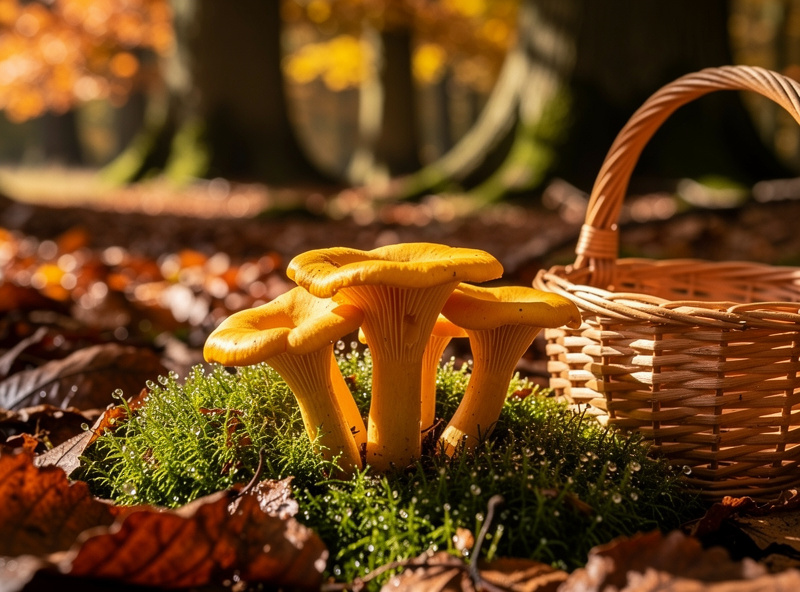
Chicken of the woods is the safest beginner mushroom on the planet in terms of fatal risk: bright orange-yellow shelves growing on living or dead hardwood, no gills, no fatal look-alikes, edible when young and firm. One real caveat worth knowing: specimens growing on conifers or eucalyptus are a different, less-studied species (Laetiporus conifericola or L. gilbertsonii rather than L. sulphureus) documented to cause GI upset — sometimes vomiting and chills — far more often than the hardwood-grown species (Cornell Mycology). Stick to hardwood-grown specimens and, like any new wild food, try a small first portion. Giant puffball is equally safe provided you cut it open before eating — the inside must be solid, uniform white, never showing colour or developing structure. Hen of the woods (maitake) grows in massive clusters at the base of oaks; its layered grey-brown caps have no real look-alike. Oyster mushrooms grow in shelving clusters on dead hardwood and have a distinctive anise smell, soft white gills running down a short or absent stem.
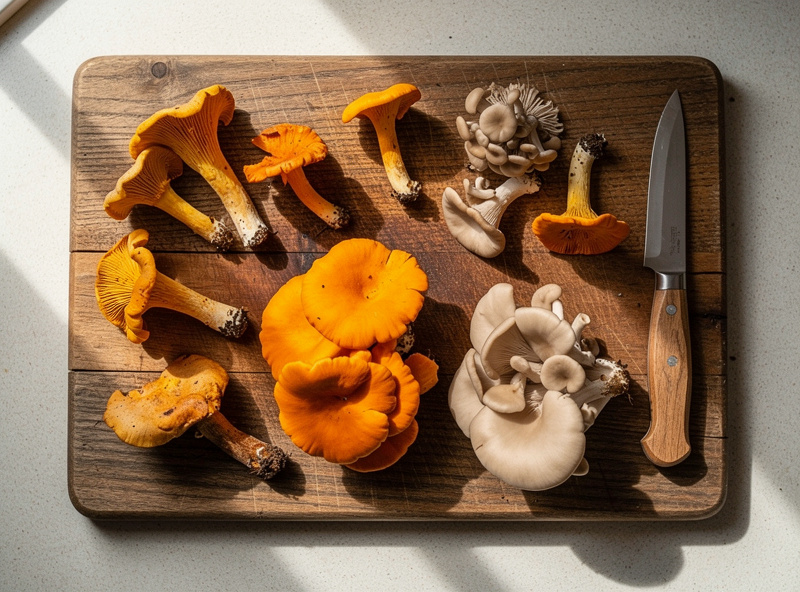
Chanterelles need slightly more care because of the Jack-O-Lantern confusion — chanterelles have ridged “false gills” you can feel as raised lines, while Jack-O-Lanterns have true blade-like gills. Shaggy mane is the easiest of all autumn species to identify (white cylindrical cap with shaggy scales, deliquescing to black ink within 12 hours of picking) but must be eaten the same day. None of these six has a confusable deadly look-alike if you cut, smell, and feel each specimen carefully.
Spore Prints and Microscopy: The Confidence Layer
Spore prints are the second line of defence for any mushroom whose ID you are not 100 percent certain of from field features alone. The procedure is simple — cap on a sheet of half-black half-white paper, glass cover, dark room, overnight — but the colour information is decisive: white spore print rules out an entire family of toxic species, brown spore print rules in others, black spores narrow further. The full procedure, including the materials I use and the chemical reagent tests for borderline cases, lives in my how to make a mushroom spore print guide.
The single most useful spore-print rule for beginners: any white-spored mushroom with a partial veil or universal veil could be an Amanita and requires expert confirmation before eating. White spores plus a ring on the stem plus a bulbous base means stop, photograph, and walk away. I keep a printed laminated chart of the spore-print colour matrix in my foraging bag — the chart maps spore colour to the families it rules out and the families it admits.
Microscopy is rarely needed for kitchen-table identification, but a 100x USB microscope (40-50 dollars) is worth owning for borderline cases — spore size, shape, and presence of features like germ pores or amyloid reactions can confirm species within a confused genus. I use it perhaps twice a year, but those two times have included one positive confirmation of edibility and one negative that kept a misidentified Galerina out of a friend’s basket.
Where to Find Mushrooms: Habitat and Tree Associations
Mushrooms are not randomly distributed. Each species has a strong association with specific trees, soil types, moisture levels, and time of year. Chanterelles grow under oak, beech, and birch in moss-covered ground; morels favour ash, elm, and disturbed soil after spring rains; chicken of the woods grows on living and recently-dead oak, cherry, and walnut; oysters grow on dead or dying hardwood logs and stumps; hen of the woods grows at the base of large oaks; shaggy manes appear in disturbed lawns and along gravel paths.
Learning the trees is half the foraging skill. I spent year one walking my local woods just learning to identify oak versus maple versus birch versus cherry before I ever started looking for mushrooms — the species map onto trees so cleanly that knowing the trees doubles your hit rate. The other half is reading microhabitat: which side of the slope (north faces hold moisture), which depth in the leaf litter, how close to the trunk, and what understory plants signal the right moisture and pH.
Habitat documentation has become my single most useful foraging discipline. A waterproof notebook records: GPS coordinates of every productive patch, tree species at the patch, dominant understory, slope orientation, date, weather of the prior week, and species + count harvested. Five years of those notes lets me predict within roughly three days when each patch will produce in a given season. It is the same kind of site-reading instinct I use on the gardening side of the property — matching plant to microclimate rather than fighting it — and that underlying skill of reading microhabitat transfers between disciplines more than people expect.
When to Forage: Seasonal Calendar by Region
Each species fruits in a defined window driven by rainfall and temperature. The general temperate-zone calendar I follow: spring morels (April-May), summer chanterelles and chicken of the woods (June-August), autumn boletes, hen of the woods, oysters, and hedgehogs (September-November), winter oyster (December-February on living trees in mild climates). The exact dates shift by 2-4 weeks based on latitude and elevation.
The trigger that beats any calendar is rainfall plus temperature. A 25-millimetre rain event followed by 3-5 days of 15-22 C temperatures typically triggers a flush 4-7 days later — almost regardless of calendar month. My foraging notebook tracks rain events and temperature swings as much as it tracks species; correlation between rain-plus-warm-snap and productive forage day in my notes runs over 80 percent.
One specific seasonal note: false morels (Gyromitra) fruit at roughly the same time and in similar habitat to true morels. The look-alike pressure is highest in late April-early May. The visual difference is reliable once trained, and the cut-lengthways test is unambiguous, but the timing overlap is the reason foraging instructors universally start beginners on later-season species before introducing the morel hunt. Look-alike-specific photos and field marks live in morel mushroom look-alikes.
Field Gear and Documentation
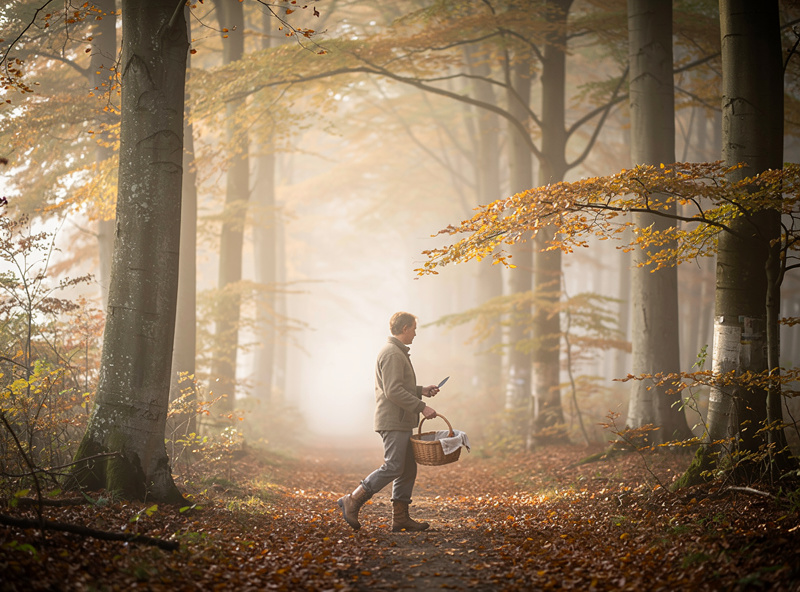
The complete foraging kit I carry: a cloth-lined wicker basket (so spores fall through and inoculate the patch as I walk), a small paring knife with a sheath, a soft brush for cleaning specimens, a waterproof notebook and pencil, a 10x hand lens, my phone for photos and GPS marking, and a printed laminated field guide for the regional species. Total weight under 1 kilogram; total cost under 60 dollars.
The basket choice matters: plastic bags suffocate fresh mushrooms, accelerating decay and making identification harder. A breathable cloth-lined basket keeps specimens firm for the walk home and lets spores fall back into the forest — over time, a foraged patch keeps producing partly because you have been re-sowing it on every visit. The knife is for cutting at the stem base (preserving the universal veil if present) and slicing specimens for the lengthways cut.
Documentation discipline I cannot recommend strongly enough: photograph every specimen in situ before picking, photograph the underside, photograph any veil structures, photograph the stem base after digging. Four photos per specimen at the moment of harvest gives you an unambiguous record for later spore-print confirmation and for your second-opinion network. I send unclear specimens to a regional mycology Facebook group; the typical response time is under an hour and the consensus has been right every time I have had reason to verify it.
The Look-Alike Problem: Five Confusions That Have Killed
Five specific look-alike pairs cause the vast majority of serious poisonings in North America and Europe: Amanita phalloides mistaken for paddy straw or young Agaricus; Galerina marginata mistaken for honey mushroom; Gyromitra esculenta mistaken for morels; Omphalotus illudens mistaken for chanterelles; and various Lepiota species mistaken for parasol mushroom. Every serious forager memorises these five pairs and the test that distinguishes them.
Amanita phalloides shows three features no Agaricus has: white gills (Agaricus has pink-to-brown), a universal veil sac at the stem base (Agaricus has none), and a white spore print (Agaricus has brown spores). Check all three — never one alone. Galerina shows a rusty-brown spore print versus honey mushroom’s white spores; that single test ends the confusion completely. Gyromitra shows a chambered/cottony interior versus the morel’s hollow interior; cut every specimen.
Omphalotus illudens has true gills versus chanterelle’s ridged false gills, glows green in the dark (genuinely — orange jack-o-lanterns are bioluminescent), and is often found in dense clusters on wood while chanterelles grow singly from soil. Lepiota species require expert ID; the genus contains both safe and deadly members and the safe-vs-deadly cuts within the genus are not beginner territory. If you find a parasol-shaped mushroom and are not certain, do not eat it.
If You Suspect Mushroom Poisoning
This is the section I hope nobody reading this ever needs, but every forager should read it once before their first season rather than during an emergency. The single most dangerous feature of amatoxin poisoning (death cap, Galerina, and some Lepiota) is the delay: symptoms typically do not start until more than six hours after eating, sometimes as late as 12 to 24 hours, by which point real liver damage is already underway (StatPearls/NCBI). A mushroom meal that seems to have gone fine for the first several hours is not proof the meal was safe — it can be the opposite, since fast-acting GI-distress species like Jack-O-Lantern announce themselves within an hour or two, while the deadliest species stay silent far longer.
If you or anyone who shared the meal develops vomiting, diarrhea, or abdominal pain any time in the 24 hours after eating a wild mushroom, treat it as a medical emergency, not food poisoning to wait out. In the US, call Poison Control at 1-800-222-1222 or go to an emergency room immediately; outside the US, use your national poison-control equivalent. Bring a sample of the mushroom, or even the cooking scraps and peelings, with you — species identification from a physical specimen is far faster and more reliable than a description, and it directly changes treatment. Do not wait to see if symptoms get worse before seeking care, and do not assume a delayed onset means you are in the clear.
Ethical Foraging and Stewardship
Sustainable foraging matters because the mycelial network in the soil is the permanent organism — the mushroom is just the fruit body. Three rules that have kept my patches productive for six years: never take more than 30 percent of any cluster, always leave specimens of every age class behind (so spores keep raining), and cut rather than pull (pulling can damage the underground mycelium).
Land access ethics: forage only on land where you have explicit permission or where local foraging laws permit it. Many public parks prohibit mushroom collection entirely; many private forests allow it with permission; a few jurisdictions require commercial permits for any harvest over personal consumption. Know your local regulations — and the fines for breaking them, which in some regions exceed the value of the mushrooms several times over.
The deeper integration with the outdoor mycology system is direct. My outdoor cultivation systems — oak logs leaning on the north fence, the wine cap bed under the apple tree — are partly inoculated by spores from the wild patches I forage. The same species I cultivate (oyster, lion’s mane, wine cap, shiitake) all grow wild on my property because the outdoor systems are essentially garden-scale extensions of the wild ecology. For the cultivation side of that crossover, see my outdoor mushroom growing guide and the wine cap bed setup. For the cooking side once you have a basket of foraged mushrooms, the preservation choices are in how to dry mushrooms for storage and the cooking-specific notes for medicinal species are in how to cook lion’s mane.
From Forage to Cultivation: When Wild Knowledge Pays Off
Several years of foraging build a different kind of mycology intuition than cultivation does. You learn what wild mycelium looks like in situ on rotten wood, which microclimates favour which species, and how to read a fruiting flush from the previous week’s weather. That intuition transfers directly to outdoor cultivation: the conditions that make a wild oyster patch productive are the same conditions a hardwood-log oyster stack wants, and the substrate match between foraged species and your cultivation choices is almost one-to-one.
My personal pipeline: any species I have foraged successfully for two seasons gets considered for outdoor cultivation on inoculated logs or buried chips. Wild lion’s mane on a fallen beech tree tells me my property can support cultivated lion’s mane logs in the same shaded corner — I have done this, and the cultivated logs out-yielded the foraged patch threefold within three seasons. The detailed cultivation pathway for lion’s mane specifically is in the lion’s mane growing guide, and the broader medicinal cultivation framework that uses the same logic is in the medicinal mushrooms home guide.
For the kit you would need to convert from forager to grower, the bill of materials sits in the mushroom growing equipment guide. The substrate decisions for log versus bed versus indoor block are in the substrate guide. And the contamination playbook that becomes relevant the moment you bring wild species onto controlled substrate is in the contamination guide. The four-hub stack collectively forms the path from “I found a beautiful oyster mushroom in the woods” to “I produce six kilograms of oysters per year in my backyard”.
Frequently Asked Questions
What is the safest mushroom for a beginner forager to identify?
Chicken of the woods (Laetiporus sulphureus) is the single safest beginner species: bright orange-yellow shelves growing on living or dead hardwood, no gills, no toxic look-alikes in temperate climates, and edible when young and firm. Giant puffball (Calvatia gigantea) is second-safest provided you cut every specimen in half to confirm solid white interior.
Why does every wild mushroom need to be cut in half before eating?
Cutting reveals features no surface inspection shows: false morels show a chambered or cottony interior versus the true morel’s hollow stem; young Amanita masquerading as puffball reveals developing gills inside; and some toxic boletes bruise blue or red on the cut surface. Ten seconds with a paring knife rules out the most fatal mistakes.
How long do spore prints take to develop?
Spore prints typically develop in 4 to 12 hours under a glass cover at room temperature. Place the mushroom cap gill-side down on a sheet half black and half white (the contrast helps colour identification), cover with a glass, and check after an overnight wait. Some species — particularly older specimens — drop spores in under an hour.
Can I eat a mushroom if I am 90 percent sure of its identity?
No. Ninety percent confidence is not enough for any wild mushroom. The standard for safe consumption is 100 percent confidence based on at least three independent features (cap, gills or pores, stem, spore print, smell, habitat). If any one of those features is unusual or uncertain, set the specimen aside for photo documentation and do not eat it.
What is the best foraging container?
A breathable cloth-lined wicker basket is the standard for good reason: it keeps specimens firm by allowing airflow, lets spores fall through as you walk to re-sow your patches, and prevents the suffocation-driven decay you get in plastic bags. Mesh produce bags inside the basket help separate species. Avoid plastic bags entirely for wild mushrooms.
Should I rely on a phone app to identify wild mushrooms?
No. A peer-reviewed accuracy study of three popular mushroom ID apps found they correctly identified poisonous species only 30 to 44 percent of the time, and it documented Amanita phalloides (death cap) being flagged as a false identification multiple times across the tested apps. Use apps for first-pass screening only, never as your sole identification method. Cross-reference any phone-app suggestion against a printed field guide, a spore print, and at minimum a regional mycology group second opinion before eating.