
Healthy mushroom mycelium looks like a dense, pure-white cottony or rope-like growth that spreads roughly 1-2 cm per day across grain or substrate at 75-78°F in my grow room. Vigorous colonies form bright fluffy patches with no off-colors, no slimy patches, and no green, gray, or pink tones. If you see any color besides white or cream, treat it as contamination.
The mycelium-visual-ID skill is one of three things every first-year grower learns; the rest of the beginner roadmap is in my mushroom growing for beginners guide.
For each of the contamination patterns shown in these photos, the save-or-trash decision tree lives in my mushroom contamination guide.
That single sentence is the answer most growers need on day three of their first jar. The harder question — the one that decides whether you keep a tub or trash it — is reading the subtle differences: a slight off-white tint, a wispy strand pattern, a yellow droplet that may or may not be metabolite. This guide walks through every visual cue, with photos of the four growth stages, plus the contamination patterns that fool beginners every season.
What Healthy Mycelium Looks Like at Each Stage
Healthy mycelium starts as fine white threads radiating from inoculation points, thickens into a cottony mat across the substrate within 7-14 days, then forms dense rhizomorphic ropes as it nears full colonization. Color stays bright white throughout. Density should be uniform with no patchy gray, green, or yellow zones.
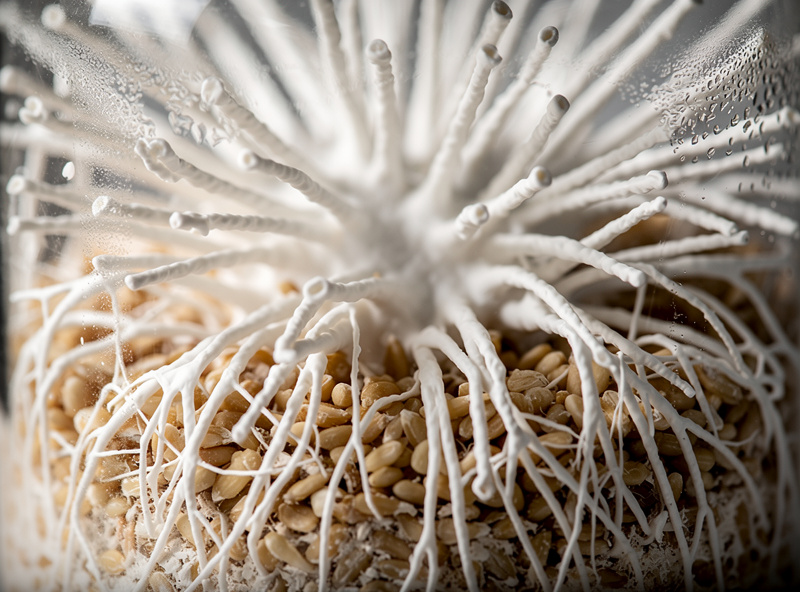
The four visible phases every grower watches for:
- Pinning hyphae (days 1-4): Fine, almost invisible white threads radiating about 2-5 mm from each inoculation point. Easy to miss without a flashlight against the substrate.
- Tufty colonization (days 5-10): Cotton-ball-like clumps appear at each origin point and start to merge. Surface looks fluffy and three-dimensional, not flat.
- Rhizomorphic growth (days 10-18): Strands thicken into visible white ropes that look like miniature roots. This is the strongest, fruiting-ready growth pattern.
- Full colonization (days 14-25): 95-100% of the visible substrate is covered in dense bright white. Some species form a thin pellicle — a smooth coat across the top — which is normal, not contamination.
Speed varies by species and temperature. In my own jars, oyster mycelium runs aggressive and thick at 70-75°F — it’s usually the fastest species I fruit. Lion’s mane is slower and tufts heavily before forming ropes; I’ve learned not to judge it against oyster’s pace or I’d toss perfectly good jars early. Read more on species-specific timelines in my guide on Lion’s Mane growing parameters.
Healthy White vs Suspicious White: The Subtle Differences
The hardest visual call is healthy white mycelium vs early-stage white-on-white contamination. Healthy mycelium is opaque, three-dimensional, and slightly fluffy. Suspicious white is often translucent, flat against the substrate, or appears as patchy circles with darker boundaries.
Five reliable tells for healthy mycelium:
- Texture: Cottony or rope-like with visible depth when you tilt the jar to side-light it.
- Boundaries: Each colony front advances as a feathery edge, not a sharp circular ring.
- Smell: Earthy, fresh, slightly mushroomy. Not sour, never sulfurous, never ammonia.
- Resilience: A poke with a flame-sterilized needle bounces back; the strands are springy, not slimy.
- Uniformity: No isolated bright-white circles inside an otherwise normal colony — those are usually mold colonies bursting through from below.
If your colony fails on two or more tells, isolate the jar in a separate room and watch it for 48 hours before deciding. I run this exact triage in my own quiet room — the growth direction tells you everything: contamination usually outpaces healthy mycelium and changes color within 24-72 hours of being visible.
Aerial Mycelium: When Fluffy Is a Warning, Not a Win
Aerial mycelium is wispy white growth that climbs up the inside of the jar or tub instead of staying on the substrate. It looks like the healthiest growth you have ever seen, but it usually signals high CO2 and not enough fresh air. Fix the airflow before the colony decides to never fruit.
Common causes of aerial mycelium and the fix for each:
- Lid sealed too tight on grain spawn: Loosen by a quarter turn or use micropore tape.
- Monotub gas exchange holes blocked: Drill or open extra 3/8-inch holes; cover with micropore tape.
- Substrate too wet: Field capacity should be a few drops when squeezed hard, not a stream. Drier substrates breathe better.
- Temperature spike above 78°F: Heat speeds metabolism, which spikes CO2 production. Move the tub to a cooler shelf.
Aerial mycelium is not contamination — it is healthy mycelium responding badly to stale air. The fix matters because heavy aerial growth often refuses to fruit even after conditions improve. Read about chamber humidity setup in our still air box vs flow hood comparison.
The Big Four Contamination Patterns That Mimic Mycelium
In my own contamination log, four contaminants show up more than everything else combined: green Trichoderma mold, gray cobweb mold, black or blue Aspergillus, and bacterial wet spot. Each has a distinct color, texture, and progression speed. Learning the visual signature of each saves entire grows.
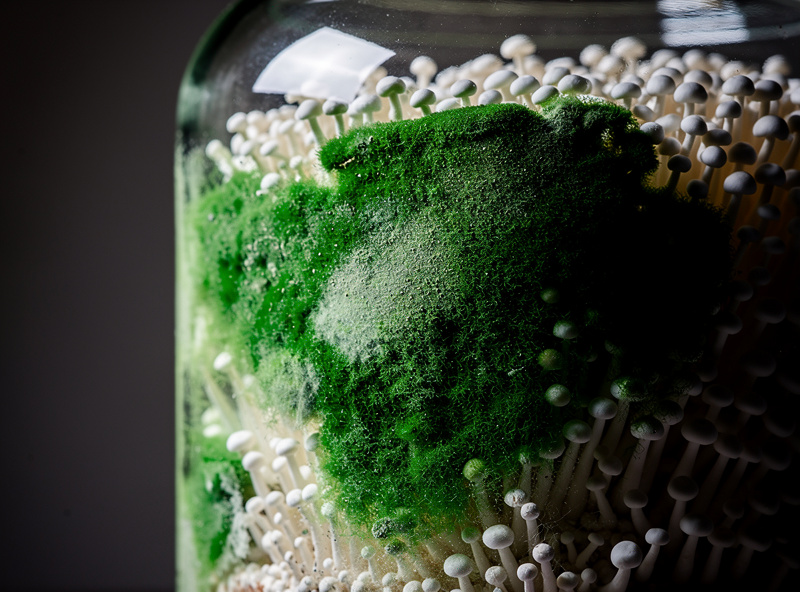
The signatures by species and behavior:
- Trichoderma (green mold): Starts as white, dense mycelium indistinguishable from healthy growth in the early stage, then changes color during sporulation to dark, vivid green — the same progression documented in cultivation research on Trichoderma green mold disease (Trichoderma detection review, PMC). Aggressive and fast — toss the jar the moment green appears.
- Aspergillus (black, blue, or yellow): Fuzzy mold colonies in dark colors. This one is a real health hazard, not just a spoiled batch — indoor Aspergillus exposure is linked to respiratory illness and allergic disease in the occupational and public-health literature (Aspergillus indoor health hazards review, PMC). Bag the jar before moving it and never agitate it open in your living space.
- Cobweb mold (Hypomyces): Wispy gray, fast-growing, web-like. Easy to confuse with healthy aerial mycelium except for the distinctly translucent quality and rapid 24-hour spread.
- Bacterial wet spot: Yellowish slimy patches on grain, paired with a sour or ammonia smell. The smell is the giveaway — healthy spawn never smells acrid.
Detailed differentiation between cobweb and healthy mycelium has its own photo guide in our piece on cobweb mold vs mycelium. The visual call between trich and healthy white during the first 36 hours is genuinely hard, which is why color is the safer signal than speed.
Reading Petri Plates and Liquid Culture Visually
Healthy mycelium on agar looks like radial fluffy white growth from the inoculation point, advancing outward at roughly 1-3 mm per day depending on species and temperature. Liquid culture shows clear amber broth with white floating clumps and no cloudiness. Cloudy LC is bacterial; toss it.
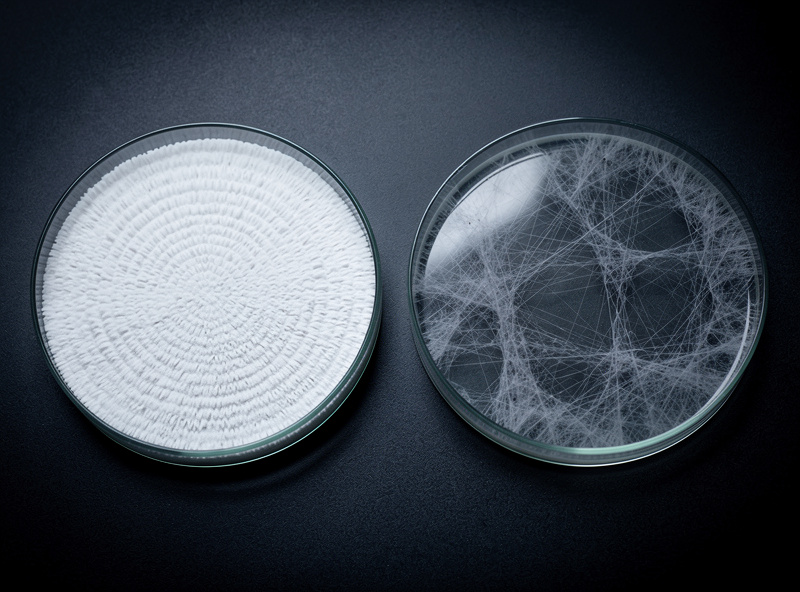
Visual signals worth memorizing for plates and LC:
- Healthy plate: Even circular front, fluffy texture, bright white color, no sectors of different colors.
- Sectoring: Wedges of different growth pattern within one colony — sign of multiple genetics; isolate the strongest sector to a fresh plate.
- Healthy LC: Clear or slightly cloudy amber liquid with white floating mycelium clumps. Should NOT look like milk.
- Bacterial LC: Uniformly cloudy or milky throughout, often with a sour smell when uncapped — confirmed contamination.
If a plate shows green, black, or pink within 7 days of inoculation, transfer the cleanest leading edge to a fresh plate immediately and abandon the original. Multiple-pass agar work cleans most weak cultures back to viable spawn within three transfers.
When to Worry vs When to Wait Another 48 Hours
Wait another 48 hours when you see uneven density, light yellow metabolite droplets, or slow colonization at low temperatures. Toss immediately when you see any green, black, blue, pink, or orange color, when bacterial smell appears, or when wispy translucent gray growth doubles in 24 hours.
The 48-hour rule that saves perfectly good grows:
- Mark the jar with a date and observation note. A photo helps too.
- Move it to a quarantine shelf away from clean spawn so airborne spores cannot cross-contaminate.
- Re-check at 24 and 48 hours under good light. Healthy mycelium will visibly thicken; contamination will visibly change color or expand.
- Decide based on direction of change, not absolute appearance. Faster growth in any direction beats slow uniform growth — but faster growth in color means contamination.
If you are still unsure after 48 hours of observation, the safer call is to discard. A single contaminated tub costs maybe $15 in materials and a few weeks of patience. A contaminated tub left next to clean grows can knock out an entire shelf of work. Beginner failure modes and rescue patterns are detailed in our guide on mushroom growing mistakes every beginner makes.
Frequently Asked Questions
Is yellow liquid on my mycelium contamination?
Yellow droplets on healthy white mycelium are usually metabolite — concentrated waste products that form when colonization stalls or stress builds. They are not contamination by themselves, but they signal the colony is unhappy. Improve airflow and check for high humidity.
How long should fully colonized mycelium look bright white before fruiting?
Most species hold a bright white fully colonized appearance for 5-14 days before pin formation begins. Oyster fruits within a week. Lion’s mane often holds 10-14 days. If your colony stays white for over 21 days with no pins, recheck humidity, FAE, and temperature drop triggers.
Can mycelium turn yellow naturally?
Yes — older fully colonized blocks naturally yellow over time as bruising accumulates and metabolites build. Yellowing alone on mature mycelium is not contamination. Yellowing combined with sour smell, slime, or rapid expansion is bacterial wet spot.
What does dying mycelium look like?
Dying mycelium loses its bright white color and turns dull cream or gray, the cottony texture flattens against the substrate, and growth halts. Heat damage above 90°F is the most common cause. Cold damage below 40°F slows it but rarely kills outright.
Is fuzzy white growth always healthy mycelium?
No. Several molds and yeasts produce fluffy white growth in the first 24-48 hours before showing color. Cobweb mold is wispy translucent gray-white that spreads visibly within hours. Use the 48-hour observation rule rather than judging fuzzy white at first sight.
Should mycelium smell like anything?
Healthy mycelium smells earthy, fresh, and faintly mushroomy. Some species smell of bread or hazelnut. It should never smell sour, vinegary, sulfurous, ammonia-like, or rotten. A bad smell is the single most reliable contamination signal — trust your nose before your eyes.