
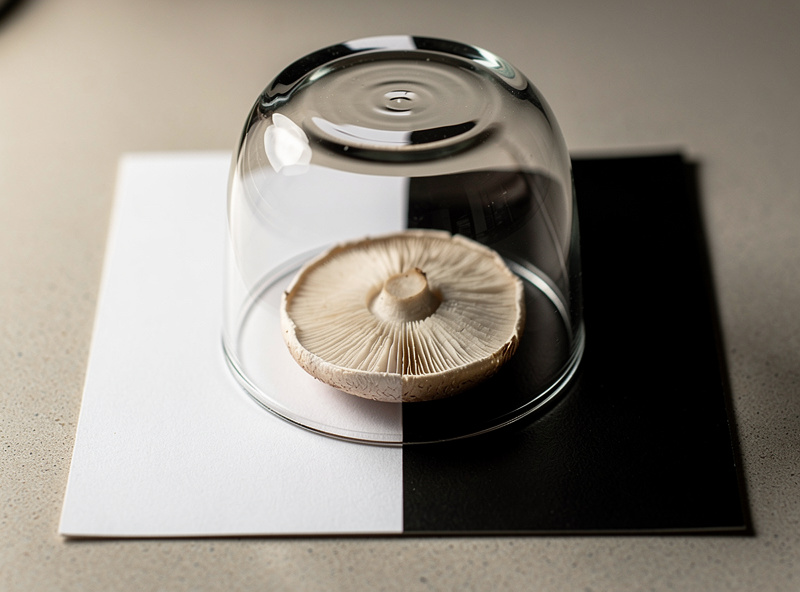
Make a mushroom spore print by trimming the stem flush with the cap, placing the cap gills-down on white paper, covering it with a glass cup to trap moisture, and leaving it undisturbed for 4-12 hours. The cap drops millions of spores in a radial pattern matching the gill structure. The resulting spore color is one of the four most reliable identification clues for any wild mushroom.
Spore prints are the confidence layer on top of field ID; the broader six-species starting kit and habitat-reading skills are in my mushroom foraging guide.
Spore color is the field-guide test that splits genera apart when the cap, stem, and gill features all look ambiguous. White, cream, pink, brown, rusty-red, purple-black, and pure black spores each map to specific groups. Misreading spore color is the difference between a safe edible Agaricus and a deadly Amanita that looks nearly identical above the gills. Every serious forager makes spore prints for any mushroom they have not identified before.
Why Spore Prints Matter for Mushroom ID
Spore color is the single most reliable taxonomic feature in mushroom identification — even more reliable than cap shape or gill attachment. Two mushrooms with identical visible features but different spore colors belong to different genera. The Death Cap (Amanita phalloides) drops white spores; the edible Meadow Mushroom (Agaricus campestris) drops chocolate-brown — same overall silhouette, opposite outcomes.
Why spore color works so consistently:
- Genus-level conservation: Spore color is set by the genetics of the entire genus. Field conditions affect cap color, cap shape, even gill spacing — but never spore color.
- Mature cap reliability: Any cap mature enough to drop visible spores is mature enough to identify. No need to wait for full maturity.
- Microscope-free taxonomy: The 8 broad spore colors get you most of the way on the genera a home forager actually runs into. The harder calls — close look-alikes within the same color group — are where a microscope and spore-size measurements start to matter.
- Independent of injury: A bruised, broken, or dirty cap still produces accurate spore prints. Even partial caps work.
The skill is foundational for foraging beyond the most obvious species (chicken-of-the-woods, morels, chanterelles). Anyone serious about wild mushroom identification reaches the spore print step within the first three foraging seasons. Read the look-alike traps in our piece on morel mushroom look-alikes.
Step-by-Step Spore Print Method
The standard home method uses ordinary white printer paper, a glass cup, and 6-8 hours of undisturbed time. Trim the stem flush with the cap so the cap sits flat, place gills-down on paper, cover with a cup to maintain humidity, and walk away. Most species drop visible spores within 4 hours; reluctant or older caps need overnight.
- Choose a fresh adult cap. Mature enough to have an open cap and exposed gills, not yet mushy or oozing. Caps less than 36 hours past full opening work best.
- Trim the stem flush. Use a sharp knife to cut the stem level with the cap underside. The cap should sit flat on the paper without a tilt.
- Place gills-down on paper. Use a half-and-half black-and-white split paper if you can — light spores show on black, dark spores show on white.
- Cover with a glass or bowl. Trapped humidity prevents the cap from drying out before spores release.
- Wait 4-12 hours. Most caps drop a visible print within 6 hours at room temperature.
- Lift the cap straight up. Disturb the print as little as possible. Photograph immediately as a permanent record.
- Note the color in good light. Compare against a printed spore color reference card under daylight.
If no print appears after 12 hours, the cap was either too young (spores not yet maturing), too old (already dropped), too dry (resealable bag or damp paper towel solves this), or the species drops too few spores to see (some woody bracket fungi). Try a younger cap from the same cluster.
Reading Spore Color: The Eight Categories
Spore colors fall into eight broad categories: white, cream, pink, ochre/yellow, brown, rusty-orange, purple-black, and black. Each maps to specific genera. The differences between cream, ochre, and pale brown are subtle but matter — pink-spored Pluteus is edible while pale-brown-spored Cortinarius can be lethal.
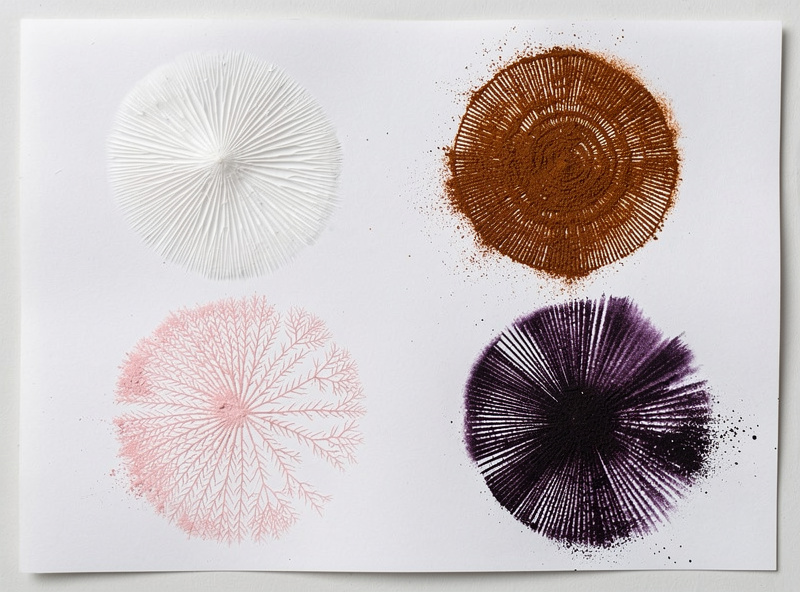
The eight color groups and what they mean:
- White to cream: Amanita, Russula, Lactarius, Tricholoma, Pleurotus (oyster). Includes both deadly and choice edibles — never eat based on white spores alone. Worth knowing on the oyster I actually grow: the print rarely reads pure white on paper, it’s closer to a pale lilac-gray, which trips up a lot of beginners expecting bright white.
- Pink: Pluteus, Entoloma, Volvariella. Pluteus is edible; Entoloma includes toxic species.
- Yellow to ochre: A small, uncommon category in home ID — most caps you’ll pull with a yellowish or ochre-toned cap actually drop brown or rusty-brown spores once printed, not yellow ones (Bolbitius is the classic trap here: yellow cap, cinnamon-brown print). The genus that actually belongs in this bucket for safety purposes is Inocybe, which is toxic — it contains muscarine and causes a cholinergic poisoning syndrome (sweating, salivation, blurred vision, and worse at high doses), not a hallucinogenic effect. Treat any small brown-gilled woodland mushroom with a conical cap as an Inocybe until proven otherwise and skip it.
- Brown (chocolate): Agaricus (button, cremini, portabella). Includes the most-eaten genus on earth.
- Rusty brown to orange: Cortinarius, Galerina, Gymnopilus, and cinnamon-brown outliers like Bolbitius. Galerina marginata is deadly — never eat anything with rusty spores without expert ID.
- Purple-brown to purple-black: Stropharia, Hypholoma. Wine cap (Stropharia rugosoannulata), the species I run in my own outdoor bed, actually prints purple-brown to nearly black, not chocolate brown — it’s easy to misfile under “brown” if you’re going off cap color instead of the print itself. Mixed edibility across this group — never eat purple-brown spored species without expert confirmation.
- Black (inky-cap group): Coprinus (inky cap), Coprinopsis, Coprinellus. Some edible, some — Coprinopsis atramentaria specifically — cause Antabuse-like reactions if you drink alcohol within a day or two of eating them.
The single most important reading rule is to compare under natural daylight, never under fluorescent or LED indoor light. Indoor light shifts pink toward cream and ochre toward brown — exactly the cases where misidentification gets dangerous. Take prints to a window before judging color. (I double-checked the wine-cap correction above against MushroomExpert.com’s own field description of the species before rewriting that section — worth doing the same any time a spore-color memory and a cap-color memory disagree.)
If you’ve eaten something and you’re not sure what it was: call Poison Control immediately at 1-800-222-1222 (US) — don’t wait for symptoms. Amatoxin poisoning from Death Cap or Galerina marginata often causes a symptom-free window of 6 to 24 hours before the real damage shows up, which is exactly why people who feel fine after a meal sometimes wait too long to seek help. Spore prints, cap features, and gill attachment are identification tools for the next find — they are not a substitute for expert confirmation or emergency care once something is already eaten. Source: StatPearls/NCBI, Mushroom Toxicity.
Common Mistakes That Ruin Spore Prints
The four mistakes that produce unreadable prints: using too-young caps, using too-old caps, paper that is too absorbent (paper towels), and removing the cup before spores fully drop. Each produces a different kind of failure that beginners mistake for “this species does not print.”
Specific failure modes and fixes:
- Faint or invisible print: Cap was too young. Spores have not yet matured. Try a sibling cap that has been open longer.
- Smeared or shapeless print: Glass was lifted while cap was wet. Wait until the print is completely dry before moving anything.
- Color mismatch with field guide: Indoor lighting shift. Re-evaluate under direct daylight before deciding.
- Print on absorbent paper: Paper towels and tissue absorb spores into the fibers, making color almost impossible to judge. Use printer paper, foil, or glass slides.
- Cap that dries out and shrinks: Cup was lifted too early. Keep covered for the full duration even if spores already appear.
For valuable identification work, take three prints from three different caps in the same fruiting cluster. Genetic variation within a single cluster is small enough that all three should match — and three matching prints settles ambiguity that a single print cannot. Read about visual identification basics in our guide on what does mycelium look like.
Storing and Preserving Spore Prints
Store prints in glass envelopes or between waxed-paper-lined index cards. Photograph each immediately after development as a permanent record — paper prints fade over time even in dark storage, so the photo is your real long-term record, not the paper. Kept dry and below 70°F, I treat a print as good for cultivation use for roughly 1-2 years; refrigerated it holds noticeably longer.
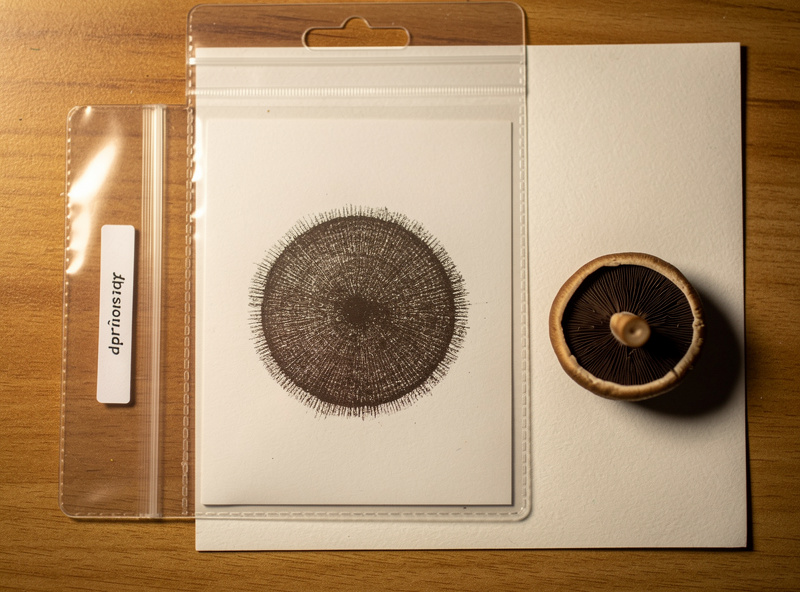
Storage and preservation rules:
- Photograph first: Immediately, in daylight, with a color calibration card if possible. Digital records do not fade.
- Glass envelope storage: Best for long-term reference. Spores stay sealed and undisturbed.
- Label with date, location, host tree: Spore color is one ID feature; location and host tree often distinguish species with similar spore colors.
- Cool dry storage: Below 70°F, below 50% humidity, away from light. A drawer in a temperature-controlled room works.
- Refrigeration for cultivation use: If saving spores for cultivation rather than ID, refrigerate at 38-40°F in a sealed, dry container. This is what actually extends viability — commonly cited in the cultivation community as several years versus 1-2 at room temperature. I don’t freeze mine; without proper desiccation and vacuum sealing, home freezing risks ice-crystal damage that can do more harm than the cold does good, so the fridge is the better bet for a home setup.
The collected prints become a reference library that improves your future ID accuracy. Most experienced foragers keep prints organized by genus or by location. After a few seasons, you can pattern-match a fresh print against your own archive faster than against a published guide. The skill compounds.
Frequently Asked Questions
How long does it take to make a mushroom spore print?
Most species drop visible spores within 4-6 hours. Slow-spore species like some Russula and dry old caps need 8-12 hours overnight. If no print appears after 12 hours, the cap was likely too young, too old, or too dry. Try a different specimen from the same cluster.
What if my mushroom spore print does not match the field guide?
First, re-check under direct daylight rather than indoor lighting which shifts colors significantly. Second, take a fresh print from a different cap to confirm. Third, accept that field guides describe ranges and your specimen may be at the edge of the range. If still unsure, consult a regional mycological society.
Can I eat a mushroom based on spore color alone?
No. Spore color is one of three or four features needed for confident identification. Always combine spore color with cap features, gill attachment, stem features, host substrate, and where possible an in-person expert confirmation. Edibility decisions never rest on a single feature.
Do all mushrooms produce spore prints?
No. Many polypores and bracket fungi produce too few spores to see, some species drop spores from the underside of pores rather than gills, and some are too tough to lay flat for printing. Cap-and-gill mushrooms are the species spore printing was designed to identify.
How long do mushroom spores stay viable for cultivation?
Refrigerated at 38-40°F in a dry, sealed container, mushroom spores stay viable noticeably longer than at room temperature, where I’d budget roughly 1-2 years before viability drops off. I don’t recommend home freezing for spore prints or syringes: without proper desiccation and vacuum sealing, the ice-crystal damage from an ordinary freezer usually does more harm than the cold temperature helps. The fridge is the safer, well-established home practice.
Can I make a spore print without a glass or cover?
Yes, but with lower reliability. The cover traps humidity that keeps the cap moist enough to release spores. Without a cover, indoor air moisture often dries the cap before spore release. Use a small bowl, jar, or even a folded paper if no glass is available.