
Outdoor mushroom cultivation takes 9 to 18 months to first harvest and rewards you for 5 to 7 years afterward. My backyard runs three concurrent systems — 14 inoculated shiitake logs leaning against a north-side fence, a wine cap bed under the apple tree, and an oyster mushroom mound on the garden compost heap. Combined yield last year: roughly 6 kilograms of fresh mushrooms across spring and autumn flushes, plus a steady supply of spent substrate for my raised beds.
This guide covers the three outdoor methods worth running at home — hardwood logs, king stropharia (wine cap) beds, and yard-waste oyster mounds — plus the climate, timing, and pest-protection lessons that decide whether the system runs itself for years or fails in the first season. Outdoor mushroom growing is less precise than indoor work, more weather-dependent, and dramatically more rewarding per hour of effort once you have a system that has run through its first full year.
The Three Outdoor Methods Compared
Outdoor cultivation splits cleanly into three methods, each with its own species range, climate fit, and time horizon. Logs are the longest-lived but require dedicated wood and shaded north-side placement. Beds are the highest-yielding per square metre but require yearly top-ups. Mounds are the fastest start but the shortest lifetime.
| Method | Best Species | Time to First Harvest | Productive Life | Yield (per unit) | Climate Fit |
|---|---|---|---|---|---|
| Hardwood logs (drill-and-plug) | Shiitake, lion’s mane, oyster, reishi | 9-18 months | 5-7 years | 100-300 g per log per flush | Temperate, cool-shaded site |
| Wine cap (king stropharia) beds | Stropharia rugosoannulata | 4-8 months | 2-4 years with top-ups | 1-3 kg per square metre/year | Temperate to mild, partial shade |
| Yard-waste oyster mounds | Pearl, blue, golden oyster | 6-10 weeks | Single season | 2-5 kg per cubic metre | Cool spring/autumn windows |
| Stump cultivation | Oyster, hen-of-the-woods, lion’s mane | 9-15 months | 3-5 years | 200-500 g per flush | Existing stumps only |
| Buried hardwood chips | Wine cap, oyster, lion’s mane | 3-6 months | 2-3 years | Variable, contextual | Garden pathways |
I run logs and a wine cap bed continuously and rotate oyster mounds seasonally. The mounds are the experimental layer where I try new species without committing logs; the bed and logs are the income-producing infrastructure. If you can only pick one to start with, pick wine cap beds — they have the fastest payoff, the broadest climate tolerance, and the deepest crossover with vegetable gardening.
Inoculating Hardwood Logs: Drill, Plug, Wax
Log cultivation is a single weekend’s work followed by a year of waiting, then years of returns. The procedure: fell or buy 1 to 1.2 metre lengths of oak, sugar maple, or beech (not pine, not softwood), let them rest 2-4 weeks for the tree’s antifungal compounds to break down, drill plug-spawn holes in a diamond pattern every 15 centimetres, hammer in inoculated wooden dowels, seal each hole with food-grade cheese wax, and stack in a heavily shaded location — the standard extension recommendation for shiitake logs is 60 to 85 percent shade during incubation (Virginia Tech Cooperative Extension), which is a lot more shade than most people assume before their first stack.
I have broken the full drill-plug-wax sequence down step by step in my log inoculation guide, and if shiitake is your target species, growing shiitake on logs covers the strain selection and shock-fruiting tricks that took me two seasons to learn.
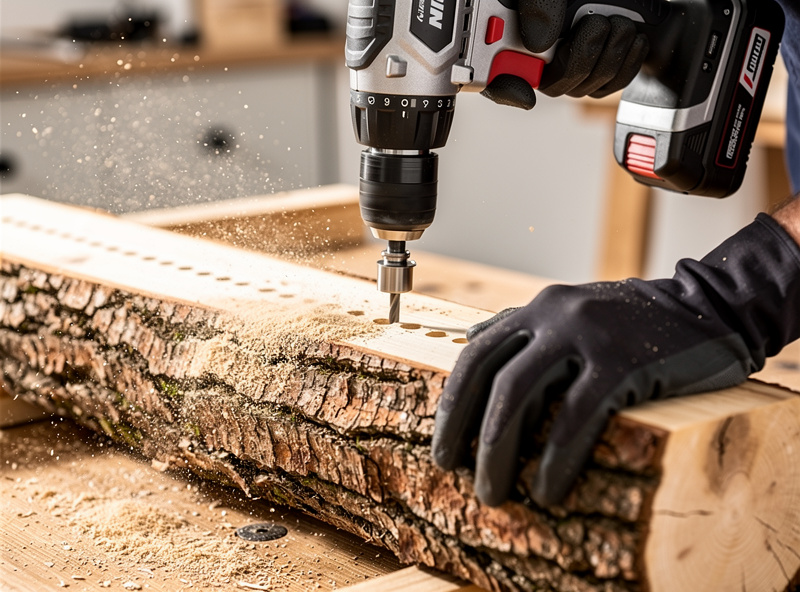
The drill bit matters: an 8.5-millimetre angled stop-collar bit gives you the correct depth and diameter for standard plug spawn. Hardware-store flat-tip bits leave inconsistent holes that lose wax and let contaminants in. The angled tip pulls the plug deeper into the wood than a flat bit; my first batch of logs in 2022 used the wrong bit and showed contamination on roughly 15 percent of plug-holes by the end of year one — a problem the proper bit eliminated entirely.
Wood species and freshness rules I follow: oak (red or white) is the most reliable — colonisation in 9-12 months, fruiting in spring and autumn for 5-7 years. Sugar maple is second-most reliable but fruits a season earlier. Beech, birch, and sweetgum work but produce less. Cherry, walnut, and softwoods (pine, cedar, fir, spruce) do not. The full wood-by-wood ranking is in best wood for mushroom logs, and the timing window for inoculation by climate zone is in when to inoculate mushroom logs.
Wine Cap Beds: The Bed That Pays Within Six Months
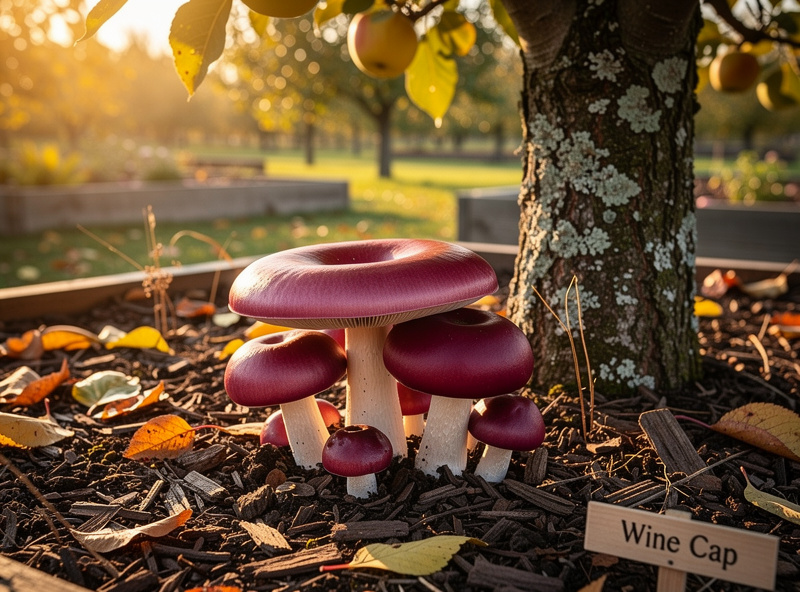
King stropharia, also called wine cap or garden giant, is the easiest outdoor mushroom to grow in a temperate climate. The bed is a 5 to 10 centimetre layer of hardwood chips spread over a flat, partly-shaded patch of ground, inoculated with grain spawn or live mycelium, top-dressed with straw, and watered through the first dry month. Unlike log species, wine cap tolerates real sun — Tilth Alliance’s own demonstration bed runs under the light shade of a single fruit tree, the kind of spot where vegetables would already be complaining about the light. Over-shading a wine cap bed like a shiitake log stack is a common beginner mistake, not a requirement. First flush hits 4 to 8 months later and the bed produces 1-3 kilograms per square metre per year for 2-4 years before the chips need topping up.
Bed shape, depth, and siting matter more than most people expect, so I walk through the layouts that have worked for me in my outdoor mushroom bed design guide; and because a wine cap bed shares ground with the vegetable patch, it pairs naturally with companion planting with mushrooms.
My bed sits between two raised vegetable beds in a 2-square-metre strip that was previously useless pathway. The wine cap mycelium grows through the chips, suppresses weeds, holds moisture, and produces 4-6 kilograms per season of large meaty mushrooms with a peppery taste. The bed also accepts garden waste as top-up: dried leaves, weed-free grass clippings, and shredded cardboard all break down into food for the next season’s mycelium.
The full bed construction — site selection, chip preparation, inoculation timing, and the autumn top-up schedule — lives in outdoor wine cap mushroom beds. The same article includes the garden-pathway hybrid design I use, which doubles as a walking surface and a mushroom bed. If you also run vegetable beds, the bed-edge crossover with the gardening side of the network (see the home composting hub) is genuinely useful — spent wine cap mycelium is one of the better compost activators I have used.
Oyster Mounds on Yard Waste and Coffee Grounds
Oyster mushroom mounds are the fastest-payoff outdoor cultivation — 6 to 10 weeks from inoculation to harvest. The build is simple: pile 30-50 litres of pasteurised straw mixed with used coffee grounds, inoculate at 10-15 percent spawn rate, cover with damp cardboard and shade cloth, and water once a week during dry stretches. The mound produces 2-5 kilograms of fresh oysters over 2-3 flushes before exhausting.
Outdoor oysters are less species-flexible than indoor oysters because cool spring and autumn windows favour pearl and pink oysters but not the heat-tolerant golden or blue varieties. In my climate (60 degrees north, USDA zone 5), I run pearl oysters in March-May and again in September-November. Mid-summer mounds dry out faster than I can water them and the spawn aborts at temperatures over 28 C.
Yard waste expands the substrate range cheaply. The full substrate-by-substrate breakdown for outdoor oyster mounds is in growing oyster mushrooms on garden waste and coffee grounds. Two things that worked on my mound: 50 percent straw plus 50 percent used coffee grounds gives the best yield-to-cost ratio; adding 10 percent shredded cardboard helps the mound hold shape through rain. Garden waste alone (leaves, grass clippings) works for outdoor king stropharia but is too nitrogen-rich for outdoor oysters.
Stump Cultivation and Buried Hardwood Chip Beds
Two specialised methods are worth knowing because they expand what you can do with materials you might already have on the property. Stump cultivation uses existing tree stumps as the substrate; buried hardwood chip beds use a 20-centimetre-deep trench filled with chips as a wider, lower-profile alternative to a raised wine cap bed.
Stumps are the easier of the two: drill plug-spawn holes around the cut face in a diamond pattern, hammer in dowels, wax the holes, and walk away. Oyster mushrooms, lion’s mane, and hen-of-the-woods all colonise hardwood stumps; the first flush typically lands 9 to 15 months after inoculation and the stump produces 200-500 grams per flush for 3-5 years until the wood is fully decomposed. The visual ID skill for distinguishing healthy mushroom growth from wood-decay fungi on a stump is the same one covered in what does mycelium look like; the mycelium runs the same way through stump wood as it runs through log wood.
Buried chip beds are excellent for narrow garden pathways. Dig a trench 30-50 centimetres wide and 15-20 centimetres deep, line the bottom with cardboard, fill with hardwood chips, inoculate with wine cap or lion’s mane grain spawn at 5-10 percent by volume, top-dress with straw, and the path doubles as a mushroom production layer. The path stays usable, the mushrooms fruit at the edges where the chips meet soil, and the system runs for 2-3 years before needing fresh chips. If you already use CVG bulk substrate indoors, the outdoor chip bed is the rougher, slower outdoor analogue.
Climate, Timing, and Why September Beats June
Outdoor mushrooms fruit in response to temperature drops and rain events. Spring and autumn are the productive seasons; high summer and deep winter are dormancy. The exact windows depend on latitude and local microclimate, but the rule that holds across most temperate zones: September-October produces the year’s best flushes because temperatures drop steadily while soil is still warm.
To stretch the season past those autumn windows, a greenhouse setup buys you weeks at both ends, and before the first hard freeze it is worth reading how I overwinter outdoor beds so they flush again the following spring.
My personal timing across three years: shiitake logs flush twice — late April-early May and again late September-October. Wine cap beds flush from June through October with the highest concentration in September. Oyster mounds work April-June and again September-November. Anything I try to push through July-August stays dormant or dries out. The climate-specific inoculation calendar I follow is in when to inoculate mushroom logs, and the seasonal-trigger logic generalises to beds and mounds with a 2-3 week earlier offset because the mycelium colonises faster in bulk substrate than in dense wood.
Region matters too. North-facing slopes hold moisture longer and produce better than south-facing sites in temperate climates; the opposite is true in cooler maritime climates where sun helps the substrate warm enough to fruit. My north-fence shiitake stack outperforms the same logs I tried on the south side by roughly 40 percent yield in trial year one — enough that I moved the south stack to north and have not run a south-facing log site since.
Shade Requirements Are Not the Same Across Methods
The single most common site-selection mistake I see people make outdoors is treating “shade” as one setting that applies to every method. It doesn’t, and the three systems I run sit at three different points on the sun-tolerance spectrum.
Log-grown species — shiitake above all — genuinely want heavy shade. The extension-level number is 60 to 85 percent shade during incubation and fruiting (Virginia Tech Cooperative Extension), and my own stack lives against a north-facing fence under a stand of birch that blocks nearly all direct summer sun. Too much light dries the bark faster than the log can hold moisture, and a log that dries out between rain events stalls colonisation. This is the rule most outdoor growing advice quietly assumes applies to everything else too — it doesn’t.
Wine cap is the opposite case, and it’s worth stating plainly because I have seen more than one beginner bury a perfectly good bed under deep shade expecting it to behave like a shiitake log. Stropharia rugosoannulata is a genuinely sun-tolerant species; the Tilth Alliance’s own public demonstration bed runs under nothing more than the dappled light of a single fruit tree, in the exact kind of half-sun spot that would leave a vegetable bed light-starved. My bed between the raised vegetable beds gets a few hours of direct afternoon sun most days and has never shown heat stress from it — the actual limiting factor for wine cap is soil moisture through a dry month, not sun exposure. Deep shade just slows it down for no benefit.
Oyster mounds fall somewhere in between, but for a different reason: the limiting factor for outdoor oysters isn’t shade percentage at all, it’s air temperature. A mound in full sun during a cool April window fruits fine; the same mound in full sun during a July heat spell aborts regardless of how much shade cloth you throw over it, because the ambient temperature itself is past the species’ tolerance. Shade cloth on an oyster mound is mostly a moisture-retention tool — it slows evaporation between waterings — rather than a light-blocking necessity in the way it is for a shiitake log.
The practical takeaway: site logs under the heaviest shade you have on the property, don’t hesitate to put a wine cap bed somewhere with real afternoon sun as long as you can keep it watered, and time oyster mounds to the cool shoulder seasons rather than trying to shade your way through a hot month.
Pest and Predator Management Outdoors
Outdoor mushroom systems attract three categories of pest: slugs and snails (eat fresh fruit bodies), squirrels and chipmunks (dig up logs to access mycelium), and bacterial slime molds (compete with the mycelium during establishment). Each one has a fix; none of them is fatal if you build the system with the pest in mind from the start.
Slugs are the most common problem and the easiest to solve. A 5-centimetre band of copper tape around the base of each log stack or wine cap bed repels almost every slug; if you forget the tape, hand-pick at dusk during fruiting weeks. Diatomaceous earth works but washes away in rain and must be reapplied weekly — the copper tape is a once-and-done solution. Squirrels and chipmunks are stopped by a 1-centimetre wire mesh laid flat under the log stack and pinned with garden staples; they cannot dig through it and lose interest within a week.
Bacterial slime molds appear on outdoor logs that get too wet or sit on damp soil rather than on a wooden pallet base. Lift every stack onto a wooden pallet or onto bricks; standing the bottom log on dry surface keeps the colonisation moisture inside the log instead of pulling it from below. I lost three logs in year one to a wet base before I moved the stack to a pallet; zero losses since.
My Backyard System After Three Seasons
Three years of running outdoor systems has taught me that the system that gives you food consistently is the one you can do all the maintenance for in 30 minutes a week. Log stacks need a weekly water spray during dry summers and an autumn check; wine cap beds need an autumn top-up; oyster mounds need to be torn down and replaced twice a year. Combined: about 25 hours per year of active work for roughly 6 kilograms of fresh mushrooms.
The cost has been moderate. Year one was the heavy spend: 14 logs at zero cost (felled from a friend’s property), 50 dollars of shiitake plug spawn, 18 dollars of wax, 6 dollars of copper tape. Wine cap bed: 30 dollars of fresh hardwood chips (free from a tree service if you ask), 12 dollars of wine cap grain spawn. Oyster mound: free straw from a horse stable, free coffee grounds from a local cafe. Total: under 90 dollars for three concurrent systems.
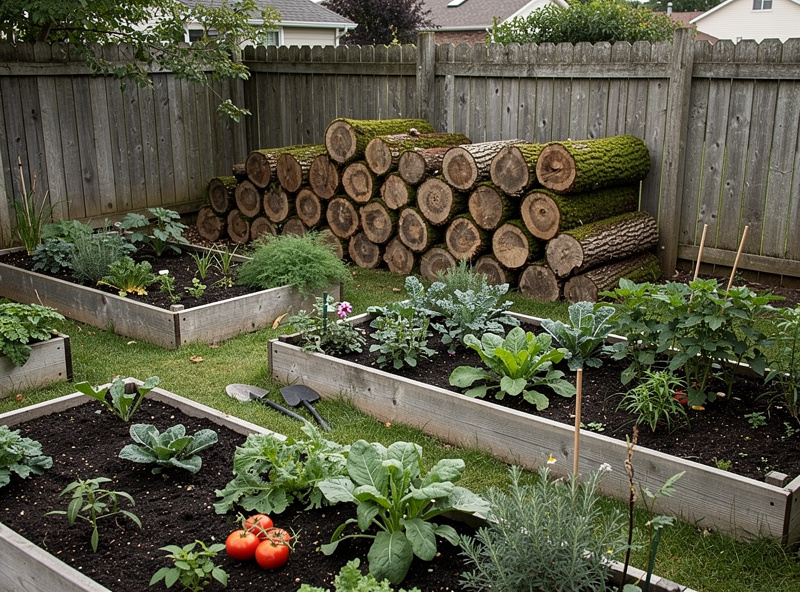
The unexpected benefit has been compost. Spent mushroom substrate from oyster mounds and wine cap top-ups is one of the better soil amendments I have used in the raised vegetable beds — the residual mycelium continues to break down organic matter and the resulting soil structure is markedly better than straight compost. If you also run a vegetable garden, the spent-substrate output justifies the cultivation work on its own, ignoring the mushroom yields.
When Outdoor Beats Indoor (and When It Does Not)
Outdoor beats indoor for long-term productivity, almost zero electricity cost, no contamination risk in the home, and the soil-and-compost crossover with gardening. Indoor beats outdoor for fast iteration, controlled climate, exotic species that need precise setpoints, and year-round availability. My personal split: shiitake, oyster, wine cap, and reishi outdoors; lion’s mane, cordyceps, turkey tail, and maitake indoors.
The exotic species rule is worth flagging. Cordyceps militaris cannot be grown outdoors in my climate; it needs 18-22 C steady temperature and a jar-based rice-broth substrate. Maitake is technically possible outdoors on hardwood logs but takes 18-24 months to fruit and yields unpredictably; I gave up on the outdoor maitake experiment after two seasons. Turkey tail will grow outdoors on dead hardwood and is fun to find when foraging — but for medicinal use I want a known-clean indoor block, not foraged material. The full indoor playbook for medicinal species is in growing medicinal mushrooms at home, and the lion’s mane specifics (which can go indoor or outdoor) are in the lion’s mane growing guide.
If you are deciding between starting indoors and starting outdoors, my recommendation is: start with a wine cap bed because it teaches you the climate-and-timing intuition outdoors cheaply, and add an indoor lion’s mane block in parallel to learn the climate-control side. Together they cover the full range of mushroom cultivation skills inside one season. The decision tree for which makes sense in your specific situation is part of the bigger mushroom growing mistakes guide.
Frequently Asked Questions
How long does it take to get the first harvest from an outdoor mushroom log?
Hardwood mushroom logs take 9 to 18 months from inoculation to first fruiting, depending on species, wood density, and climate. Oak shiitake logs in zone 5-7 typically fruit in spring of year two. Sugar maple is faster (8-12 months). Beech, birch, and sweetgum sit between 12 and 18 months.
Do I need full shade for outdoor mushroom cultivation?
It depends on the method, not a single rule. Hardwood logs (shiitake especially) want heavy shade, 60 to 85 percent, per standard extension guidance, meaning deep shade under trees or a north-facing fence line. Wine cap beds are the opposite: Stropharia rugosoannulata is sun-tolerant and grows well in only partial shade, the kind of spot where vegetables would already be light-starved, so over-shading a wine cap bed is a common beginner mistake. Oyster mounds care less about shade and more about air temperature; shade cloth there mainly slows evaporation rather than blocking light. Match the shade level to the method, not the other way around.
What is the cheapest outdoor mushroom system to start?
A wine cap (king stropharia) bed using free hardwood chips from a tree service and 12 to 20 dollars of grain spawn produces 1 to 3 kilograms per square metre per year for 2 to 4 years. Total starting cost is often under 25 dollars for 1 to 2 square metres of bed.
Can I use logs from a tree I just cut down?
Almost. Let freshly-cut hardwood logs rest 2 to 4 weeks in shade before inoculation. Fresh wood contains antifungal compounds that inhibit mushroom mycelium; the rest period lets those break down. Do not wait longer than 6 weeks or wild fungi will colonise first. The window between weeks 2 and 6 is the inoculation sweet spot.
How do I keep slugs off my outdoor mushrooms?
A 5-centimetre band of copper tape around the base of each log stack, bed edge, or oyster mound repels almost all slugs with no maintenance. Diatomaceous earth works but must be reapplied after rain. Hand-picking at dusk works in low-pressure situations but is unsustainable at higher densities.
Can I grow mushrooms outdoors in a cold climate?
Yes, with species selection. Shiitake, oyster, lion’s mane, wine cap, and reishi all tolerate USDA zones 4 through 8. The fruiting season shortens at the cold extreme but the mycelium survives winter dormancy in the log or bed. Below zone 3, log stacks should be insulated with straw bales in late autumn to prevent freeze-thaw cracking of the wood.
Related Guides on MycoMansion
- Outdoor Wine Cap Mushroom Beds: Combining Garden Pathways with Stropharia
- When to Inoculate Mushroom Logs: Seasonal Timing by Climate Zone
- Growing Oyster Mushrooms on Garden Waste and Coffee Grounds
- Best Wood for Mushroom Logs: Oak, Maple, Birch Compared
- Mushroom Substrates: The Complete Home Cultivation Guide