
Wine cap mushrooms (Stropharia rugosoannulata) thrive in outdoor wood-chip beds laid along garden pathways, between raised beds, and around fruit trees. The mycelium decomposes hardwood chips into rich garden compost — unlike indoor grows, outdoor beds avoid most beginner mistakes. In my own beds, a well-established pathway or border runs somewhere in the 5-15 pounds of edible mushrooms per square meter per year range, though I don’t have a formal scale-every-flush log to swear to the exact number.
Wine cap beds are one of three outdoor methods I run year-round; the others (logs and oyster mounds) plus the climate-and-timing playbook are in my outdoor mushroom growing guide.
This guide covers the bed geometry, wood chip selection, spawn rate, and the seasonal schedule that produces consistent flushes. Hardware target is bulk hardwood chips (most arborists deliver 5-10 cubic yards free) plus a 5-10 pound bag of wine cap sawdust spawn (40-80 USD from North Spore, Field & Forest, or other reputable spawn suppliers).
Why Wine Cap Beds Solve Three Garden Problems at Once
The first benefit is mushrooms. Wine cap is one of the easiest gourmet mushrooms to grow outdoors — the variety the spawn supplier sells is selected for vigor in temperate climates and produces reliably from late spring through autumn. The flavor sits between portobello and shiitake, with a slightly nutty meatiness that holds up to grilling, sautéing, or drying. My own 10-foot path has run somewhere around 8-15 pounds of mushrooms per year once it got established, though that number moves with rainfall and how consistent I am about watering during dry spells — treat it as a realistic range from my logs, not a guarantee.
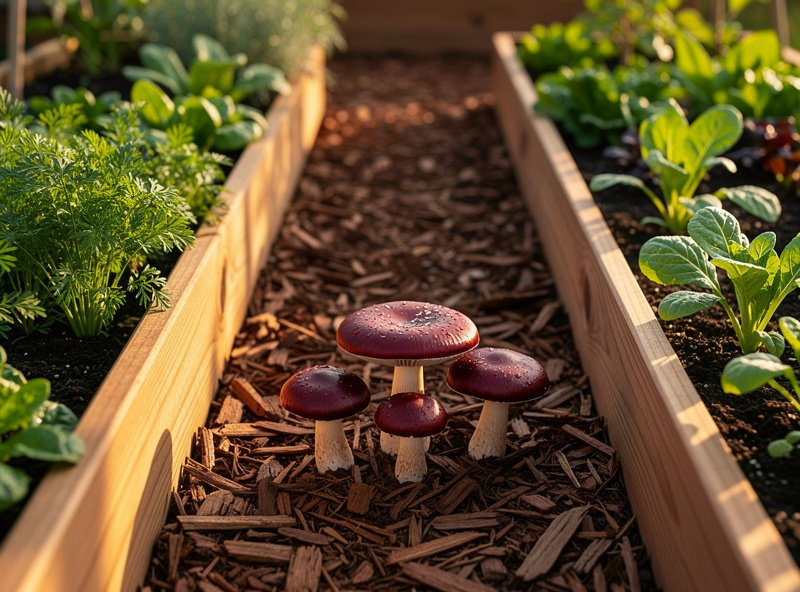
The second benefit is soil. As the wine cap mycelium decomposes the wood chips, it converts cellulose and lignin into mycelial-rich humus that quietly upgrades the surrounding bed soil — this is a well-established saprotrophic function, not a root symbiosis. Adjacent vegetable beds receive the upgraded compost passively when you turn beds at the start of each season; in my own garden I’ve noticed the soil under a couple of years’ worth of colonized chips is visibly darker and holds moisture longer than the untouched beds nearby. The integration with broader bed management is on the raised beds and planters complete guide.
The third benefit is weed suppression. A 4-6 inch deep wood chip pathway smothers existing weeds and prevents new ones from germinating. The mycelium adds a second layer of competitive pressure that makes weeds even less likely to break through. After year 1, expect zero weed pressure on a properly chip-mulched and inoculated pathway.
Bed Geometry: Pathway, Border, or Patch
The pathway is the most efficient layout: 18-30 inches wide, 4-6 inches deep, running between raised garden beds. The pathway uses space that was already not productive (you cannot grow vegetables on a walking path) and converts it into mushroom and compost production. A 10-foot path covers about 25-40 square feet — enough for 5-10 pounds of mushrooms per year at moderate inoculation rates.
The border layout runs along garden fences or property lines, 24-36 inches wide, 4-6 inches deep. Borders work well under the dappled light of a garden tree or fence line — wine cap tolerates a wide range of light and is actually more sun-tolerant than most cultivated species, but the common mistake is treating it like a shiitake log and burying it in dense, heavy shade, which slows it down rather than helping it. Part-sun to light “garden shade” is the real sweet spot, a pattern Tilth Alliance’s own bed under a plum tree confirms. Borders are slightly less efficient than pathways because they require dedicated space, but the mushroom yield per linear foot is higher because the bed is wider.
The patch layout is a 4-6 foot square of chips placed under fruit trees or in a corner of the yard. Patches produce well but waste edge area; reserve them for spaces that have no other use. The fruit-tree pairing is particularly valuable because wine cap is a wood-chip decomposer, not a mycorrhizal fungus, so it doesn’t compete with the tree’s own root associations — it just quietly turns the mulch into humus feeding the same root zone.
| Layout | Dimensions | Yield Year 1 | Yield Year 2-3 | Best For |
|---|---|---|---|---|
| Pathway (10 ft) | 24 in x 10 ft x 5 in | 3-5 lbs | 8-15 lbs | Between raised beds |
| Border (10 ft) | 30 in x 10 ft x 5 in | 5-8 lbs | 12-20 lbs | Property line, shaded |
| Patch (5×5 ft) | 5 ft x 5 ft x 5 in | 4-7 lbs | 10-18 lbs | Under fruit trees |
| Connected pathways | 30+ ft total | 10-15 lbs | 30-45 lbs | Production-scale yard |
| Shaded raised bed top | 4 ft x 8 ft x 4 in | 6-9 lbs | 15-25 lbs | North-facing yard |
Wood Chip Selection
Hardwood chips are required: oak, maple, beech, birch, and ash all work. Avoid softwoods (pine, fir, spruce, cedar) entirely — wine cap will not colonize softwood reliably and the residual resin actively inhibits mycelium growth. Avoid black walnut and eucalyptus because both produce allelopathic compounds that suppress fungal growth.
Source chips from local arborists, who typically deliver 5-10 cubic yards free of charge to homeowners willing to take whatever they have — my own pile has come from three different arborists over the years, and I’ve learned to just ask what species they’ve got rather than requesting something specific. The arborist’s truck dumps a pile in the driveway; you spread over 1-2 weekends. The chips are usually a mix of species, which is fine for wine cap as long as the pile is at least 70% hardwood. The recommended wood-substrate options align with the matching best wood for mushroom logs guide.
Fresh green chips (cut within 2 weeks) work better than dry aged chips. Wine cap colonizes fresh wood faster because the moisture content matches the mycelium’s preferred range. If your chips arrive dry, soak them in a hose for 24 hours before laying the bed — the mycelium establishes 2-3 weeks faster on hydrated chips.
Inoculation Rate and Spawn Type
Use sawdust spawn at the rate of 1-2 pounds per square meter (10 square feet). For a 10-foot pathway at 24 inches wide (~20 square feet), plan on 2-4 pounds of spawn. Sawdust spawn integrates with chip beds far better than grain spawn or plug spawn because the particle size matches the chip texture and the mycelium incorporates evenly throughout the bed. Grain spawn tends to attract rodents.
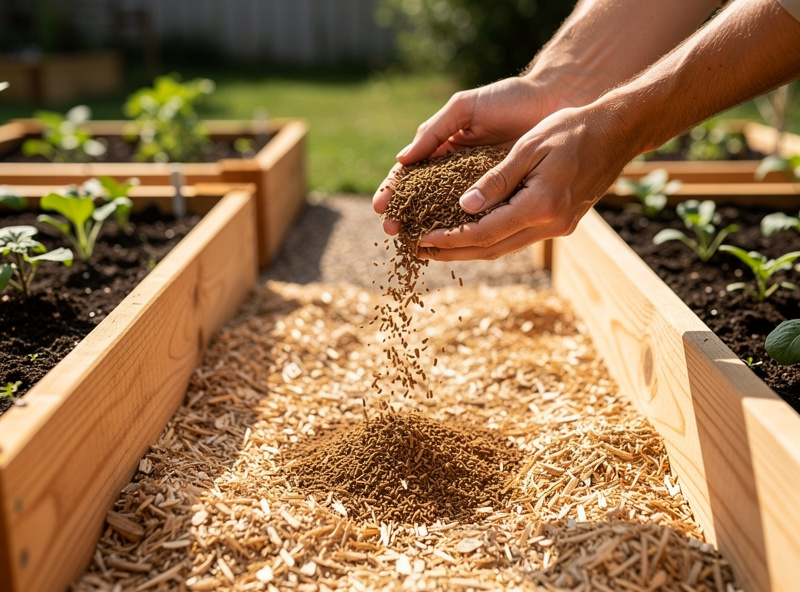
Layer the spawn correctly. Lay the first 2-inch chip layer, sprinkle half the spawn evenly, lay 2 more inches of chips, sprinkle the remaining spawn, top with 1 inch of chips. The sandwiched spawn distribution accelerates colonization because the mycelium reaches its preferred depth (between 2-4 inches deep) without having to travel far from a single surface application.
Spring inoculation (April-May in temperate zones) produces first mushrooms in late summer of the same year. Fall inoculation (September-October) gives the mycelium all winter to establish, with first mushrooms in mid-spring of the following year. Both timings work; fall is slightly preferred because the cooler establishment period reduces competition from other fungi.
Bed Maintenance: Water, Top-Up, Re-Inoculate
Water the bed during dry spells. Wine cap needs the chips to stay at “wrung-out sponge” moisture for active fruiting; below that, mycelium retreats and mushroom production stops. A 30-second pass with a hose every 3-4 days during dry weeks keeps the bed productive. Drip irrigation buried under the chips works as a permanent solution if you live in a dry climate.
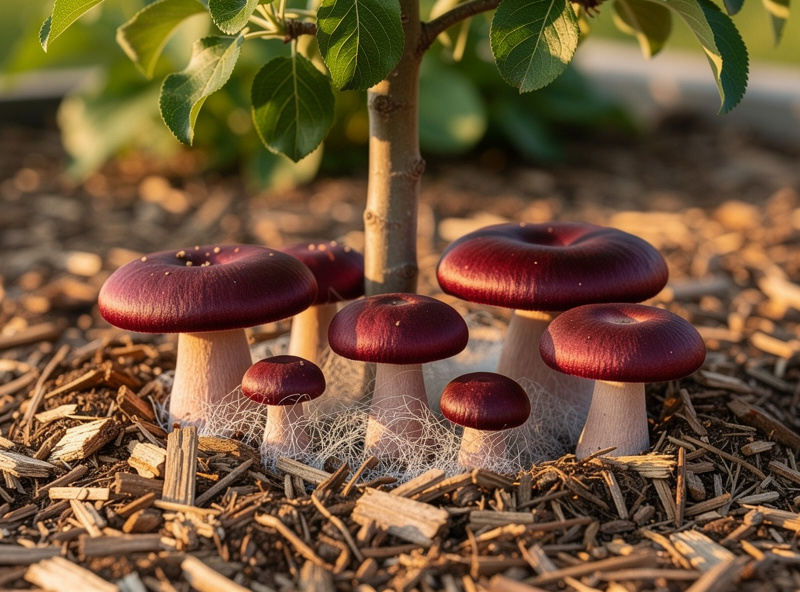
Top up chips annually. The mycelium consumes 1-2 inches of chip depth per year as it converts wood to compost. Each spring, add 2-3 inches of fresh chips to maintain the 4-6 inch depth. The new layer extends the bed life and feeds another year of fruiting. Around year 3-4, the mycelium colonization rate slows; this is the time to re-inoculate with fresh spawn while topping up chips.
Harvest mushrooms before the caps flatten. Wine cap caps emerge as a deep burgundy ball; over 24-48 hours they expand into a flat plate. Pick at the early “ball” stage when the underside is still pale — the texture is firmer and the flavor is at peak. Late-stage flat caps are still edible but slightly bitter. Cut at soil level rather than pulling to avoid disturbing mycelium for the next flush.
For the broader fruit-tree-and-mushroom integration, including which tree species pair best with wine cap, the small garden trees and shrubs complete guide covers the orchard-meets-mushroom layout that maximizes both yields. Apples, pears, and plums are the top three companions for wine cap beds beneath their drip lines.
Frequently Asked Questions
How much does it cost to start a wine cap mushroom bed?
80-150 USD for a 10-foot garden pathway. The main cost is sawdust spawn at 40-80 USD for 5-10 pounds. Hardwood chips are usually free from local arborists who deliver 5-10 cubic yards in exchange for taking whatever wood they have available.
What wood chips work for wine cap mushrooms?
Hardwood only: oak, maple, beech, birch, ash. Avoid softwoods (pine, fir, spruce, cedar) because wine cap will not colonize them. Avoid black walnut and eucalyptus due to allelopathic compounds. Fresh green chips colonize faster than aged chips, so use chips delivered within 2 weeks of cutting.
When should I inoculate a wine cap bed?
Spring (April-May) produces first mushrooms in late summer of the same year. Fall (September-October) gives the mycelium winter to establish, with first mushrooms in mid-spring next year. Fall is slightly preferred because cool temperatures reduce competition from other fungi during establishment.
How much yield can I expect per square meter?
In my own logs, year 1 runs 3-5 pounds per square meter and year 2-3 peaks around 8-15 pounds per square meter under good conditions (consistent moisture, part-sun to dappled shade rather than deep shade, healthy mycelium). Treat these as a realistic range from personal experience, not a lab-measured average. Yield drops in year 4 unless you re-inoculate and top up with fresh chips.
Do wine cap beds attract pests?
Slugs and rodents can be issues during wet periods. Slugs eat young mushrooms; control with diatomaceous earth or beer traps. Rodents may dig if you use grain spawn (sawdust spawn does not attract them). Otherwise wine cap beds are pest-resistant compared to vegetable gardens.
Can I plant vegetables next to a wine cap bed?
Yes, and the proximity benefits the vegetables. Wine cap is a wood-chip decomposer, not a mycorrhizal fungus, so it doesn’t form root associations the way some fungi do — what it does is convert wood chips into rich humus that enriches adjacent bed soil over a couple of seasons, which benefits any vegetables planted nearby, brassicas and alliums included.