
Growing shiitake on supplemented sawdust blocks turns a 5-pound bag of sterilized hardwood into 1 to 2 pounds of mushrooms over three flushes, usually inside 60 to 90 days from inoculation to first harvest. Block cultivation is the indoor, year-round path to shiitake, and it behaves nothing like the oyster bags most growers start on. Shiitake makes you wait through a long colonization, then through a strange-looking browning phase, and only then rewards a cold-water shock with a heavy pin set.
I run shiitake on hardwood blocks on the same bench where I keep lion’s mane and king oyster, and it is the species that taught me patience. An oyster bag is in full flush before a shiitake block has even finished turning brown. This guide covers the whole block pipeline as I run it — substrate formula, sterilization, the colonize-and-brown wait, soak-shocking, fruiting, and the multi-flush harvest cycle — and points you to the deeper spoke guides for each stage. If you want the outdoor, hardwood-log version of this crop instead, that lives in a separate guide: how to grow shiitake on logs is a fundamentally different timeline (months to years), and this page stays strictly on indoor blocks.
Why Shiitake on Blocks Is Different From Every Other Bag Crop
Shiitake is a slow, supplement-hungry primary decomposer that demands a sterilized block, not a pasteurized one, and a colonization that ends in a tough brown skin before it will fruit. That single trait — the browning requirement — is what separates it from oyster, lion’s mane, and king oyster, all of which fruit straight off a white, freshly-colonized substrate.
On the bench, the practical consequences stack up fast. Oyster forgives a sloppy pasteurized straw substrate because it colonizes aggressively and outruns most competitors. Shiitake does the opposite: it colonizes slowly, which means any contamination that survives your sterilization gets a long head start. So shiitake blocks are sterilized in a pressure canner, never just pasteurized, and they are heavily supplemented with bran to fuel that slow, dense growth. The reward for the wait is a substrate that fruits in repeated flushes over two to three months, with the famous meaty texture and umami depth that no oyster matches. If you are completely new to fruiting bags, read my complete substrate guide first so the sterilize-versus-pasteurize logic is clear before you commit a canner load to shiitake.
Choosing a Shiitake Strain for Blocks
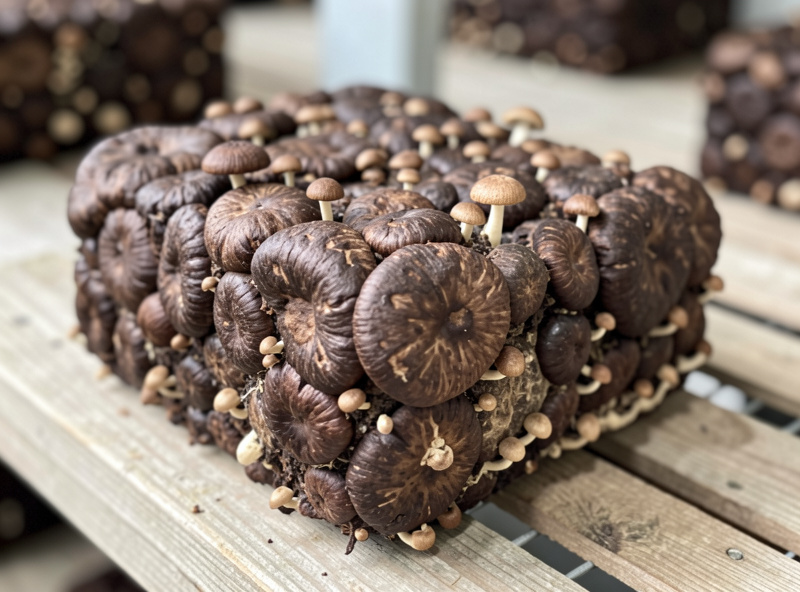
Shiitake strains split into two broad camps for block growers: wide-range strains that fruit across a forgiving 10 to 24°C band, and warm-weather strains that want steadier 18 to 24°C and tolerate less of a cold shock. For a first indoor block run, a wide-range commercial sawdust-spawn strain is the safer buy because it forgives an imperfect fruiting room.
I keep my shiitake to vetted gourmet sawdust-spawn lines and judge a strain by three things: how heavily it browns, how strongly it responds to a cold soak, and cap quality at my fruiting temperatures. Warm-weather strains can shrug off a weak shock and refuse to pin if your water never gets cold enough, which catches out growers in a heated flat. Buy sawdust spawn rather than grain spawn for blocks — it transitions onto the wood base without the nutrition shock that grain spawn risks, and it carries less of the bacterial load that a wet grain jar can bring to a slow crop. Whatever strain you run, log it and stay consistent so you learn its browning and shock behavior across several blocks rather than chasing a new line every batch.
The Shiitake Block Substrate: Supplemented Hardwood Sawdust
The standard shiitake fruiting block is roughly 80% hardwood sawdust to 20% supplement by dry weight, hydrated to field capacity, then sterilized. Oak is the classic base, with beech, maple, and sweetgum all working well — the hardwoods Michigan State University Extension recommends for Lentinula edodes; the bran supplement (wheat bran is the workhorse) is what pushes shiitake yield far past a bran-free block.
I mix shiitake a little richer than I mix oyster. A block I trust is built on hardwood fuel pellets or fine hardwood sawdust as the base, wheat bran at around 20% of dry weight, and a spoon of gypsum per block for structure and to buffer the mix. Shiitake will take supplementation that would turn an oyster block into a contamination bomb, because once it brings up that brown skin it defends the block well — but only after a clean sterilization. Hydration matters as much as the recipe: squeeze a handful and you want a few drops, not a stream. My field-capacity moisture test walks through getting that exactly right, because an over-wet shiitake block anaerobically sours in the bag and never colonizes.
The full build, ratios, and why shiitake wants more bran than lion’s mane is its own deep dive — see growing shiitake on supplemented blocks for the exact formula and the pressure-canner schedule. The base recipe also overlaps with my general supplemented sawdust substrate recipe and the Masters Mix formula I run for lion’s mane and king oyster, though shiitake leans more on bran than on soy hull.
Sterilize, Do Not Pasteurize
Supplemented shiitake blocks must hit full sterilization — 15 PSI in a pressure canner for 2.5 hours for a 5-pound block, longer for bigger masses. Pasteurization temperatures that work for straw oyster will leave a bran-rich block teeming with surviving bacteria and mold spores that overrun shiitake during its slow colonize.
This is the single most important rule on the page. Bran is food for everything, not just shiitake, and shiitake is too slow to win a fair race. The line between pasteurization and sterilization, and why each suits a different substrate, is laid out in my pasteurization comparison and the broader bulk substrate prep guide. For shiitake blocks there is no shortcut: pressure-sterilize, cool fully, then inoculate in still air or under a flow hood.
Spawn, Inoculation, and the Long Colonization
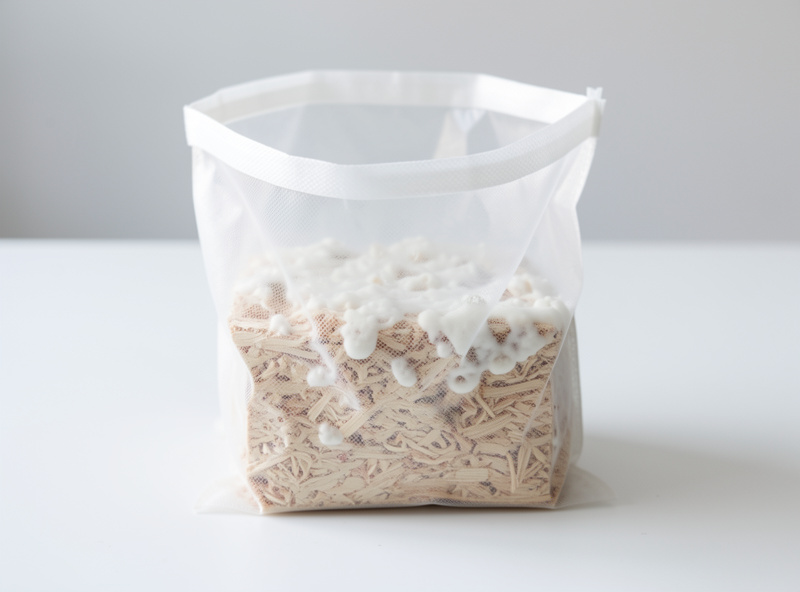
Shiitake blocks are inoculated with sawdust spawn at roughly 5 to 10% of block weight, then sealed in a filter-patch bag to colonize in the dark at 21 to 24°C for three to six weeks — far longer than oyster’s one to two. Sawdust spawn beats grain spawn here because it matches the block’s wood base and transitions onto it without a nutrition shock.
I inoculate cooled blocks in front of the flow hood, breaking spawn into the bag and massaging it through before heat-sealing the filter patch. Then it goes onto the dark colonization shelf and I leave it alone. The mycelium runs white and fluffy first, knitting the block solid. Resist the urge to keep opening the bag to check — every peek is a fresh-air-exchange event that invites contamination into a block that will sit colonizing for over a month. If a block does go wrong, contamination ID is a first-class skill on this site; the symptoms and the toss-versus-save calls live in the shiitake troubleshooting guide.
The Sterile Chain: Where Block Runs Actually Fail
Most failed shiitake blocks die at the spawn or transfer stage, not in the fruiting room. The sterile chain runs culture to grain or sawdust spawn to sterilized block to fruiting, and the weak link is almost always introducing spawn into the cooled block — the one moment the sterile interior is open to room air. Get that transfer clean and a shiitake block defends itself for months.
For routine block inoculation a still-air box is usually enough: cooled blocks, broken-up sawdust spawn, gloved hands, and a quiet room with the air settled. I move to the laminar flow hood when I am working agar plates or starting grain spawn, where the exposure window is longer and only filtered laminar airflow keeps plates clean. The decision is exposure time — a quick spawn-into-bag massage survives the SAB; an open plate does not. Wipe everything with 70% isopropyl, work away from your own breath and movement, and seal the filter patch immediately. The same contamination discipline that protects a shiitake block is the discipline that protects a sourdough starter, a koji tray, and a curing chamber — clean process is one habit pointed at four different microbes. If a block does throw green Trichoderma, cobweb mold, or sour bacterial wet-spot, the toss-versus-save calls are in the troubleshooting guide.
The Browning Phase: The Step Everyone Skips Wrong
After a shiitake block is fully white, it is not ready to fruit — it must brown. Over another two to four weeks the white mycelium thickens, develops a tan-to-chocolate rind, and may weep amber droplets. That brown skin is the block protecting itself and storing energy; fruiting it before it browns gives weak, sparse pins and a contamination-prone surface.
This is where new shiitake growers panic. A block turning brown and beading amber liquid looks, to an oyster grower, exactly like something has gone wrong. It hasn’t — that is healthy shiitake doing precisely what it should. I keep browning blocks in the bag, in low light with a little fresh-air exchange, and let them firm up. A properly browned block feels like a dense rubbery loaf and bounces back when pressed. Knowing healthy brown rind from actual contamination is a judgment call worth getting right; the comparison photos and decision rules are in the troubleshooting guide, and the general arc from spawn to fruiting body is covered in my mushroom life cycle explainer.
Soak-Shocking: How You Trigger a Flush
A browned shiitake block fruits on demand when you cold-water shock it: pop it out of the bag and submerge it in cold water (ideally 10 to 15°C) for 6 to 24 hours. The sudden temperature drop and full rehydration mimic the autumn rains that trigger shiitake in the wild, and a strong shock sets a heavy, even pin flush within days.
I weigh blocks before and after the dunk and want them to regain most of the water they lost during browning and the previous flush. Hold the block down with a weight or a second container of water — a colonized block floats. Too short a soak gives a thin flush; too warm a soak does little. This is the single highest-leverage technique in block shiitake, and it is worth its own read: soak-shocking shiitake for fruiting covers water temperature, soak duration, weighing, and how to re-shock a stubborn block. After the soak, the block moves straight into fruiting conditions.
Fruiting Conditions: Pins to Harvest
Shocked shiitake blocks pin and fruit at 16 to 18°C with 80 to 90% humidity, several fresh-air exchanges per hour, and indirect light, taking roughly 5 to 10 days from shock to harvest. Shiitake likes it cooler than oyster and wants strong fresh-air exchange — stuffy, high-CO2 air gives long stems and tiny caps.
In my fruiting tent the shocked block sits on a rack with an ultrasonic humidifier on a humidistat and a small fan moving air. Pins appear as brown bumps pushing through the rind, swell into recognizable caps, and the cap edge stays slightly curled under until just before it flattens — that curl is the harvest cue. Lower humidity than oyster suits shiitake; too wet and you invite bacterial blotch on the caps. The full environmental dial-in — temperature, humidity, the FAE-versus-humidity tradeoff, and light — is in the shiitake fruiting conditions guide. For the airflow side specifically, my write-ups on FAE and CO2 and choosing a fruiting chamber humidifier apply directly.
Harvest, Multiple Flushes, and Yield
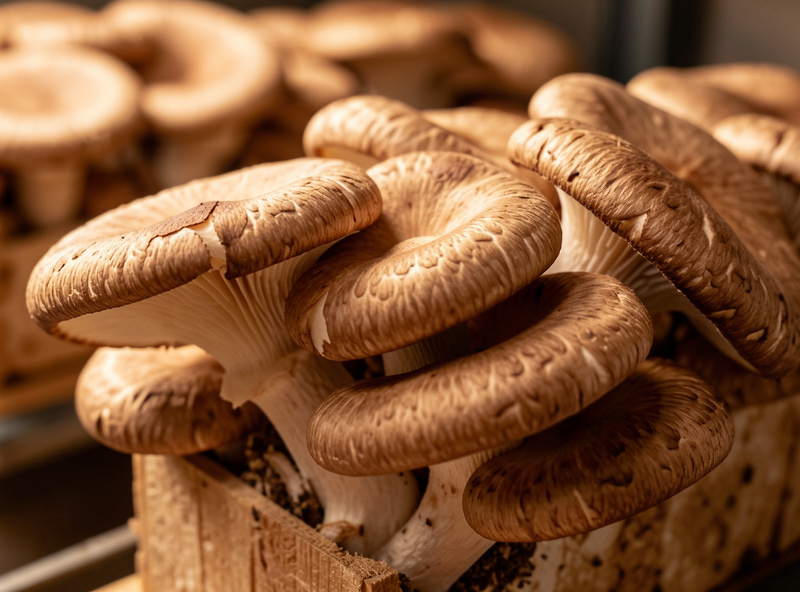
Harvest each shiitake when the cap has opened to about 70% — edge still slightly curled, gills exposed — by twisting it off at the base. A healthy 5-pound block gives two to four flushes, with the first being the largest, and a total fresh yield of roughly 1 to 2 pounds across the block’s life.
Between flushes the block rests, re-colonizes the harvest scars, and then you soak-shock it again to trigger the next round. Each flush is smaller than the last as the block’s stored energy depletes. I judge a block spent when a soak no longer brings up pins or when contamination finally breaks through the weakened rind. Realistic numbers matter here — biological efficiency and what a block actually returns per pound of substrate are laid out in my yield-per-block guide. When a shiitake block is finished, it is not waste; the spent substrate goes to the garden.
Dunking and Resting Between Flushes
After a flush, a shiitake block needs both water and rest before it will give the next one. The block lost significant weight to the fruit bodies and to evaporation, so it gets a recovery soak — a shorter, gentler dunk than the initial fruiting shock — to bring it back toward field capacity, then a quiet rest of one to two weeks back in low light while the mycelium reknits the harvest scars and rebuilds reserves.
I let the block tell me when it is ready: the harvest wounds heal over with fresh white growth and the rind firms back up. Re-shock too soon, off a depleted block, and you get a thin scatter of pins that abort. Give it the rest and the second flush comes in clean. Each cycle returns less than the last, so I track block weight as the honest signal — when a soak no longer lifts the weight much and pins stop responding, that block has given what it has. The detailed soak mechanics, water temperature, and weighing method are in the soak-shocking guide.
Block vs Log: Pick Your Timeline
Blocks fruit in two to three months indoors and let you grow shiitake year-round; logs take 6 to 18 months to colonize but then fruit for several years outdoors with almost no equipment. They are two valid routes to the same mushroom, and which one fits depends on your space, patience, and whether you want fast indoor cycles or a low-effort outdoor stand. I run both. The full side-by-side — speed, yield, cost, effort, and flavor — is in shiitake log vs block comparison, and the outdoor route has its own start-to-finish guides in growing shiitake on logs and log inoculation. If you go the log route, wood species choice matters more than anything.
Drying and Storing Your Harvest
Shiitake is one of the few mushrooms that genuinely improves dried — dehydrating concentrates its guanylate, deepening the umami, and dried shiitake keeps for a year-plus in a sealed jar. Fresh shiitake holds about a week in a paper bag in the fridge; for anything beyond that, dry it.
I dehydrate at low heat until the caps snap, then store them in sealed jars away from light. Rehydrated shiitake, and the soaking liquid, carry more flavor than most fresh mushrooms. The full method — dehydrator settings, snap-dry testing, jar storage, and avoiding the moisture that ruins a batch — is in drying and storing shiitake mushrooms, and once they are dried, my shiitake recipe guide shows how to put that concentrated umami to work.
Equipment and Comparison
You can run block shiitake with a pressure canner, a clean still-air box or flow hood, a colonization shelf, and a fruiting chamber with a humidifier. The table below maps the block timeline against the log route so you can see where the effort and the wait actually fall.
| Factor | Supplemented Blocks (Indoor) | Hardwood Logs (Outdoor) |
|---|---|---|
| Time to first harvest | 60–90 days | 6–18 months |
| Substrate | Sterilized supplemented sawdust | Fresh-cut hardwood logs |
| Sterilization needed | Yes — pressure canner | No — natural log |
| Productive lifespan | 2–3 months, 2–4 flushes | 3–6 years |
| Yield per unit | 1–2 lb per 5 lb block | 0.5–1 lb per log per year |
| Fruiting trigger | Cold-water soak shock | Soak shock or natural rain |
| Year-round | Yes, indoor climate control | Seasonal, weather-driven |
| Equipment cost | Higher upfront (canner, chamber) | Low (drill, spawn, wax) |
For the gear itself, a stovetop pressure canner and shiitake sawdust spawn are the two purchases that decide whether your block run works. An ultrasonic humidifier on a humidistat handles the fruiting climate. As an Amazon Associate I earn from qualifying purchases.
Frequently Asked Questions
How long does it take to grow shiitake on blocks?
From inoculation to first harvest is usually 60 to 90 days: three to six weeks to fully colonize, two to four weeks to brown, then five to ten days from soak-shock to harvest. Blocks then flush two to four times over two to three months.
Do shiitake blocks need to be sterilized or just pasteurized?
Sterilized. Supplemented sawdust blocks are bran-rich and colonize slowly, so they must hit full sterilization at 15 PSI in a pressure canner for about 2.5 hours for a 5-pound block. Pasteurization leaves survivors that overrun slow shiitake.
Why is my shiitake block turning brown?
That is normal and required. After colonizing white, a shiitake block develops a tan-to-chocolate rind and may weep amber droplets over two to four weeks. The brown skin stores energy and protects the block. It must brown before it will fruit well.
How do I make a shiitake block fruit?
Cold-water soak-shock it. Submerge a fully browned block in 10 to 15°C water for 6 to 24 hours, weighing it down so it stays under. The temperature drop and rehydration trigger a heavy pin set within a few days when the block returns to fruiting conditions.
How many times will a shiitake block fruit?
A healthy 5-pound block typically gives two to four flushes over two to three months, with the first flush the largest. Soak-shock the block again between flushes. It is spent when a soak no longer brings up pins or contamination breaks through the rind.
What temperature do shiitake fruit at?
Cooler than oyster: 16 to 18°C with 80 to 90% humidity, strong fresh-air exchange, and indirect light. Warmer air gives long stems and small caps; air that is too stuffy raises CO2 and distorts the fruit bodies.