
Lion’s mane (Hericium erinaceus) fruits reliably at 60-70°F with 85-92% humidity, on a 50/50 hardwood sawdust and soy hull substrate, with two daily fresh air exchanges of 30 seconds each. Pinning starts 14-21 days after full colonization, and harvest follows 7-10 days later. Skip those parameters by even a few degrees and you will get long stems, bald patches, or premature browning.
For the full overview across six species — including reishi, turkey tail, cordyceps, and maitake — see my broader guide on growing medicinal mushrooms at home.
Lion’s mane is one of the more parameter-sensitive mushrooms a home grower will run into — it tolerates a much narrower temperature and CO2 window than oysters, and it punishes mistakes visibly. The chart below is the working table I refer to before every batch, plus the eight or nine specific deviation symptoms that tell you which variable is off. Written by Kenny Nyhus Fadil.
Lion’s Mane Growing Parameters — Quick Chart
This is the single chart most growers want. Print it and tape it to the wall above the fruiting chamber. Each row is a confirmed working window, not a single point — the values cover commercial, hobby, and outdoor-temperature scenarios. If you see a fruit go off-script, check the parameters in this order: temperature, humidity, fresh air exchange, then substrate moisture.
| Parameter | Colonization phase | Pinning phase | Fruiting phase |
|---|---|---|---|
| Temperature | 70-75°F (21-24°C) | 60-65°F (15-18°C) | 60-70°F (15-21°C) |
| Humidity | Sealed bag — n/a | 90-95% RH | 85-92% RH |
| Fresh air exchange | None needed | 2× daily, 30 sec | 2-3× daily, 30 sec |
| CO2 ceiling | n/a (sealed) | <800 ppm | <1,000 ppm |
| Light | None needed | 500-1,000 lux indirect | 500-1,000 lux indirect |
| Substrate moisture | 60-65% | 60-65% | 60-65% + surface mist |
| Substrate pH | 5.5-6.5 | 5.5-6.5 | 5.5-6.5 |
| Time to next phase | 14-21 days | 5-7 days | 7-10 days to harvest |
Substrate: 50/50 Hardwood Sawdust and Soy Hull (Masters Mix)
Lion’s mane needs a hardwood-based substrate. The reference recipe is Masters Mix — equal weights of hardwood sawdust pellets (oak, beech, maple work; never cedar or pine) and soy hull pellets, hydrated to 60-65% moisture. The pellets break down with hot water in 30-60 minutes; bagged at 5 pounds dry weight per grow bag they yield roughly 1.5-2.5 pounds of fruits across two flushes on my own bench. Published biological efficiency (BE) numbers for this species swing widely by substrate and strain — a 2023 commercial-scale trial on rubber and bamboo sawdust reported BE from about 14% up to 43% depending on the mix (Scientific Reports, 2023), while home-grower Masters Mix recipes with soy hull supplementation are widely reported to run well above that. Treat any single BE figure for this species as substrate- and strain-dependent, not a fixed constant.
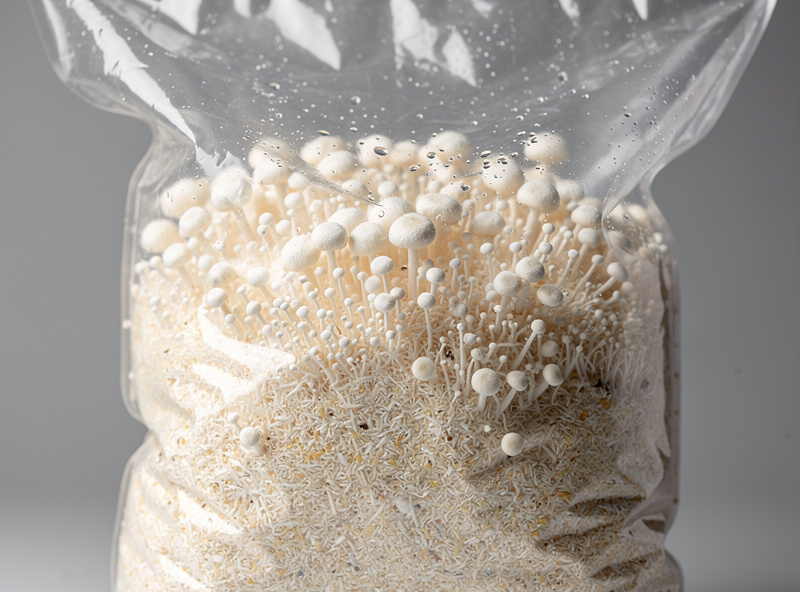
Pure coffee grounds, straw, and coir do not work for lion’s mane — in my own bench trials, yields on those substrates are a fraction of what the same block pulls on Masters Mix, and contamination odds climb too. The species needs the long-chain cellulose from hardwood and the protein boost from soy hulls to produce dense, photogenic fruiting bodies. If you do not have soy hulls, supplemented sawdust with wheat bran (5-10% by weight) is an acceptable substitute. The substrate guides cover specific brand recommendations for sawdust pellets and soy hulls available at agricultural supply stores.
Temperature: The Tightest Window of Any Common Species
Lion’s mane is the most temperature-picky of the common cultivated species. Colonization at 70-75°F is comfortable for most homes; pinning at 60-65°F is where most growers struggle. Above 70°F during pinning, the species often skips primordia entirely and produces aborted bumps that brown and die without forming spines. Below 55°F, fruiting stalls or freezes (the species pauses growth rather than dying).
The practical fix in warm climates is to pin and fruit in the coolest room of the house — basements, garages in fall and winter, or a small dedicated grow room with a thermostat-controlled cooling pad. A wine fridge with the temperature set to 62°F works for 1-2 bags at a time. The species rewards the effort: fruit aesthetics and yield jump noticeably when temperature stays in band. Dry and store harvested lion’s mane properly, explore sauna recovery protocols, and see the complete lion’s mane growing guide for full cultivation walkthrough. Browse growing equipment guides for specific cooling solutions.
Humidity and Fresh Air Exchange
Lion’s mane needs 85-92% humidity during fruiting — slightly lower than oyster setups (which run 92-95%). Above 95%, the spines mat together and develop bacterial wet spots; the surface goes glossy and fruits brown out within 48 hours. Below 80%, the spines tip-curl and the fruit develops “bald patches” where spines failed to elongate.
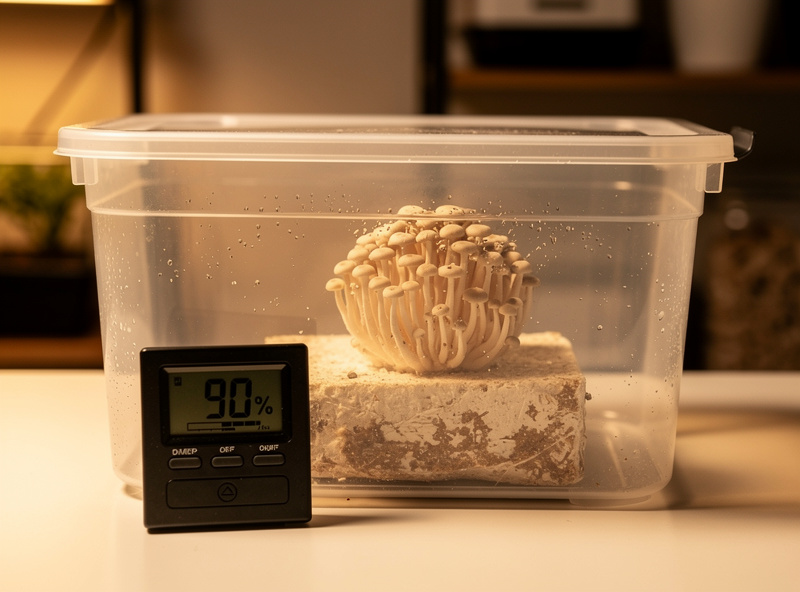
Fresh air exchange is the variable beginners under-supply most often. CO2 above 1,000 ppm during fruiting causes the bald-patch deformity and the long-stem deformity simultaneously — both are CO2 signatures, not humidity issues despite looking water-related. The solution is two to three 30-second fans per day with the chamber lid slightly cracked, plus four to six 1-inch FAE holes drilled into the side of any monotub. Avoid the common beginner FAE mistakes if your fruits are coming out misshapen.
Timeline and Realistic Yield
From inoculation, expect 14-21 days to full colonization, 5-7 more days for primordia to form, and 7-10 days from primordia to harvest. Total cycle: roughly 30-40 days for the first flush. A 5-pound dry-weight Masters Mix bag yields a primary flush of 1.0-1.5 pounds and a secondary flush 14-20 days later of 0.4-0.7 pounds. Third flushes are possible but typically not worth the bag space — start a fresh substrate instead.
Yield collapses fast if any single parameter slips. On my own bags, running pinning too warm has been the single biggest yield killer — a bag pinned at 75°F instead of the 60-65°F window has come in dramatically lighter than an identical bag held in range. Humidity above 95% costs yield too, through surface bacterial spotting that ruins fruits before they’re worth picking. The species is forgiving on substrate and aggressive on contamination resistance, but it punishes parameter drift. Cross-check the cobweb mold guide if a slow flush starts looking off — high humidity favors cobweb on lion’s mane just as much as oyster.
When to Harvest: The Spine-Length Test
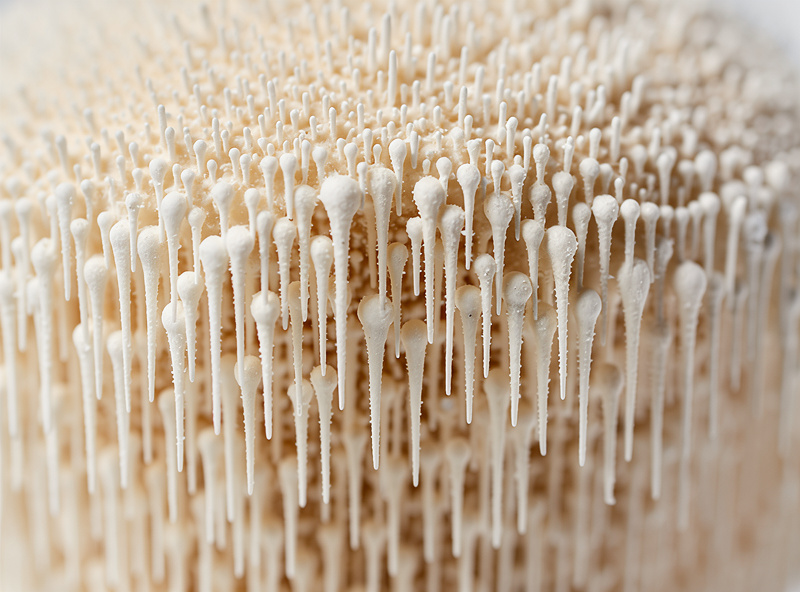
Harvest lion’s mane when the longest spines reach 0.5-1 cm — and never wait until they brown. The browning starts at the spine tips and travels upward; a fruit that has any tip-browning is past optimal harvest and will taste bitter and dry. The window from “ready” to “past peak” is about 36-48 hours, narrower than most cultivated species. A fruit picked too early (spines under 0.3 cm) is fine to eat but will weigh substantially less.
Cut the entire fruit at the substrate base with a clean knife in one motion — do not pull. A clean cut surface heals over and a second flush forms within 14-20 days from the same site. Pulling tears the substrate, opens a wound that’s slower to heal and easier for contamination to exploit, and noticeably hurts second-flush yield in my own experience. See more post-harvest contamination guides for handling between flushes.
Frequently Asked Questions
What temperature do lion’s mane mushrooms grow best at?
Lion’s mane fruits best at 60-70°F (15-21°C) and colonizes at 70-75°F (21-24°C). The species is more temperature-sensitive than oyster mushrooms — temperatures above 72°F during pinning often cause aborted primordia and the long-stem deformity. Wine fridges or basement rooms work well for home setups in warm climates.
What humidity do lion’s mane mushrooms need?
Lion’s mane requires 85-92% relative humidity during fruiting. Above 95% causes bacterial spotting and matted spines; below 80% causes spine tip curl and bald patches. The window is narrower than the 92-95% oyster mushrooms tolerate, so a calibrated hygrometer in the fruiting chamber is essential.
What is the best substrate for lion’s mane mushrooms?
Masters Mix — equal weights of hardwood sawdust pellets and soy hull pellets, hydrated to 60-65% moisture — is the reference substrate for lion’s mane. Published biological efficiency for this species varies widely by substrate and strain (peer-reviewed trials on rubber and bamboo sawdust report roughly 14-43% BE), but home-grower Masters Mix recipes with soy hull supplementation are widely reported to outperform that range substantially. Pure coffee grounds, straw, and coir all underperform on this species. Supplemented hardwood sawdust with 5-10% wheat bran is an acceptable substitute.
How long does lion’s mane mushroom take to grow?
From inoculation, expect 14-21 days for full colonization, 5-7 days for primordia formation, and 7-10 days from primordia to harvest. Total cycle is 30-40 days for the first flush. A second flush appears 14-20 days after the first harvest and yields about 30-50% of the first flush weight.
Why are my lion’s mane mushrooms growing long stems with no spines?
Long-stem deformity with little or no spine development is a CO2 signal — fresh air exchange is too low. Lion’s mane needs CO2 below 1,000 ppm during fruiting. Increase fans to 2-3 cycles per day for 30 seconds each, drill more FAE holes into the chamber, or crack the lid during fruiting to keep CO2 in range.
Can lion’s mane be grown outdoors?
Yes — lion’s mane fruits outdoors on hardwood logs (oak, beech, maple) inoculated with plug spawn in spring. Outdoor cycles take 6-18 months until first fruiting and produce one flush per year per log for 3-5 years. Indoor block cultivation is faster and more controllable but outdoor logs produce larger and more aesthetically distinct fruiting bodies.