
For cordyceps militaris, liquid culture beats agar on speed but agar beats it on cleanliness. Liquid culture inoculates a jar of cooked rice in 7 to 10 days; an agar transfer takes 14 or more, but lets you actually see contamination before it reaches your substrate. I run both, and which one I reach for depends entirely on how much I trust the culture in front of me.
That trade-off is the whole game with this species. Cordyceps is slow, light-hungry, and unforgiving of bacteria, so the culture you start from sets the ceiling for the whole grow. This guide is the propagation half of cordyceps cultivation — making, checking, and storing clean cordyceps cultures — not the fruiting walk-through. If you want the full grow-out, my guide to growing cordyceps militaris at home in jars covers substrate, light, and harvest.
Cordyceps Liquid Culture vs Agar: Which Should You Use?
Use liquid culture when you already have a clean, verified culture and want speed and volume; use agar when you are cleaning up a culture, isolating from a spore print, or you simply don’t trust what you’re holding. On my bench liquid culture inoculates a grain or rice jar in about 7 days versus 14-plus for agar, but agar’s flat plate is the only place you can actually see a green Trichoderma sector or a slimy bacterial smear before it rides into your substrate.
The honest framing is that they are not rivals — they are two stages of the same pipeline. I isolate and verify on agar, then expand the clean wedge into liquid culture for the speed. Skipping agar entirely is the single most common reason a cordyceps project quietly fails: the liquid looked cloudy-good, went into ten rice jars, and three weeks later half of them stalled with a sour smell.
What Is Liquid Culture for Cordyceps?
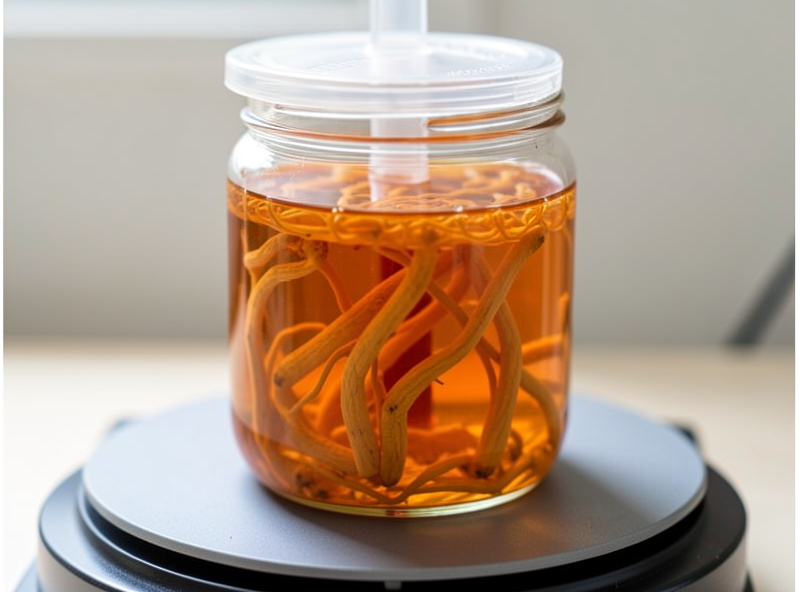
Liquid culture is live mycelium suspended in a sterilized sugar-water broth, kept in a jar with a self-healing injection port. For cordyceps militaris I run a light 4% solution — roughly 4 grams of light malt extract or honey per 100 ml of water — because this species sulks in anything too rich. A finished jar shows wispy, cloud-like growth and faint amber tint, not a thick scum on the bottom.
The appeal is dilution: one healthy jar of liquid culture can inoculate 10 to 20 substrate jars with a 3 to 5 ml shot each, far more reach than a single agar plate. I keep mine on a magnetic stir plate with a sterilized stir bar for a day or two after growth shows — the gentle vortex breaks the mycelium into thousands of fragments, so each milliliter you draw is loaded with viable starting points rather than one slow clump.
What Is Agar Work for Cordyceps?
Agar is the same nutrients set into a firm gel in a Petri dish, so mycelium grows as a visible flat colony you can inspect under good light. For cordyceps I pour light malt extract agar (LMA) at about 15 to 20 grams of agar per liter — the same broth recipe as my liquid culture, just gelled. A clean cordyceps colony on agar grows as fine, even, slightly orange-tinged mycelium with no zones, no fuzzy aerial tufts, and no off colors.
The reason agar is non-negotiable for serious work is that it is the only stage where contamination announces itself before it costs you anything. A green or blue-green sector is Trichoderma; a wet, shiny, yellow-edged patch with a sour note is bacteria; cobweb mold races across grey and loose. You cut a clean wedge away from any of that, transfer it to a fresh plate, and you have just rescued a culture instead of inoculating ten jars of trouble. My agar plate guide for beginners covers pouring and flame-sterile transfers in detail.
How Do You Make Cordyceps Liquid Culture Step by Step?
Mix a 4% light-malt broth, fill jars two-thirds full, fit a modified lid with a micropore-taped filter hole and an injection port, then pressure sterilize at 15 PSI for 30 minutes and cool fully. Inoculate from a clean agar wedge or an existing verified culture, never from an unverified syringe. Within a week of stir-plate agitation you should see the broth clouding evenly.
The order that keeps me clean: sterilize and cool first, flame the port and your needle, inject in front of the still-air box, then wipe the port with 70% isopropyl. I let the jar colonize at room temperature, 68 to 72°F, away from direct light during this stage. If by day 4 you see nothing and the broth stays crystal clear, the inoculation likely failed sterile rather than slow — restart rather than wait and hope.
How Do You Transfer Cordyceps on Agar?
Work in a still-air box or under a flow hood, flame your scalpel until it glows, cool it on clean agar for two seconds, then cut a 5 mm wedge of clean leading-edge mycelium and place it face-down on a fresh plate. Tape the lid, label it, and incubate at 68 to 72°F. A clean cordyceps wedge will show new growth ringing the transfer within 3 to 5 days.
The two mistakes I made early were taking wedges from old, tired centre growth instead of the active edge, and not cooling the scalpel — a too-hot blade cooks the mycelium and the transfer just sits there dead. Take from the outermost healthy ring, keep the dish open for the shortest possible time, and never breathe across an open plate. Sectoring like this is also how you stabilize a strain that has started fruiting weakly.
Spotting Contamination in Each Method
Agar shows contamination clearly and early; liquid culture hides it until it is often too late, which is exactly why the two belong together. On a plate you read color and texture directly. In a jar you are reading indirect signals: clear broth that should be cloudy, a layer of sediment that looks slimy rather than fluffy, gas bubbles, a cloudy ring climbing the glass, or — the giveaway — a sour, vinegary, or rotten smell when you crack the lid to inoculate.
My rule is simple and it has saved more grows than any single piece of gear: a liquid culture only earns the right to touch substrate if it traces back to a verified agar plate or to liquid I made from one. If a jar smells wrong, it goes in the bin, no matter how much it cost in time. For the full visual rundown of what each contaminant looks like, see my work on liquid culture versus spore syringe versus grain spawn, which covers the beginner starting points this species shares with the gourmet ones.
Storing Cordyceps Cultures Long Term
Store agar plates sealed and inverted in the fridge at around 39°F and they hold for 4 to 6 months; liquid culture keeps 2 to 3 months refrigerated before vigor drops. Agar is the better library because a single clean plate is your master copy — you can always pour fresh plates or start new liquid from it, where stored liquid culture slowly loses punch and eventually won’t take.
I keep my verified cordyceps strain as a couple of sealed agar slants in the back of the fridge and treat them as the backup I never inoculate from casually. For working stock I make fresh liquid culture off those slants a week before I need it. Cordyceps in particular tends to senesce — grow weaker and fruit less — over many generations, so I cull back to the oldest verified slant rather than transferring liquid-to-liquid indefinitely.
The Gear I Actually Use
The cordyceps culture lab is short on gadgets and long on discipline. The pieces that genuinely matter are a pressure canner to sterilize broth and agar jars properly, a still-air box or flow hood for transfers, and a magnetic stir plate to keep liquid culture broken up and evenly colonized. Everything else is consumables: jars, modified lids, micropore tape, 70% isopropyl, a scalpel, and an alcohol lamp or torch.
If you are building this out, a basic magnetic stir plate is the upgrade that most changed my liquid-culture results, and a set of jars with injection-port lids saves you modifying every lid by hand. As an Amazon Associate I earn from qualifying purchases; these are the categories of gear I run on my own bench.
Frequently Asked Questions
Can you grow cordyceps from liquid culture alone?
Yes, if the liquid culture is clean and verified. The risk is that liquid hides contamination, so I only use liquid culture that traces back to a clean agar plate. Starting from unverified liquid is the top cause of failed cordyceps grows.
How long does cordyceps liquid culture take to colonize?
A healthy cordyceps liquid culture clouds up and is ready to use in about 7 to 10 days at 68 to 72°F, faster with a magnetic stir plate. If the broth is still crystal clear at day 4, the inoculation likely failed rather than running slow.
Is agar necessary for cordyceps cultivation?
Agar is not strictly required but it is the only stage where you can see and cut away contamination before it reaches substrate. Serious growers isolate and verify on agar, then expand to liquid culture for speed and volume.
What broth recipe works best for cordyceps liquid culture?
A light 4% solution of malt extract or honey, roughly 4 grams per 100 ml of water, suits cordyceps militaris. This species sulks in rich broths, so keep it lean and pressure sterilize the jars at 15 PSI for 30 minutes.
How do you store a cordyceps culture long term?
Store sealed, inverted agar plates or slants in the fridge at around 39°F for 4 to 6 months as your master copy. Liquid culture keeps only 2 to 3 months before vigor drops, so make fresh working liquid from a stored plate when you need it.