
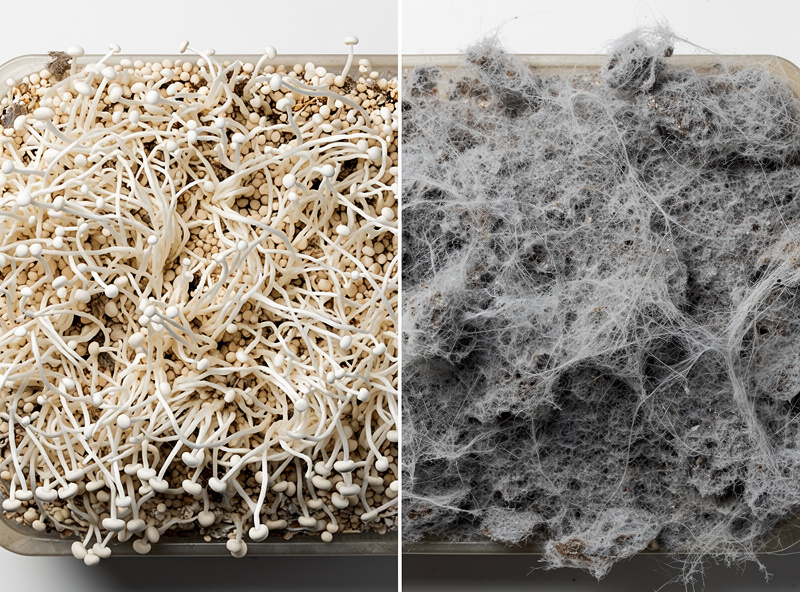
Cobweb mold spreads across a mushroom substrate in 24-48 hours as a fluffy gray-white veil with visible spider-web hyphae, while healthy mycelium grows slowly over 7-14 days as dense, bright-white, root-like strands that hug the substrate. The fastest visual giveaway is speed and texture: cobweb fluffs upward, mycelium builds outward.
Cobweb is one of five contaminants you will meet at home; the full identification and remediation playbook is in my mushroom contamination guide.
If you grow mushrooms long enough, you will eventually open a fruiting chamber and freeze for a moment, unsure whether the white fuzz on your substrate is a healthy colony or the start of a contamination event. The stakes are real — cobweb mold (Dactylium dendroides, sometimes Cladobotryum mycophilum) can overrun a tub in two days and ruin weeks of work. This guide walks through the seven concrete differences that let you tell the two apart, the rescue method that saves about 60% of caught-early infections, and the smell, touch, and time tests for when you are still not sure. The article was written by Kenny Nyhus Fadil, publisher of MycoMansion and the Sovereign Fortress hobbyist network.
What Is Cobweb Mold?
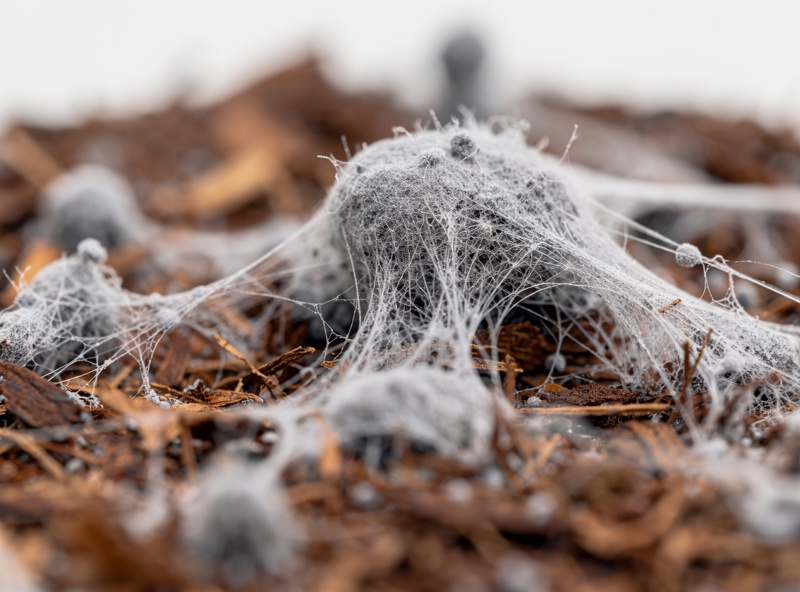
Cobweb mold is a fast-growing fungal contaminant caused most often by Dactylium dendroides or Cladobotryum mycophilum. It appears as a soft gray-white fluff with visible thread-like hyphae that lift upward from the substrate, looking remarkably like a spider’s web. In my own tubs, held at 90%+ humidity with weak fresh-air exchange, a dime-sized patch has covered a full 6-quart monotub within two days — that speed is usually the fastest tell versus mycelium. It’s not just anecdote: lab tracking of airborne Cladobotryum spore counts in a working mushroom growing room found conidia reaching maximum dispersal distances within 15 minutes of a patch being disturbed, with the surrounding air fully recirculated through the room’s ventilation inside the same window (Adie et al., Applied and Environmental Microbiology, 2006) — which is part of why one overlooked patch can seed a whole tent if you disturb it while inspecting.
The mold is opportunistic rather than aggressive in a sterile sense — it loses to healthy colonized mycelium on equal footing, but it thrives in the same warm, humid conditions that mushrooms need to fruit. That is why most growers see it in week three, right when humidity is peaked for pinning. It is a humidity and airflow problem more than a sterile-technique problem.
What Is Healthy Mushroom Mycelium?
Healthy mushroom mycelium is the vegetative growth phase of the fungus — a dense network of bright white hyphae that colonizes substrate before producing fruiting bodies. On grain spawn it forms tight, rope-like rhizomorphs; on bulk substrates it grows as a flat, hugging mat that progresses outward roughly 1-2 cm per day under good conditions.
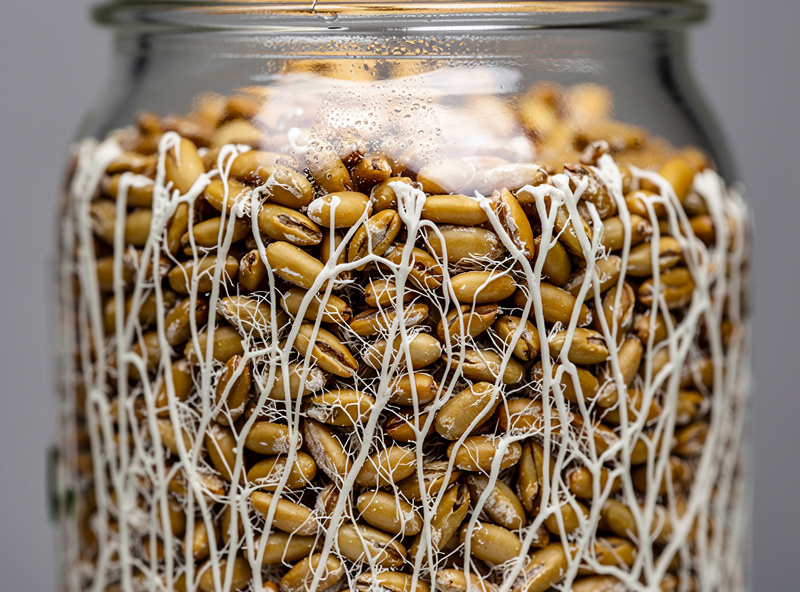
The defining visual signal is density and direction. Healthy mycelium is structurally tight — when you look at it under a phone macro lens, you see firm cordy strands or a smooth tomentose mat, not airy fluff. It also tends to grow toward the substrate, anchoring into food, rather than away from it. If your “mycelium” is rising upward into the headspace of a tub like a low fog, you are most likely looking at cobweb mold instead.
Seven Visual Differences Between Cobweb Mold and Mycelium
The fastest, most reliable way to call the difference is to compare seven visible features side by side. The table below distills the field tests experienced growers run before deciding whether to treat or toss a tub. None of these tests requires equipment beyond a good light, a phone camera, and a clean stir stick.
| Feature | Healthy Mycelium | Cobweb Mold |
|---|---|---|
| Color | Bright white, sometimes faint blue-green age tint | Gray-white to dingy gray, occasionally faint pink as it ages |
| Texture | Dense, cordy, root-like or smooth and tomentose | Loose, airy, fluffy — visibly thread-like at arm’s length |
| Growth direction | Outward, hugging the substrate | Upward, lifting off the substrate into headspace |
| Speed | 1-2 cm per day; full colonization 7-14 days | Visible expansion in 12-24 hours; covers a tub in 36-48 hours |
| Edge appearance | Defined leading edge with active hyphae tips | Diffuse, fading edge — looks like smoke at the boundary |
| Response to airflow | Unaffected by gentle fanning | Visibly disturbed — strands bend or collapse with a light puff |
| Smell | Sweet, earthy, fresh — like wet forest floor | Musty, slightly sour, sometimes faintly chemical |
If three or more rows lean toward the cobweb column, treat the tub as contaminated and act on it within the day. Cobweb does not pause while you decide — every hour you wait is a measurable percentage of substrate consumed.
How to Treat Cobweb Mold (Save vs Toss the Tub)
Treatment depends on coverage, and coverage is the whole game. If cobweb covers under 10% of the surface and pins have not yet formed, I reach for a 3% hydrogen peroxide mist plus a 30-minute fresh-air-exchange spike — in my own tubs that combination has saved more batches than it’s lost, but it isn’t a guarantee, and I’ve had a “clean” kill come back within a week more than once. Once coverage passes roughly a quarter of the surface I stop treating and toss; by then the mold has already eaten enough substrate that chasing a full recovery isn’t worth the risk of it spreading to a neighboring tub. For context on how stubborn this pathogen actually is: a 2024 peer-reviewed trial testing dedicated fungicides against Cladobotryum mycophilum in commercial button-mushroom production topped out at 81% control with the best-performing compound, and a widely used industry-standard fungicide landed around 61% (Chen et al., Journal of Fungi, 2024). If calibrated commercial fungicides applied by growers running the disease professionally cap out in that range, a home mist-and-vent rescue is worth trying early — but treat it as a real chance, not a sure thing.
The peroxide step is straightforward: fill a clean spray bottle with off-the-shelf 3% hydrogen peroxide (the brown bottle from any pharmacy), mist the affected area until visibly damp but not soaked, and immediately open the tub for 30 minutes of FAE while running a gentle fan two feet away. Peroxide breaks down to water and oxygen on contact, so it does not leave residue that harms healthy mycelium. Before doing any of this, review our cultivation and safety disclaimer — peroxide is mild but it is still a chemical, and ventilation matters.
Why Cobweb Mold Appears (Causes and Prevention)
Cobweb mold has three classic triggers: humidity above 95%, fresh air exchange under one full air swap per hour, and a substrate temperature held above 75°F (24°C) for more than a few hours. Hit two of those three at the same time and most tubs will eventually show cobweb regardless of how clean your inoculation technique was. It is a chamber-conditions problem, not a sterile-procedure problem.
Prevention is mechanical. Drill more FAE holes (six 1-inch holes per side on a 6-quart tub is a good baseline), reduce misting frequency, and aim for substrate temps in the 65-72°F (18-22°C) range during fruiting. The substrate you choose matters less than the chamber climate, but coir-based mixes do hold a little less surface moisture than straw, which marginally reduces the cobweb risk window. For the equipment side — fans, hygrometers, FAE schedules — see our mushroom growing equipment guides.
Smell, Touch, and Time Tests for When You Are Still Unsure
If the visual call is genuinely 50/50, three non-invasive tests resolve almost every borderline case in under five minutes. None of them require opening the tub for long, and none risk introducing new contamination if you wash your hands first.
The fan test. Hold a piece of cardboard six inches from the patch and wave it once gently. Cobweb strands will visibly bend, lean, or partially collapse. Healthy mycelium does not move. The smell test. Open the tub and inhale once briefly from a foot away — fresh sweet earth means mycelium, slightly sour or chemical-musty means cobweb. The 90-minute time test. Mark the patch boundary with a small piece of foil. If the boundary has visibly moved outward in 90 minutes, you are looking at cobweb. Healthy mycelium grows at a fraction of that speed and shows no change at the 90-minute scale.
If you are a first-time grower working through the most common errors and these tests still leave you uncertain, the conservative choice is to treat as contamination and toss. The cost of one wasted tub is small. The cost of letting cobweb spread to your next batch through reused gear is much larger.
Frequently Asked Questions
Can cobweb mold make you sick if you eat the mushrooms?
Cobweb mold itself is not classified as toxic to humans, but a contaminated grow is also unlikely to produce healthy fruits — the mold competes for substrate and degrades pin formation. Standard practice is to discard the substrate and not consume any fruits that grew alongside visible cobweb growth.
How fast does cobweb mold spread on a mushroom substrate?
Cobweb mold typically spreads at 12-24 hours per visible expansion phase and can cover a 6-quart monotub in 36-48 hours under high humidity and poor fresh air exchange. Healthy mycelium grows roughly 1-2 cm per day, which is at least ten times slower than active cobweb expansion.
Will hydrogen peroxide kill cobweb mold without harming mycelium?
A 3% hydrogen peroxide mist applied directly to a small cobweb patch breaks down into water and oxygen on contact and does not leave residue harmful to colonized mycelium. It works best on patches under 10% of the substrate surface with no pins formed yet. Even calibrated commercial fungicides tested against this pathogen in peer-reviewed trials only reach 61-81% control, so treat a home peroxide mist as a real chance worth taking early, not a guaranteed fix.
What is the difference between cobweb mold and mushroom mycelium hyphae?
Cobweb mold hyphae are visibly thicker, looser, and grow upward into the air as fluffy gray strands, while mushroom mycelium hyphae are tighter, denser, and grow outward across or into the substrate as bright white root-like cords or smooth mats.
Why does cobweb mold appear during the fruiting stage of mushroom growth?
The fruiting stage requires high humidity (90%+) and warm temperatures (65-75°F), which are also ideal conditions for cobweb mold germination from airborne spores. Most cobweb infections appear in week three, when the chamber climate is at peak humidity for pin formation.
Should I throw out my entire mushroom grow if I see cobweb mold?
Discard the substrate once cobweb covers roughly a quarter of the surface or more — by then it has consumed too much substrate to be worth chasing. Under 10% coverage with no formed pins, a peroxide mist plus an extended fresh-air-exchange spike is worth trying, though even dedicated commercial fungicide trials on this pathogen only reach 61-81% control, so treat any home rescue as a chance, not a guarantee.