
Automating a mushroom grow room means wiring the humidifier, fans, and lights onto controllers so the chamber holds its targets without you babysitting it — and the honest truth is that the right level of automation for a home grower is modest: a humidistat, a couple of timers, and smart plugs as fail-safes. After automating my own fruiting tent over several seasons, I keep my system deliberately simple, because every added device is another point of failure that can dump your humidity or cook a flush while you are at work.
This guide is about the control system as a whole — how to wire devices together, schedule them, and build in fail-safes — not about the sensors that feed it. For the monitoring and sensor side (what to measure, where to place probes, climate-data logging), read Smart Sensors for Mushroom Fruiting Chambers, which is the companion to this piece. This article sits under the complete home mushroom equipment guide.
What’s Worth Automating
Three things in a fruiting chamber benefit from automation: humidity, fresh-air exchange, and light. Humidity wants closed-loop control (a humidistat that turns the humidifier on and off to hold a setpoint). FAE and light are fine on simple repeating timers because they do not need feedback — you just want the fan cycling a few minutes per hour and the light on a day/night schedule. That split — closed-loop for humidity, open-loop timers for fan and light — is the whole architecture for most home setups.
What is not worth automating at home is temperature, usually — most growers pick a room that sits in the right range rather than building active heating and cooling, which is genuinely complex. Keep the system to the three levers that matter and you avoid the over-engineering trap. The grow does not need to be a smart-home project; it needs to hold humidity and swap air reliably, which the grow tent setup guide lays out at the hardware level.
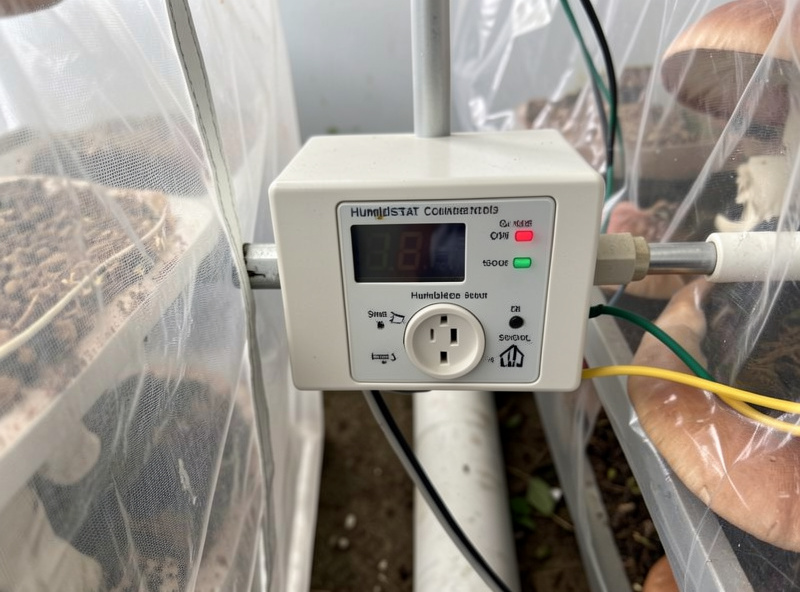
Closed-Loop Humidity Control
The heart of an automated chamber is the humidistat: it reads relative humidity and switches the humidifier to hold a band, say 88-92%. A dedicated humidistat controller with an outlet is the simplest version — the humidifier plugs into it, and it cycles power to keep the setpoint. This single device replaces you standing there with a hygrometer, and it is the highest-value automation in the whole grow.
Set a deadband so the unit does not chatter on and off every few seconds — turn the humidifier on below the low threshold, off above the high one, with a gap between. I pair the controller with the humidifier covered in the fruiting chamber humidifier guide, because the controller is only as good as the misting hardware it switches. A humidistat commanding an undersized humidifier still loses the battle against an open FAE fan; size the hardware to the job first, then let the controller manage it.
Timers, Smart Plugs, and Scheduling
For fan and light, simple repeating timers do the job. A cycle timer that runs the FAE fan a few minutes per hour and a daily timer for the 12-hour light schedule cover both. Smart plugs add app control and scheduling flexibility, which is convenient but not essential — a $10 mechanical cycle timer is more reliable than a Wi-Fi plug that loses its schedule when the router reboots.
If you do use smart plugs, pick ones that hold their schedule locally rather than depending on a cloud connection, so a brief internet outage does not leave your fan dead. As an Amazon Associate I earn from qualifying purchases. The point of automation is reliability while you are away; a device that needs the cloud to run a timer is the opposite of reliable. I keep the fan and light on dumb-but-dependable timers and reserve any smart gear for monitoring, not life-support functions.
Fail-Safes That Save a Flush
Automation fails. The humidifier tank empties, a plug dies, a fan seizes — and if the system has no fail-safe, you come home to a crashed grow. The cheapest insurance is a humidity buffer (moist perlite or a wet towel in the base) that holds the chamber for hours if the humidifier quits, smoothing over a refill miss. That passive buffer has saved more of my flushes than any clever controller.
Beyond that, I keep the system observable: a separate accurate hygrometer I can glance at confirms the automation is actually holding, because a controller reading off a drifted internal sensor will happily maintain the wrong number. The smart sensors and alerts in the sensors guide are how you catch a failure early; this control layer is what acts on it. The two together — sensing and actuation — are the full automation picture, and most home growers genuinely only need the simple version of each.
Wiring Devices Onto One Schedule
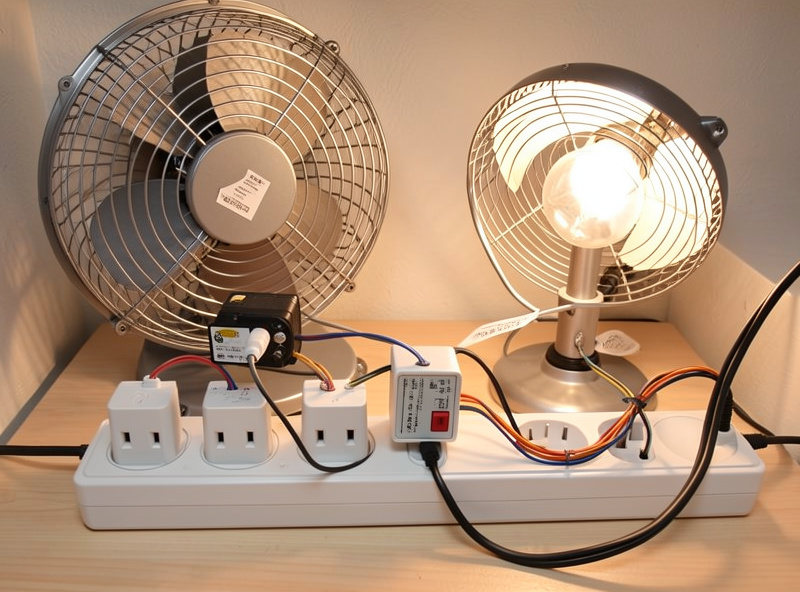
When you have more than one chamber or a few devices, the temptation is to run a tangle of separate timers and wall-warts. A cleaner approach is a single switched power strip or a small controller with multiple outlets, each on its own schedule — humidifier on the humidistat outlet, fan on the cycle outlet, light on the daily outlet. Grouping the loads keeps the wiring legible and makes it obvious at a glance whether a device is powered, which matters when you are troubleshooting a sagging chamber at 11 PM.
Mind the electrical load. A humidifier, a couple of fans, and lights together draw modest current, but everything in a fruiting room is running in a damp, high-humidity environment, so I keep connections off the floor, use outlets on a GFCI circuit, and never let a power strip sit where condensation can drip into it. Water and mains power in the same small space is the one safety line I do not blur — the chamber is humid by design, and the electronics have to live above and dry of that. Route cords so drips run away from connectors, and give the humidifier its own reliable outlet rather than daisy-chaining it through three adapters.
For multi-chamber setups, label everything. When five outlets feed five devices across two tents, an unlabeled strip becomes a guessing game the moment something fails. A few minutes with a label maker when you build the rig saves an hour of tracing wires when a fan dies mid-flush. This is dull, unglamorous discipline — and it is exactly the kind of thing that separates a grow room that runs untended from one that quietly fails the week you stop watching it.
Building It Up Without Over-Engineering
Start minimal and add only what a real problem demands. Step one is a humidistat on the humidifier — that alone transforms the grow from constant attention to occasional checks. Step two is timers on the fan and light. Step three, if you travel or run many chambers, is monitoring with alerts so you know remotely when something drifts. Most home growers stop at step two and fruit beautifully.
The failure mode I warn against is building a complex relay-and-microcontroller rig before you have fruited a single clean flush manually — you end up debugging electronics instead of learning to read your mushrooms. Master the manual chamber first; automate the parts that are genuinely tedious second. The same clean-process patience that runs my whole bench applies here: the lion’s mane colonizes in the tent on a humidistat, the sourdough rises in the kitchen, the salami loses weight in the curing chamber — four patient processes, each automated only as much as it actually needs. Commercial fruiting rooms run sophisticated PLC climate control; a home grow room is a humidistat, two timers, and a perlite buffer, and that is a feature, not a limitation.
When Scaling Up Justifies More Control
There is a real inflection point where heavier automation earns its place: when you run several chambers at once, or fruit species with genuinely different requirements side by side. One Martha tent on a humidistat is trivial; four tubs each wanting slightly different humidity and FAE is where manual management breaks down and you start missing things. At that scale, monitoring with alerts stops being a luxury and becomes the thing that lets you run the operation without living in the grow room.
Even then, I scale the sensing and alerting before I scale the actuation. Knowing a chamber has drifted lets me intervene; a fully automated rig that silently maintains a wrong setpoint is worse than a simple one that pings me to go look. The asymmetry matters — a missed alert costs a flush, but a confidently-wrong automated correction can cost several before you notice. So as the room grows, I add eyes faster than I add hands, and I keep the actuation dumb and dependable: the same humidistat-and-timer pattern, just replicated per chamber, with one monitoring layer watching the whole room.
The species split is the other driver. Oyster forgives a lot; lion’s mane and king oyster are pickier about CO2 and air. If you fruit a forgiving species, the manual-plus-humidistat setup is plenty for a long time. If you are pushing several demanding species in parallel, the per-chamber control plus monitoring starts paying for itself in saved flushes. Match the automation to the actual difficulty of what you are growing, not to how impressive the rig looks.
Related Equipment Guides
- Mushroom Growing Equipment: The Complete Home Setup Guide
- Smart Sensors for Mushroom Fruiting Chambers: Climate Automation
- Mushroom Fruiting Chamber Humidifier: Picking and Running One
- Mushroom Grow Tent Setup: Martha vs Vivosun vs Gorilla
- Best Grow Light for Mushrooms: Color and Schedule by Species