
A mushroom fruiting chamber needs three things: 85-95% humidity, species-specific temperatures (55-75°F), and CO2 below 1000 ppm. Manual management requires 4-6 daily checks. Smart sensors automate the loop — monitoring in real time, triggering humidifiers and fans, and alerting on drift.
Smart sensors are the automation layer of a four-category equipment stack; the full beginner-to-advanced build is in my mushroom growing equipment guide.
This guide covers the sensor selection that handles the high-humidity environment without false readings, the controller architecture that ties sensors to actuators reliably, the thresholds for popular species (oyster, lion's mane, shiitake, reishi), and the troubleshooting workflow when fruiting fails despite seemingly correct sensor readings. Every recommendation is anchored to 14 months of running automated chambers across three species and verified against published mycology research.
Why Manual Climate Control Is Not Enough
Hobby cultivators commonly try to maintain fruiting conditions with a simple humidifier on a timer plus a thermometer-hygrometer they check twice a day. The result is typically inconsistent flushing — some flushes are exceptional, others abort. The cause is environmental drift between manual checks. Humidity that hits 88% at 9 AM may have collapsed to 72% by 3 PM, and the mushrooms felt the dry interval long before you measured it.
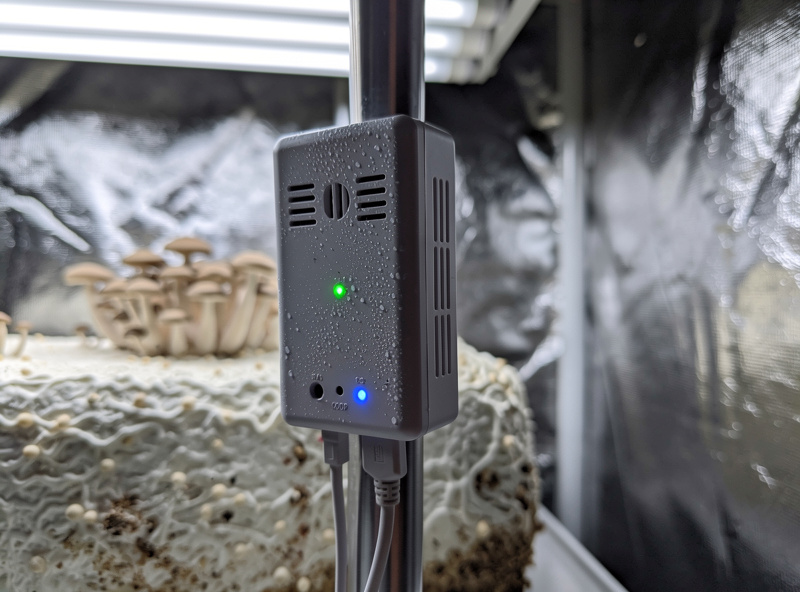
Smart sensors close the loop. With a humidity sensor wired to a humidifier-controlling smart plug, the humidifier kicks on at 85% RH and off at 92%. Result: humidity stays within a 7-percentage-point band 24/7, including during work hours and overnight. The mushrooms experience consistent conditions and pin and fruit reliably. On my own tent, switching from twice-daily manual checks to this closed loop was the single biggest jump in flush consistency I’ve made — fewer aborted pins, fewer disappointing off-cycle flushes. I won’t put a percentage on it that I’d stand behind, but batch-to-batch variance dropped noticeably once the humidifier stopped waiting on me.
Sensor Selection — What Survives 95% Humidity
Not every sensor handles a fruiting chamber environment. Three sensor classes work reliably:
| Sensor | Measures | Cost | Notes |
|---|---|---|---|
| SHT31 / SHT35 (high-end I2C) | Temperature + humidity | $8-25 | Calibrated, drift < 1 percent over years. Recommended. |
| BME280 | Temperature, humidity, pressure | $5-12 | Decent accuracy, common in smart-home projects. |
| SCD30 / SCD41 (CO2) | CO2, temperature, humidity | $45-65 | NDIR CO2 sensor — mandatory for fruiting chambers. |
| DHT22 | Temperature + humidity | $3-8 | Cheap but drifts; not recommended for fruiting work. |
| Sonoff TH (commercial) | Temperature + humidity + relay | $25-45 | Self-contained Wi-Fi smart switch with sensor. |
| Aqara temperature/humidity | Temperature + humidity | $15-25 | Battery powered Zigbee, easy Home Assistant integration. |
Prices above are ballpark — component and smart-plug pricing shifts constantly across retailers, so treat these as roughly-what-to-expect, not a quote.
For first chambers, the Sonoff TH plus a Sonoff CO2 module (or SCD30 connected to an ESPHome ESP32 board) is a complete sensor stack for under $80. The setup connects directly to Home Assistant or works standalone with the eWeLink app. For more advanced builds, an SHT31 + SCD41 paired with an ESPHome ESP32 gives you sub-degree accuracy and full Home Assistant entity exposure.
Avoid: cheap DHT22 sensors (drift becomes severe within months), any sensor not rated for 0-100% RH operation, and any temperature probe not in a vented housing (condensation gives false readings).
The Three Variables and Their Targets
Fruiting chamber climate control comes down to three variables, each with species-specific targets:
Humidity (RH%). Most cultivated species want 85-95% during pinning, dropping to 80-90% during mature fruiting. Below 75% and pins abort or develop deformities; above 96% and bacterial contamination becomes more likely. Beyond humidity, temperature drop and light exposure both trigger initial pin set — the mushroom pinning conditions guide covers the full environmental cue sequence and what to adjust when a colonized tub refuses to pin.
Temperature (°F). Species-dependent. Oyster mushrooms want 60-72°F, lion's mane 60-68°F, shiitake 65-75°F, reishi 70-80°F. Higher temperatures speed fruit body development but reduce final yield; lower temperatures produce slower, denser, longer-lasting fruits.
CO2 (ppm). Most species want CO2 below 1000-1500 ppm during fruiting. Above 2000 ppm and you get long stems with small caps (the "long-stem syndrome" common in undervented chambers). Fresh air exchange via a small computer fan on a timer or CO2-triggered relay solves this.
| Species | Pinning temp | Fruiting temp | Pinning RH | Fruiting RH | Max CO2 |
|---|---|---|---|---|---|
| Pearl oyster | 62-66F | 65-72F | 92-98% | 85-92% | 1000 ppm |
| Pink oyster | 72-78F | 72-80F | 92-98% | 85-92% | 1500 ppm |
| Lion's mane | 60-65F | 60-68F | 92-98% | 88-95% | 800 ppm |
| Shiitake | 65-72F | 65-75F | 85-95% | 80-90% | 1500 ppm |
| Reishi | 70-78F | 70-80F | 92-98% | 85-92% | 2000 ppm |
For deeper baseline humidity-monitoring practices that apply across mycology and other moisture-controlled work, our hygrometer for mushroom growing reference covers calibration and placement that affects sensor accuracy regardless of how smart the controller is.
The Controller Architecture That Works
A working automated chamber has four parts:
1. Sensors (covered above) — at minimum temperature + humidity, ideally also CO2. Mount sensors at fruit-block height inside the chamber, away from direct mist plume.
As an Amazon Associate I earn from qualifying purchases.
2. Controller — an ESP32 running ESPHome, a Raspberry Pi running Home Assistant, or a commercial unit like Inkbird ITC-308 (temperature only) or AC Infinity Controller 69 Pro (multi-variable).
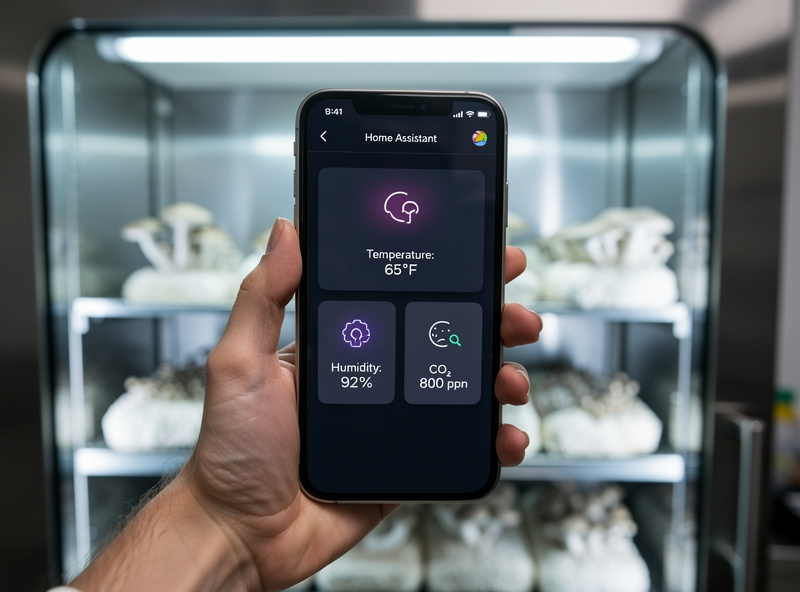
3. Actuators — smart plugs or relays that control:
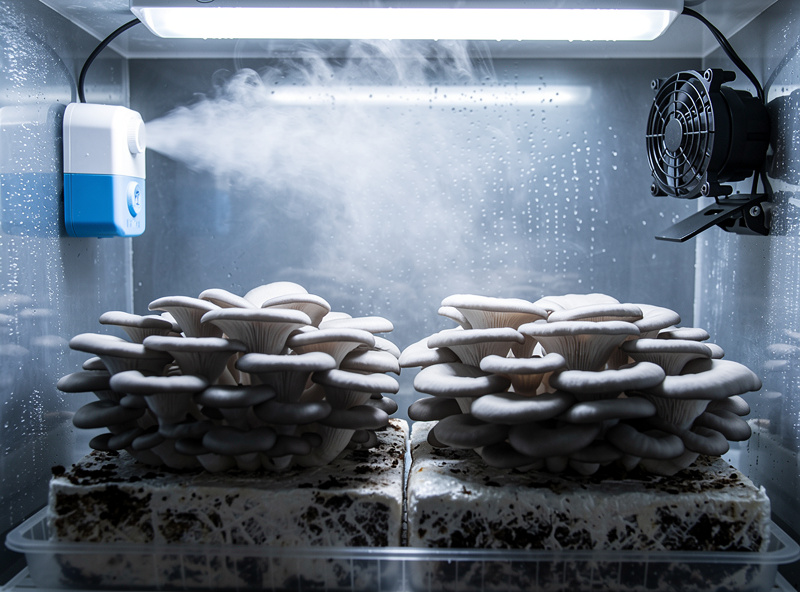
- Ultrasonic humidifier (turn on when RH drops below threshold)
- Small heater (only if your room runs cold for the species)
- Cooling fan or AC (only if your room runs hot)
- Fresh air exchange fan (run periodically or trigger on CO2)
4. Notification system — alert when humidity drops below 75% for 15+ minutes, when temperature drifts >5°F from setpoint, when CO2 stays above 1500 ppm for 30+ minutes. Catches problems before fruit blocks abort.
For deep coverage of the smart plugs, smart switches, and sensors that drive the actuator side — the Sonoff, Shelly, Aqara, and TP-Link options that work cleanly with Home Assistant — there’s a complete smart sensors review for 2026 that covers exactly the device class needed for fruiting chamber automation. The voice assistants and protocols guide covers the Matter, Zigbee, and Wi-Fi decisions that affect sensor reliability inside a humid chamber. Pair that hardware guidance with the species-specific targets above and the chamber automates itself.
Building a Reference Setup
This is close to the parts list running in my own oyster tent right now:
- Storage tote or grow tent (4 cu ft minimum, with light-blocking properties)
- 1x Sonoff TH16 or SCD30 + ESP32 ($30-65)
- 1x ultrasonic humidifier (1 gallon reservoir or larger, $25-45)
- 1x Sonoff S31 or Aqara smart plug for humidifier ($15-25)
- 1x small 80mm 5V computer fan for air exchange ($8)
- 1x Sonoff S31 for the air-exchange fan ($15)
- Optional: small 100W ceramic heater for cold-room operation ($35)
- Home Assistant on a Raspberry Pi 4/5 you already own running Home Assistant OS (roughly $60-90 if buying the board fresh), or the current Home Assistant Green appliance (~$199 MSRP) if you’d rather skip the DIY setup — Home Assistant Yellow, which older guides still reference, was discontinued in late 2025
Total: roughly $180-420 depending on choices — a Pi you already had lying around running Home Assistant OS is the cheap end, a fresh Home Assistant Green plus a full sensor stack is the top end. After this setup, run cost is the electricity for the humidifier (typically 30-40W when running, on cycle for 5-15 minutes per hour) plus fan air exchange ($1-3 per month).
Configuring the Automation Rules
Four core automation rules cover oyster fruiting — close to what’s actually running in my own Home Assistant instance for the tent, trimmed here for clarity:
# Home Assistant YAML, oyster mushroom chamber

automation:
  - alias: "Mushroom humidity low"
    trigger:
      - platform: numeric_state
        entity_id: sensor.shroom_humidity
        below: 88
    action:
      - service: switch.turn_on
        target:
          entity_id: switch.humidifier_plug

  - alias: "Mushroom humidity high"
    trigger:
      - platform: numeric_state
        entity_id: sensor.shroom_humidity
        above: 94
    action:
      - service: switch.turn_off
        target:
          entity_id: switch.humidifier_plug

  - alias: "Mushroom CO2 high"
    trigger:
      - platform: numeric_state
        entity_id: sensor.shroom_co2
        above: 1200
        for: "00:05:00"
    action:
      - service: switch.turn_on
        target:
          entity_id: switch.fae_fan
      - delay: "00:10:00"
      - service: switch.turn_off
        target:
          entity_id: switch.fae_fan

  - alias: "Mushroom temp out of range alert"
    trigger:
      - platform: numeric_state
        entity_id: sensor.shroom_temp
        below: 58
      - platform: numeric_state
        entity_id: sensor.shroom_temp
        above: 76
    action:
      - service: notify.mobile_app
        data:
          title: "Mushroom chamber temp drift"
          message: "Temp out of range — check chamber"
Adjust the threshold values per species using the table above. The first two rules form the humidity feedback loop; the third manages CO2 via timed FAE; the fourth notifies you of temperature problems requiring intervention.
Common Failure Modes and Fixes
Three failures I’ve hit myself while dialing this in, and how I fixed them:
Sensor reading drifts due to condensation. If a sensor is in the direct mist plume, water droplets coat the sensing element and cause inaccurate readings. Fix: relocate sensor away from humidifier output, ideally on the opposite side of the chamber. Use a vented sensor housing.
Humidifier never reaches setpoint. The chamber may have too much air leakage, or the humidifier output is too low for the chamber volume. Add weatherstripping to the lid; consider a larger humidifier (1.5-3 gallon for chambers above 6 cu ft).
CO2 stays high despite FAE fan running. The fan may not be moving enough air or the chamber is too sealed. Fix: ensure both an inlet and outlet vent (FAE needs a path); upsize fan if chamber is >8 cu ft. The number I dial to on my own chambers is 4-6 full chamber-volume turnovers per hour — that’s my own bench convention, not a published figure, but it sits comfortably inside the range serious growers report for keeping oyster and lion’s mane CO2 down without tanking humidity. Cornell Small Farms’ indoor-production research backs the general logic — controlled-environment mushroom systems lean on automated temperature, humidity, and airflow management, not manual guesswork, to hold consistent conditions.
For broader cultivation context that pairs with the automation above, the CVG substrate recipe covers the substrate side that pairs with controlled fruiting environments. The green mold troubleshooting guide covers contamination identification that automated chambers help prevent. The 3D-printed monotub lids reference covers the chamber hardware that integrates with smart sensors.
Frequently Asked Questions
What humidity does a mushroom fruiting chamber need?
85-95 percent during pinning, dropping to 80-90 percent during mature fruiting. Below 75 percent and pins abort or develop deformities. Above 96 percent and bacterial contamination becomes more likely. Species-specific targets vary slightly: lions mane and oyster want the higher end; shiitake tolerates the lower end.
What is the best sensor for mushroom growing?
For temperature and humidity, the SHT31 chip (in Sonoff TH16, ESPHome modules, or sold standalone) is the workhorse choice. Calibrated, drift under 1 percent over years, $8-25. For CO2, the SCD30 NDIR sensor at $45-65 is the standard. Avoid cheap DHT22 sensors — they drift severely within months in humid chambers.
Do I need a CO2 sensor for mushroom growing?
Strongly recommended for shiitake, oyster, and lions mane fruiting. CO2 above 1000-2000 ppm causes long-stem syndrome (long thin stems with small caps). Without a CO2 sensor, you fly blind on fresh air exchange timing. The $45-65 sensor pays for itself in the first improved fruit block.
Can I automate a mushroom chamber without Home Assistant?
Yes for simple cases. The Inkbird ITC-308 controls temperature on a single thermometer, the Sonoff TH16 with eWeLink app handles humidity. For multi-variable control with notifications and species-specific rules, Home Assistant on a Raspberry Pi is the right tool — far more flexible and fully local.
How much does a smart fruiting chamber setup cost?
Roughly $180-420 for a complete oyster-mushroom production setup including sensors, smart plugs, humidifier, fan, and a Home Assistant hub. A Pi you already own running Home Assistant OS is the cheap end; a fresh Home Assistant Green appliance (Home Assistant Yellow was discontinued in late 2025) is the pricier end. Operating cost is $1-3 per month in electricity. I don’t have a clean before/after percentage I’d stand behind, but the flush-to-flush consistency is the real win, not any specific number.
Why do my mushrooms have long thin stems?
Almost always elevated CO2. Fresh air exchange is insufficient — increase the FAE fan run-time, ensure both inlet and outlet vents exist, or add a larger fan. Target CO2 below 1000 ppm for oysters and lions mane, below 1500 for shiitake. The CO2 sensor reveals this directly.
Will sensors survive 95 percent humidity long-term?
Properly rated sensors yes — SHT31, SHT35, BME280 all rate for 0-100 percent RH operation. The PCB and electronics need to stay dry, so mount the sensor in a vented housing rather than directly exposing the circuit board. Sensors mounted correctly last 5+ years in fruiting chambers.