
The four most dangerous morel look-alikes are false morel (Gyromitra esculenta), early false morel (Verpa bohemica), elfin saddle (Helvella species), and stinkhorn fungi. The single most reliable test: a true morel is completely hollow from the cap tip through the base of the stem when sliced vertically (making a spore print adds a second verification layer). Anything cottony, chambered, or solid inside is NOT a true morel — do not eat it.
Life-safety note: the cross-section test is the single best field check, but no visual test is a substitute for confirmed identification. If you are unsure, do not eat it — see the what to do when unsure section below.
Morels are one of five deadly look-alike pairs every forager should memorise; the full beginner-safety playbook is in my mushroom foraging guide.
False morel poisoning is documented but genuinely dangerous when it happens: the National Poison Data System logged 703 Gyromitra-related exposure calls across North America between 1999 and 2016, and NAMA’s toxicology program tracks it as its own recognized poisoning syndrome — the toxin (gyromitrin, which metabolizes into monomethylhydrazine, the same compound used as rocket fuel) causes serious liver, kidney, and nervous-system damage, and historical mass-poisoning events in Europe have been fatal. The visual differences between real and false morels are subtle if you only know the basics. The breakdown below covers the four most common look-alikes with the field tests that actually distinguish them. Written by Kenny Nyhus Fadil. This article is general foraging information — review our cultivation and foraging safety disclaimer before consuming any wild mushroom.
What a True Morel Actually Looks Like
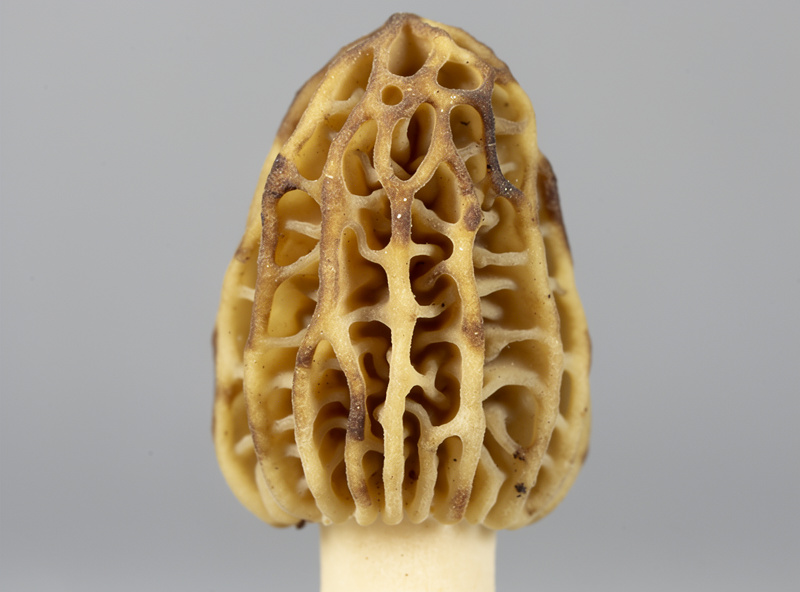
True morels (Morchella species) have a honeycomb-pitted cap with vertical ridges that form a regular grid pattern of small recesses. The cap shape is conical to ovoid — pointed at the top, rounded at the bottom — and the cap attaches directly to the stem at the base of the cap, with no skirt or hanging tissue. Color ranges from pale tan to dark gray-brown depending on species and age.
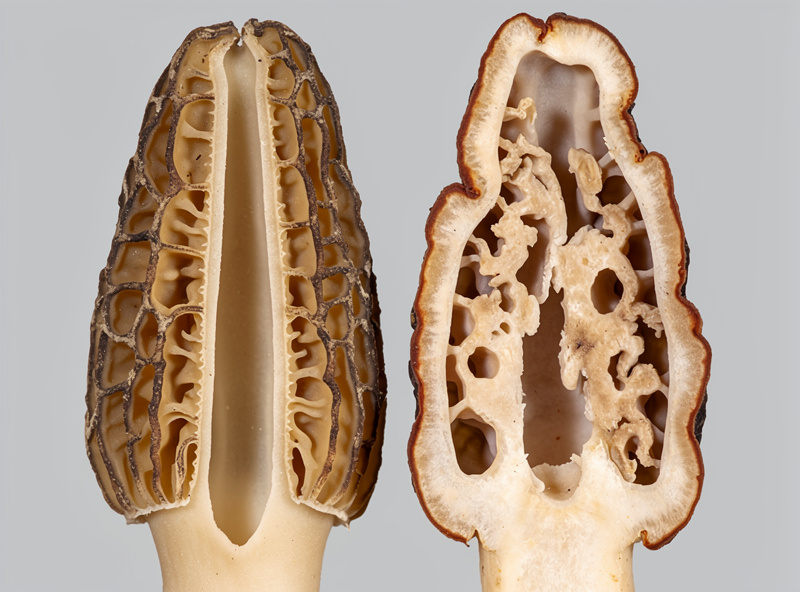
Most importantly, true morels are completely hollow inside. Slice one vertically from cap tip to stem base and you see one continuous empty chamber — no cottony fibers, no internal walls, no chambered structures. On its own this is the single most useful field test against the dangerous look-alikes — every one of the toxic species below fails it. The hollow interior is uniform across all Morchella species and is the most consistent visual marker between real morels and toxic look-alikes.
Look-Alike #1: False Morel (Gyromitra esculenta)
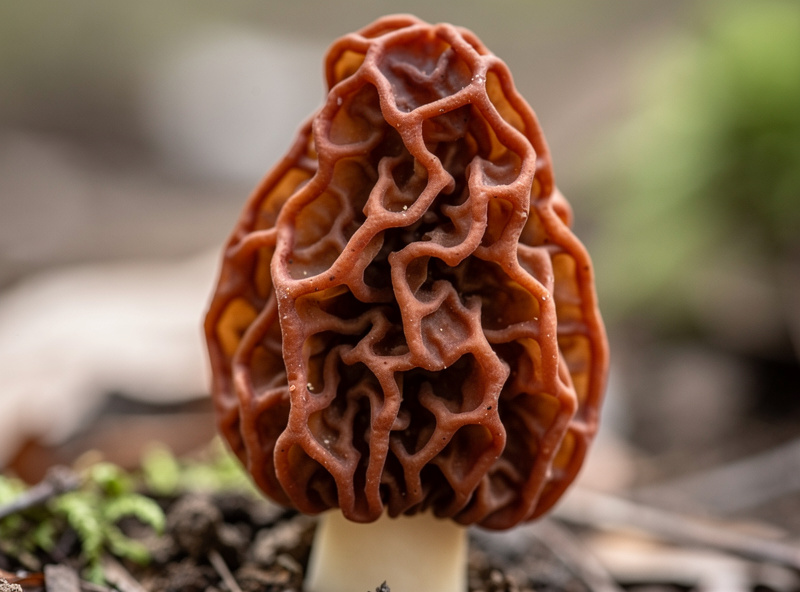
False morel is the most dangerous look-alike and the one most often confused with the real thing. The cap is wrinkled or convoluted in a brain-like or saddle-like pattern rather than a regular honeycomb of pits — there are no clear vertical ridges forming uniform pockets. Color is typically reddish-brown to dark mahogany, occasionally near-black. The cap shape is irregular and lobed rather than conical.
The interior test is decisive — slice a Gyromitra vertically and you find a chambered, partly cottony structure with multiple irregular cavities and tissue partitions. Never one clean hollow chamber. Gyromitra contains gyromitrin, which the body metabolizes into monomethylhydrazine — the same compound NAMA’s toxicology program notes has been used as rocket fuel. Onset is typically 6-12 hours after ingestion, though the documented range runs as wide as 2-24 hours: severe nausea, vomiting, diarrhea, headache, and in serious cases liver damage, kidney injury, and hemolysis. North American poison-center data shows fatalities are rare with prompt treatment, but historical mass-poisoning events (mostly older Eastern European cases, often among people who prepared the mushroom for others) have been fatal — this is not a toxin to gamble on. Some cultures boil and strain Gyromitra anyway, but the practice is genuinely dangerous and not recommended for casual foragers.
Look-Alike #2: Early False Morel (Verpa bohemica)
Verpa bohemica appears 2-3 weeks before true morels in the same habitat — often the first “morel-shaped” fungus a forager finds in spring, which is exactly why it gets eaten by mistake. The cap is wrinkled like a thimble or skirt, hanging loosely from the top of the stem rather than attaching at the cap base. The cap is typically yellow-brown and hangs free around the stem.
The defining feature: Verpa attaches to the stem only at the cap apex (the top), hanging loosely like a thimble, with cotton-candy-like wisps of flesh inside rather than a clean hollow chamber. Lift any morel-shaped fungus and look at how the cap meets the stem. If the cap is loose around the stem with a gap underneath, it is a Verpa. True morels have the cap fused to the stem all the way down to the cap base. Verpa’s toxicity is genuinely disputed in the mycological literature — NAMA groups it under the same gyromitrin-syndrome watchlist as Gyromitra and some Helvella species, though the toxin level is unconfirmed and reactions vary widely between individuals, from no symptoms to gastrointestinal upset and loss of coordination. That inconsistency is exactly why it’s not worth the risk — do not eat it. See visual identification guides for similar pattern recognition skills.
Look-Alike #3: Elfin Saddle (Helvella species)
Elfin saddles look superficially morel-shaped from a distance — irregular cap on a tall white stem — but the cap is saddle-shaped or three-lobed rather than honeycomb-pitted. Helvella crispa has a creamy-white wavy saddle cap; Helvella lacunosa is gray-black with a fluted stem. They tend to grow later in the season than morels and in slightly different habitats (paths, edges, disturbed soil rather than under specific tree species).
The fluted, deeply ribbed stem is the giveaway on Helvella — true morels have smooth or slightly textured stems but never deeply fluted with prominent vertical channels. Several Helvella species, including H. crispa and H. lacunosa, are documented to carry gyromitrin or gyromitrin-like hydrazines and cause gastrointestinal symptoms when eaten raw; some older guides listed them as edible when cooked, but current sources have walked that back, and there is research raising concern that repeated exposure to gyromitrin-type compounds over years carries long-term neurological risk. That’s not a trade worth making for a wild mushroom that isn’t even a true morel. If the cap is a saddle or three-lobed shape rather than a clear pitted honeycomb, walk away.
Look-Alike #4: Stinkhorn (Phallus and Mutinus species)
Stinkhorns are the easiest of the look-alikes to identify once you know about them — they smell like rotting meat. The smell is intentional (it attracts flies that distribute the spores), and it is unmistakable from several feet away. The cap is dark green-olive with a slimy spore mass coating it, and the stem is white and spongy. The shape can superficially resemble a morel from a distance, especially Phallus impudicus.
If you are downwind and the mushroom you are looking at smells like a dumpster, it is almost certainly a stinkhorn. Stinkhorns are not particularly toxic, but no one would consider eating one — the smell-and-slime combination is its own deterrent. They are common in mulched gardens, wood-chipped paths, and disturbed forest floor. Mention this to anyone you teach to forage; the smell test prevents this category of mistake instantly.
The Five Field Tests for Morel ID
Run all five tests on every fruiting body you intend to eat — not just one or two. Foragers who skip tests because “it looks like a morel” are exactly the demographic that ends up in the ER. The tests take 30 seconds each and rule out every common look-alike when used together. Bring a small knife and a paper bag, never a plastic one.
| Test | True morel result | What it rules out |
|---|---|---|
| 1. Slice vertically | One clean hollow chamber from cap tip to stem base | Gyromitra (chambered), Verpa (loose cap) |
| 2. Cap-to-stem attachment | Cap fused to stem at the cap base | Verpa (attaches only at cap top) |
| 3. Cap pattern | Honeycomb pits with vertical ridges | Gyromitra (brain-like), Helvella (saddle-shaped) |
| 4. Stem texture | Smooth or slightly mealy | Helvella (deeply fluted) |
| 5. Smell test | Mild earthy / nutty | Stinkhorn (rotting meat) |
When You Are Still Unsure
The single best answer to “is this a morel?” is to NOT eat the one you are unsure about. Take photos from three angles (whole mushroom, cap close-up, vertical cross-section), post them to a dedicated regional foraging Facebook group or to r/MushroomID with substrate and habitat info, and get expert confirmation. Real morels appear in waves — if you see one, you will see more. Skipping one questionable specimen costs nothing.
Spore prints help on some species but are less useful for morels because the morphological tests above are already decisive. The cross-section test alone catches essentially every morel-vs-Gyromitra confusion, but run all five tests together anyway — a single test is a good filter, not a guarantee, and the cost of being wrong here is real illness. Any cultivator transitioning into wild foraging should also study visual fungal ID patterns — the same skills that distinguish healthy mycelium from contamination apply to wild mushroom identification, and avoiding the seven beginner mistakes in cultivation reinforces careful observation habits in foraging too.
Frequently Asked Questions
What is the most reliable test for telling a real morel from a false morel?
Slice the mushroom vertically from cap tip to stem base. A true morel is completely hollow inside — one continuous empty chamber. False morels (Gyromitra) and elfin saddles (Helvella) have chambered, cottony, or solid interiors, and Verpa has cotton-candy-like wisps inside. It’s the single most useful field test, but run all five tests together rather than relying on one alone.
Are false morels deadly?
False morels (Gyromitra esculenta) contain gyromitrin, which the body metabolizes into monomethylhydrazine, the compound NAMA’s toxicology program notes has been used as rocket fuel. Symptoms — nausea, vomiting, headache, and in serious cases liver and kidney damage — typically appear 6-12 hours after ingestion (documented range 2-24 hours). North American poison-center data shows fatalities are rare with prompt treatment, but historical mass-poisoning events have been fatal. Sensitivity varies between individuals — never test tolerance by eating one.
Can you eat false morels if you cook them?
Some cultures boil and strain Gyromitra and report eating it without immediate harm, but the toxin is volatile and partially water-soluble — boiling reduces but does not eliminate it. Repeat exposure is linked to cumulative liver damage. Casual foragers should never eat false morels regardless of preparation method.
How do you tell a real morel from a Verpa?
Look at the cap-to-stem attachment. True morels have the cap fused to the stem at the bottom of the cap. Verpa bohemica caps attach only at the very top of the stem, hanging loosely like a thimble with a visible gap underneath and cotton-candy-like wisps inside instead of a clean hollow chamber. Lift the cap edge with a finger — if it lifts freely from the stem, it is a Verpa.
When do real morels appear compared to false morels?
Verpa bohemica typically appears 2-3 weeks before true morels in the same habitat. Gyromitra esculenta and most Helvella species fruit in roughly the same window as true morels. The early arrivals are often the dangerous ones — being the first morel-shaped fungus a forager sees in spring is exactly why look-alikes get mistakenly collected.
What should I do if I think I ate a false morel?
Call Poison Control immediately (1-800-222-1222 in the US) and seek emergency medical care if symptoms appear. Bring a sample of the mushroom (or photos) for identification. Symptoms typically appear 6-12 hours after ingestion, sometimes as fast as 2. Do not wait for symptoms to escalate — gyromitrin poisoning is serious and earlier treatment significantly improves outcomes.