
A still air box (SAB) is the right call for hobby growers running under 20 jars per month — it costs $30-60, takes 30 minutes to build, and gets contamination rates under 5% with practice. A laminar flow hood is necessary above that volume or for liquid culture and agar work, where the SAB simply cannot compete with the constant HEPA-filtered airflow.
The SAB-vs-flow-hood decision is one of fourteen equipment choices in a complete home lab; the full bill of materials is in my mushroom growing equipment guide.
The “do I need a flow hood?” question kills more first-month mycology budgets than any other purchase. New growers see flow hood photos on Reddit and assume the SAB is a compromise. It is not — it is the right tool for a different job. The decision below walks through volume, technique type, budget, and noise so you can pick once and stop second-guessing. Written by Kenny Nyhus Fadil, publisher of MycoMansion.
What Is a Still Air Box?
A still air box is a sealed plastic container with two arm holes that lets you do inoculation and transfer work in a small enclosed volume of motionless air. The principle is simple: airborne contamination spores stay suspended in moving air — a principle that applies equally to hygrometer selection, 3D-printed monotub lids, and smart fruiting chamber sensors. Stop the air movement and the spores settle on surfaces in roughly 60-90 seconds, leaving a clean working window above the floor of the box.
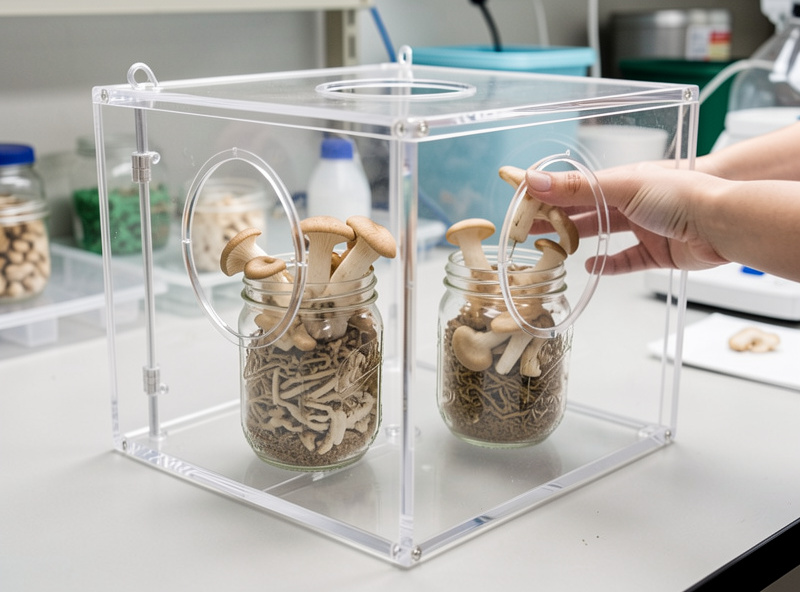
The standard build is a 27-66 quart clear plastic tote with two 4-inch holes cut for arms, sometimes with a piece of clear acrylic lid for visibility. Total cost is $25-50 depending on whether you buy the bin new and which size you choose. A SAB takes 20-40 minutes to build with a hole saw or razor knife. Done well, in my own early transfers it turned a habit of losing jars regularly in open air into an occasional miss — the box itself doesn’t guarantee anything, but it removes the single biggest contamination variable a beginner controls.
What Is a Laminar Flow Hood?
A laminar flow hood is a powered cabinet that pushes HEPA-filtered air across the work zone in a smooth horizontal sheet. By EPA’s definition, a true HEPA filter removes at least 99.97% of particles at 0.3 microns — the hardest particle size to trap, which means anything larger or smaller is caught with even higher efficiency (US EPA, What Is a HEPA Filter?). That range comfortably covers the spore sizes that cause most cultivation contamination. Anything you place into the airstream is bathed in clean air for the entire duration of the work session, no settling time required.
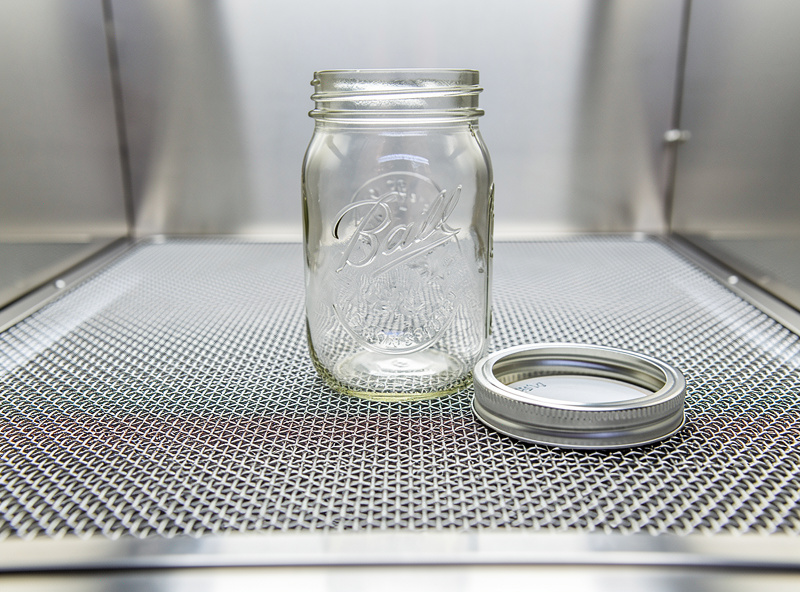
A 24-inch HEPA flow hood from a budget mycology supplier runs $300-500. A DIY build using a residential HEPA filter and a properly sized box fan lands around $150-200 in parts and takes a weekend. Commercial-grade units (24-36 inch professional benchtop hoods) run $700-1,500. They are quieter than a SAB feels (the air movement gives you confidence), easier on the back, and effectively unlimited in throughput — the constraint becomes how fast you can flame-sterilize tools between transfers, not air quality.
When the Still Air Box Wins
For the large majority of home growers, the SAB is the correct choice. The sweet spot is hobbyists running 5-20 jars per month, mainly grain spawn inoculations and substrate-to-spawn work, with no plans to dive into agar plates or liquid culture. In my own experience the learning curve is short — once you learn to keep your hands moving slowly and not fan air across the work zone, the failure mode is technique, not equipment.
Cost is the obvious argument. A $40 SAB pays for itself on the second jar you save from contamination. The non-obvious argument is portability — you can store a SAB on a shelf and use it on the kitchen counter, then wipe it down and put it away. A flow hood lives in your space. Browse our mushroom growing equipment guides for specific SAB build instructions and bin recommendations.
When the Flow Hood Wins (And the SAB Does Not Cut It)
Three scenarios push you out of SAB territory. First, agar work — pouring plates and isolating cultures requires extended hands-in-the-zone time that a SAB cannot reliably provide because spores eventually drift in through the arm holes. Second, liquid culture — vials and syringes need long sterile transfer windows and frequent re-sterilization between draws. Third, volume above 20 jars per month — the cumulative open-time across that many jars stacks the contamination odds against the SAB. When agar work is the next step, the mushroom agar plate guide covers medium preparation, pouring technique, transfer workflow, and how to read a plate for clean versus contaminated growth.
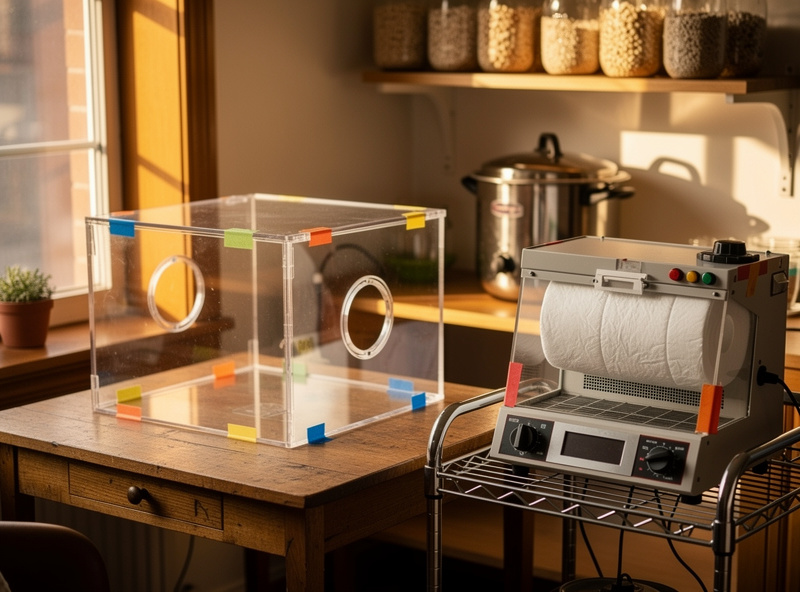
The flow hood unlocks workflows the SAB cannot. Spore-to-LC, LC-to-grain, isolation on agar from a contaminated tub, and storage of master cultures all become reliable. A grower who plans to take cultivation past oyster-on-coffee-grounds eventually needs one — but eventually is not month one. Most growers correctly hit “eventually” around month 6-12, by which time they know their actual workflow.
The Budget vs Volume Decision
The cleanest decision rule: if your projected monthly jar throughput is below 20 and you are not doing agar or LC, the SAB is correct and the flow hood is overkill. Sterile transfer equipment only works if your substrate was properly sterilized first — the pressure cooker mushroom sterilization guide covers run time, PSI, jar loading, and the most common sterilization failures. If you are doing agar, LC, or above 20 jars/month, the flow hood is correct and the SAB will silently bottleneck your contamination rate. The middle case (10-20 jars + occasional LC) goes either way — most growers in that bracket build a DIY flow hood for $150-200 rather than buy a $400 commercial one.
Per-tub cost matters too. A SAB is nearly free to run after the initial build — a bit of isopropyl and the occasional replacement bin over years of use. A flow hood costs more up front but effectively nothing per use once it’s running. Most home growers never run enough volume for that upfront cost to actually pay for itself against a SAB. A successful first-time grower working through the most common errors and avoiding the seven beginner mistakes rarely needs more than a SAB for the entire first year.
Comparison Table: Still Air Box vs Flow Hood
| Feature | Still Air Box | Laminar Flow Hood |
|---|---|---|
| Cost (DIY) | $25-50 | $150-200 |
| Cost (commercial) | n/a — DIY only | $300-1,500 |
| Build time | 20-40 minutes | 4-8 hours (DIY) |
| Best for jar volume | Up to 20/month | Unlimited |
| Agar work | Marginal — high failure | Reliable |
| Liquid culture transfers | Marginal | Reliable |
| Storage / portability | Lives on a shelf | Permanent footprint |
| Noise level | Silent | 55-70 dB (a window AC) |
| Beginner contamination risk | Noticeably higher, drops fast with practice | Low from day one |
| Practiced-grower contamination risk | Low, technique-dependent | Lowest of the two |
How to Decide in Under 60 Seconds
Three questions resolve almost every case. (1) Will you do agar plates or liquid culture in the next six months? Yes → flow hood. No → keep reading. (2) Do you plan to run more than 20 jars per month? Yes → flow hood. No → SAB. (3) Are you uncomfortable with a 5-10% baseline contamination rate? Yes → flow hood for peace of mind. No → SAB. If you answered no three times, build the SAB and revisit the question in six months.
Beginners who try to skip the SAB and go straight to a flow hood usually waste money — they stall on the upstream skills (substrate hydration, FAE management, identifying healthy vs cobweb mold) that have nothing to do with sterile technique. The flow hood does not fix bad substrate. The SAB does not stop you from learning anything you would have learned otherwise. See more contamination troubleshooting guides if your current setup is throwing failures and you are trying to diagnose whether the chamber or the technique is at fault.
Frequently Asked Questions
Is a still air box enough for first-time mushroom growers?
Yes — the still air box is the correct first piece of sterile-technique equipment for nearly every beginner. Practice gets contamination rates into the 5-10% range, which is acceptable for hobby-scale grain spawn and substrate work. Flow hoods become useful only when scaling past 20 jars per month or starting agar and liquid culture.
How much does a DIY laminar flow hood cost to build?
A functional DIY flow hood using a residential HEPA filter (typically a 12×24 inch H13-grade filter) and a properly sized box fan costs $150-200 in parts and takes a weekend to assemble. Commercial mycology-grade hoods start around $300 for 24-inch units and reach $1,500 for professional benchtop models.
Can you do agar work in a still air box?
Agar plate work in a SAB is technically possible but unreliable — extended hands-in-the-zone time allows airborne spores to drift past the arm holes and settle on the open agar surface during a pour or transfer. Most growers who push agar work in a SAB report meaningfully higher contamination than the same work under a flow hood’s continuous filtered airstream, which is the main reason serious agar and liquid-culture work eventually pushes growers toward a hood.
How long do you wait inside a still air box before working?
Wait 60-90 seconds after closing the SAB before doing any work. The wait lets airborne particles settle out of suspension. Disturbing the air during that window — moving items in or out, fanning the lid — restarts the clock and forces another full settling cycle.
Do laminar flow hoods need their HEPA filter replaced?
Laminar flow hood HEPA filters typically last 2-5 years under home use depending on cleanliness of the source air and frequency of operation. Filters with a magnehelic gauge make the replacement decision objective — once the gauge reads above 1.0 inches of water column, the filter is loaded and should be replaced.
Is a flow hood louder than a still air box?
A flow hood runs continuously while in use and produces 55-70 decibels — comparable to a window air conditioner. A still air box is silent. For grow rooms in shared living spaces, the flow hood noise is a real consideration; for dedicated workshop or basement setups it is rarely a problem.