
The pressure cooker isn’t actually the vulnerable part of an off-grid mushroom lab. Mine is a stovetop pressure canner that runs on a burner — gas, propane camp stove, even a wood cookstove in a pinch — and it doesn’t care whether the grid is up. What actually breaks when the power drops is everything downstream of sterilization: the colonizing jars that want a steady 75–81°F, the fruiting tent that needs steady humidity, and the fresh-air exchange that keeps a sealed grow room from going stale. Those are biology problems wearing a power problem’s clothes, and the fix looks nothing like sizing an inverter.
I’ve run this lab through enough grid blips — a Swedish winter storm knocking out power for six hours, a breaker trip that went unnoticed overnight — to know exactly where a mushroom lab actually loses a batch when the lights go out. It’s almost never the sterilization step. It’s the hours and days after, when a jar of colonizing mycelium or a tent full of pinning oyster clusters sits at the mercy of whatever the room does on its own.
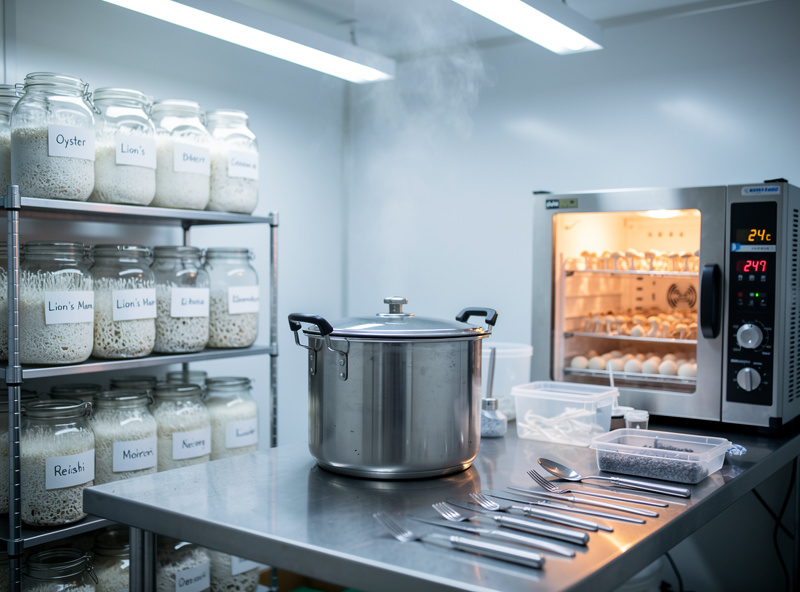
What Actually Breaks First When the Power Drops
A grain jar mid-colonization is living biology racing a clock against contamination, and temperature is the dial that sets the pace of that race. Most of the gourmet species in my rotation — oyster, lion’s mane, king oyster — colonize fastest and cleanest somewhere in the mid-70s to low-80s Fahrenheit. Drop a colonizing shelf into an unheated Swedish room during a winter outage and the temperature can fall well below that window within a few hours, and slow mycelium doesn’t just take longer to finish — it loses ground to whatever competing mold spore is also sitting on that grain, waiting for an opening. Trichoderma in particular thrives across roughly the same range my oyster and lion’s mane spawn wants, so a stressed, slow-growing jar isn’t just behind schedule, it’s more vulnerable exactly when it can least afford to be.
The fruiting tent has a different failure mode. Lose the humidifier for half a day mid-flush and pins that were plumping nicely start drying at the cap edge instead — once a pin dries out partway through development it doesn’t recover, even after humidity comes back. Lose air circulation on top of that in a sealed tent and CO2 builds, which on a longer outage shows up as thin, leggy stems reaching for fresh air that isn’t coming — the classic sign of a fruiting chamber that’s gone stale.
Sterilization Doesn’t Need the Grid — Timing Does
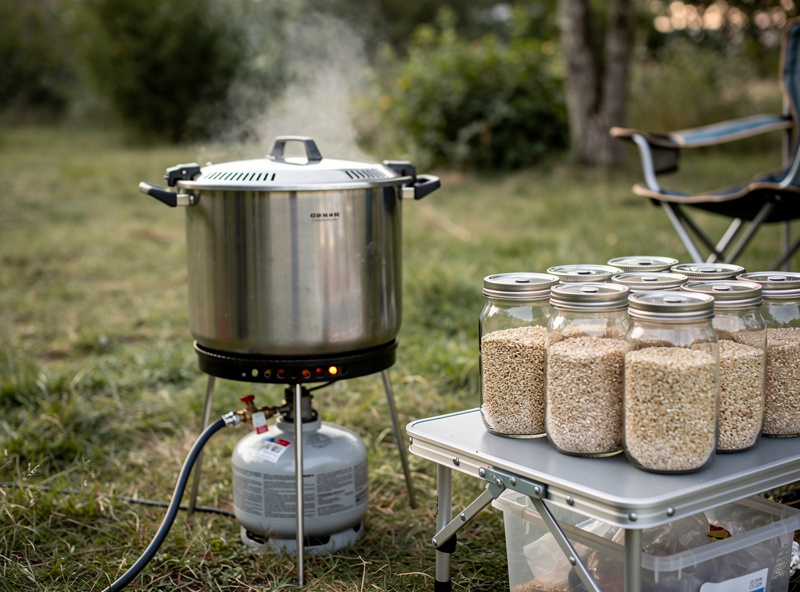
My stovetop pressure canner runs a grain-jar load for roughly 90 minutes to two and a half hours at 15 PSI depending on jar size, and it runs the same whether that heat is coming from a gas range, a propane camp burner outdoors, or — if it ever came to that — a wood stove. None of that needs an inverter, a battery bank, or a single volt of stored power. What it does need is an unbroken cycle: a canner that drops below 15 PSI partway through doesn’t reach the hold time needed to kill bacterial endospores in the grain, and a partially sterilized jar is a contaminated jar. That’s not a power-sizing problem, it’s a scheduling one — I don’t start a sterilization run if I know a storm or a scheduled outage is coming, and if I’m running on a camp burner outdoors, that’s the one piece of this whole workflow that genuinely does need to happen outside or somewhere ventilated, since any open flame indoors is a combustion-byproduct risk regardless of what’s cooking. Getting the sterilization cycle itself right — PSI, hold time, jar spacing, and cooldown — is covered in the pressure cooker mushroom sterilization guide.
Keeping a Colonizing Grow Stable Through an Outage
The colonization shelf is the part of the lab I actually protect, and the fix is mostly thermal mass, not electronics. My incubation shelf sits inside an insulated tote with a couple of gallon jugs of room-temperature water tucked in alongside the jars — plain thermal mass that slows how fast the whole tote’s temperature can swing in either direction, so a six-hour outage reads more like a two- or three-degree drift instead of a cliff. On a longer outage I’ll move the jars to the most interior room in the house, away from exterior walls and windows, which in a Swedish winter is worth several degrees on its own before a single watt of backup power gets involved.
Where a small battery earns its keep is bridging the gap on the heat mat itself — not running the whole lab, just keeping 15 to 30 watts flowing to a thermostat-controlled mat for as many hours as the outage actually runs. A modest power bank or a small 100- to 200-watt-hour battery does that job for the length of most storm-related outages I’ve actually seen, and it’s a far smaller, cheaper piece of gear than anything sized to also carry a pressure canner’s load — because it was never supposed to carry that load in the first place.
Fruiting Tent and Fresh Air: Low-Power Choices That Matter More Than a Battery
The humidifier and the circulation fan in my Martha tent draw somewhere in the 10-to-20-watt and 5-to-10-watt range respectively — genuinely small loads, which is exactly why a small battery can carry them through a short outage without any of the sizing math a bigger appliance would need. But the more useful outage skill is knowing what doesn’t need power at all: hand-misting the tent walls and floor every couple of hours holds humidity reasonably well without a running humidifier, and propping the tent open for a minute or two a few times a day moves stale air out without a fan. I’ve bridged outages up to about eight hours this way with no real loss to a flush already underway — it’s more hands-on than letting the humidistat run itself, but it costs nothing and it works.
Fresh-air exchange is the one I watch closest during any outage longer than a few hours, because a fruiting chamber that goes stale on CO2 doesn’t recover mid-flush — the etiolated, long-stemmed growth that results is what you get for the rest of that flush, not just until power returns. A sealed tent with no fan and no manual venting for half a day in a warm room is worse for a flush in progress than the same outage would be for a colonizing jar sitting quietly in the dark.
Battery Basics, at the Depth a Grower Actually Needs
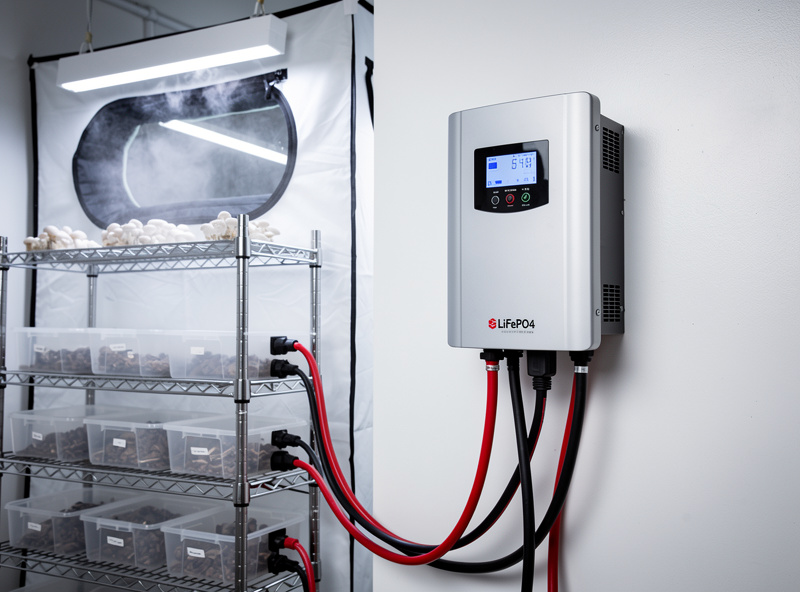
None of this requires sizing a battery bank the way you’d size one for a whole off-grid cabin. The loads worth backing up in a mushroom lab — a thermostat-controlled heat mat, an ultrasonic humidifier, a small circulation fan — add up to well under 100 watts running continuously, which is a different problem entirely from a 1,500-watt appliance. A basic power bank or a small LiFePO4 unit in the 100-to-200-watt-hour class bridges a several-hour outage for those loads without any inverter-surge or wire-gauge math to work through. If you’re actually sizing a battery bank for a cabin or a genuinely off-grid setup — not just bridging the occasional outage — the wattage-to-amp-hour math is the same whether it’s powering a mushroom lab or a house circuit, and batterystoragehq’s sizing guide walks through that math well if you need it.
What I Actually Run, and How It’s Set Up for Outages
The lab itself hasn’t changed for outages — it’s the same gear I run every week, just arranged with grid instability in mind. The colonization shelf runs off a heat mat and thermostat, now sitting inside the insulated tote with its water-jug thermal mass rather than out in the open on a wire rack. The Martha-style fruiting tent keeps its ultrasonic humidifier on a humidistat and its small circulation fan, both light enough loads that the backup power bank barely notices them. The still-air box and the stovetop canner don’t need anything backup-related at all — one is unpowered by design, the other only draws power for the burner it’s already sitting on, whatever that burner happens to be. Keeping the outage plan this simple is deliberate: the fewer pieces of the lab that depend on grid power in the first place, the less there is to size a battery for.
A hygrometer and a couple of cheap thermometers do the actual monitoring during an outage — one on the incubation shelf, one in the fruiting tent — because guessing at the temperature inside an insulated tote is how a six-hour outage quietly turns into a lost batch. I check both within the first hour of any outage and again every few hours after; if the incubation shelf hasn’t drifted more than two or three degrees by hour four, the thermal mass is doing its job and I leave it alone.
One Batch I Lost to a Bad Call
The clearest lesson I’ve had on this came from a winter storm that took the power out overnight for about nine hours. I’d left a fresh batch of lion’s mane grain jars on the incubation shelf against an exterior wall instead of moving them to the interior room I now use by default, and by morning the room had dropped into the low 60s Fahrenheit — cold enough that colonization had all but stalled. Two of the six jars pulled through once the heat mat came back; the other four had visible green Trichoderma taking hold within another day, exactly the outcome you’d expect from mycelium that spent a night too slow and too stressed to hold its ground. I toss contaminated grain rather than gamble on it, so that was four jars and a week of colonization time gone. Every jar since has gone into the insulated tote in the interior room the moment a storm forecast shows up, and I haven’t lost a batch to an outage since.
The Real Off-Grid Answer Is a Cultivation Answer
An off-grid or outage-prone mushroom lab isn’t a power-system design problem wearing a cultivation hobby’s clothes — it’s the other way around. The sterilization step is the one part of the whole chain that genuinely doesn’t need grid power at all if you’re running a stovetop canner instead of an electric multicooker. What needs protecting is the living biology on either side of it: a colonizing jar that wants steady warmth and a fruiting tent that wants steady humidity and fresh air, both of which respond better to insulation, thermal mass, and a modest battery bridging the gap than to any amount of inverter sizing. Protect the biology first and the power problem mostly takes care of itself.
Frequently Asked Questions
What happens to colonizing grain spawn if the temperature swings during a power outage?
Colonization slows as the temperature drops below the mid-70s to low-80s Fahrenheit that most gourmet species prefer, and slower mycelium is more vulnerable to competing contaminants like Trichoderma, which thrive in roughly the same range. A short outage of a few hours rarely causes visible damage; a longer outage in an unheated room, especially overnight in winter, is when contamination risk climbs. Thermal mass (insulated tote, water jugs) and moving jars to an interior room both buy meaningful time.
Can I sterilize mushroom substrate without any electricity at all?
Yes. A stovetop pressure canner runs on any heat source that reaches and holds 15 PSI — a gas range, a propane camp stove used outdoors or in a well-ventilated space, or in a genuine emergency a wood cookstove. The canner itself needs no electricity; only an electric multicooker-style pressure cooker does. The real requirement is an uninterrupted cycle, since a canner that drops pressure partway through won’t reach the hold time needed to kill bacterial endospores.
How do I keep a fruiting tent humid during a power outage?
Hand-misting the tent walls and floor every couple of hours holds humidity reasonably well without a running humidifier for outages up to roughly eight hours. For fresh air, prop the tent open briefly a few times a day instead of relying on a fan — a sealed tent that goes stale on CO2 mid-flush produces long, thin, etiolated stems for the rest of that flush, so manual venting matters more than the humidifier during a short outage.
Do I need a big battery bank to run a home mushroom lab off-grid?
No, not for the cultivation side. A heat mat, humidifier, and small circulation fan together draw well under 100 watts continuously, which a modest power bank or a small 100-to-200-watt-hour LiFePO4 unit can bridge for several hours. A large battery bank is only needed if you’re also trying to run an electric pressure cooker off-grid — a stovetop canner on a burner sidesteps that requirement entirely.
How long can a mushroom lab go without power before a batch is at risk?
In practice, a well-insulated colonization shelf with some thermal mass can ride out six to eight hours with minimal impact, especially in a room with some ambient warmth. A fruiting tent is more time-sensitive because drying pins don’t recover, so anything past a few hours without at least manual misting and venting starts to show in flush quality. Overnight outages in an unheated exterior room are where real losses happen.