
Cordyceps militaris is the one functional mushroom I grow that does not touch wood, straw, or a pressure-canned block — it fruits on a sweetened grain-and-rice jar under light, and it takes about 60-75 days from inoculation to harvest. It is the orange, club-shaped species you have seen sold as a powder, and unlike the wild caterpillar-fungus Ophiocordyceps, militaris grows happily on a vegetarian substrate in a jar on a shelf.
I run cordyceps in wide-mouth jars rather than bags because the workflow is closer to liquid-culture work than to bulk fruiting. The two things that make or break it are light (it genuinely needs it to color up and form clubs) and a clean liquid-culture start. Get those right and it is one of the more satisfying species to grow at home because the whole life cycle happens in front of you in a jar.
What Substrate Does Cordyceps Militaris Grow On?
Cordyceps militaris fruits on a supplemented rice or grain substrate — typically 40 g of brown rice or millet plus about 80 ml of a nutrient broth in a wide-mouth jar. The broth carries the supplements: a small amount of light malt extract, a pinch of nutritional yeast, and tryptone or peptone are the common additions that drive strong club formation.
I make my jars by combining the rice and the broth, then sterilizing at 15 PSI for 40-45 minutes in the pressure canner — cordyceps jars are small and dense, so they do not need the 2.5-hour run a big hardwood block takes. After cooling, I inoculate with 3-5 ml of cordyceps liquid culture per jar. The supplement matters more here than with any wood-lover I grow: a plain rice jar with no nitrogen source will colonize but throw thin, pale, low-yield clubs. The broth recipe is the lever you actually pull to improve yield.
On yield, keep expectations realistic at jar scale. A well-run wide-mouth jar gives me a dense mat of clubs on the rice surface that dries down to only a small fraction of its fresh weight — cordyceps is mostly water and the dried product is light. That is why I run several jars at once rather than one: the per-jar harvest is modest, but a row of six jars under a single light strip costs almost nothing extra to fruit and adds up to a usable batch. I treat cordyceps the way I treat agar work — small parallel units where one bad jar does not sink the run — rather than the all-eggs-in-one-block approach I take with a 5 lb hardwood reishi or shiitake fruiting block.
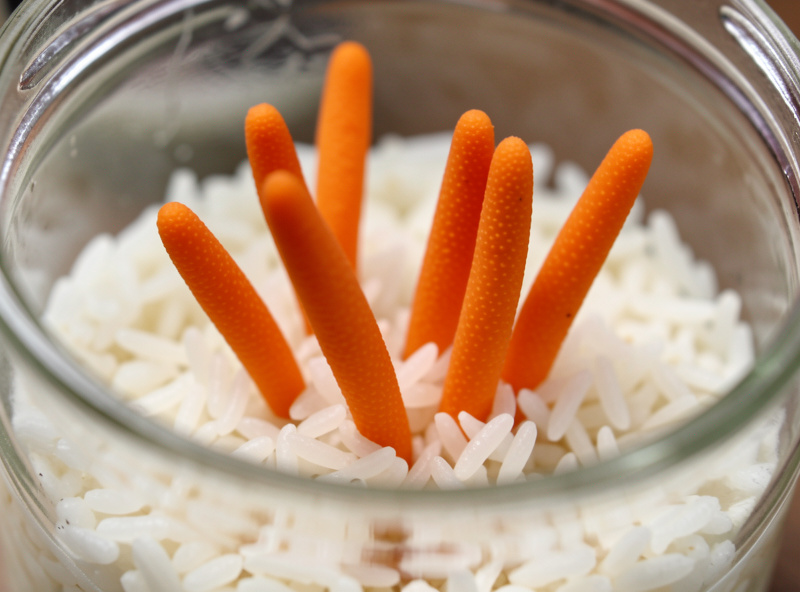
Why Does Cordyceps Need Light to Fruit?
Cordyceps militaris is one of the few cultivated mushrooms that genuinely requires light to fruit — it needs roughly 12 hours a day of indirect light at around 500-1,000 lux to trigger and color the orange clubs. Grown in the dark it stays white, flat, and will not form proper stroma.
I keep my colonized cordyceps jars under a cheap LED grow light strip on a 12-on/12-off timer once the surface is fully white. Without light the culture just sits there as a white crust; add light and within a week you see the first orange pinheads push up. This is the opposite instinct from most of my grow room, where I keep colonization dark — cordyceps flips the rule at the fruiting stage. The light requirement is also why a windowsill works in a pinch, though I prefer the timer for consistency. My FAE and CO2 fruiting guide covers the air-exchange side, which cordyceps also needs once the clubs start forming.
How Long Does Cordyceps Take to Grow?
Cordyceps militaris takes about 60-75 days total: 10-14 days to colonize the rice surface in the dark, then 30-45 days of light-driven fruiting as the orange clubs grow up and thicken. It is slower than oyster but faster than reishi, and the whole arc is visible in the jar.
After the surface goes fully white, I move the jars under light and loosen the lids slightly for fresh-air exchange. The clubs start as tiny orange dots, elongate into the recognizable finger shapes, and are ready when growth stalls and the tips stop extending. Temperature wants to sit around 64-68°F — cordyceps does not like the warmth that reishi craves, and a hot shelf gives you stunted clubs. I keep a hygrometer in the fruiting space and aim for 85-90% humidity, lower than the 95% I run for oyster, because too-wet cordyceps jars invite bacterial slime on the rice surface.
How Do You Harvest and Dry Cordyceps?
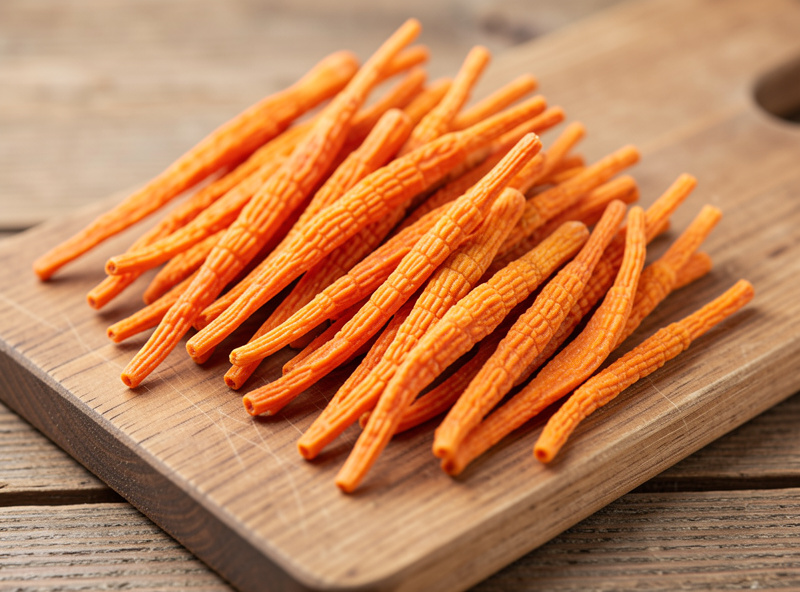
Harvest cordyceps when the orange clubs stop elongating and reach roughly 4-8 cm tall, usually 5-6 weeks after the lights go on. Twist or cut the clubs at the rice surface, then dry them at low heat (95-113°F) until they snap cleanly — the same snap-dry endpoint I use for every functional mushroom.
I pull the whole cluster, brush off any clinging rice, and lay the clubs in the dehydrator at the lowest setting. Cordyceps clubs are slender, so they dry fast — often under 8 hours versus the day-plus a thick reishi conk needs. For the moisture targets and storage details, my walkthrough on drying and storing medicinal mushrooms applies directly. As with reishi, I keep the framing strictly cultivation-and-preparation: cordyceps compounds are studied in the research literature, but any health question belongs with a clinician, not a grow guide.
Common Cordyceps Growing Problems
The failures I see most are pale or absent clubs from too little light, and bacterial contamination on the wet rice surface. Cordyceps also senesces — the culture degrades over generations — faster than the wood-lovers, so a tired liquid culture throws weak jars no matter how clean your technique is.
If your jars colonize white but never go orange, light is almost always the cause — add 12 hours a day and watch them turn within a week. If you get a slimy, sour-smelling film on the rice, that is bacterial blotch from excess moisture or a transfer slip; toss those jars rather than fight them. And if a whole batch fruits weak despite a clean process, your culture has likely senesced — the fix is starting fresh from a younger liquid culture or a clone, which my contamination control guide and clean-transfer habits feed directly into. Cordyceps rewards the same sterile discipline as my grain spawn workflow, just at jar scale.
One habit that has saved me batches: I keep a younger backup liquid culture going on the stir plate at all times, transferred from a fresh clone every few generations, specifically because cordyceps senesces faster than anything else I grow. The moment a batch of jars fruits noticeably weaker than the last — thinner clubs, slower coloring, lower fill on the rice — I stop propagating from that line and step back to the backup. Chasing one more generation out of a tired culture is the single most common way I have watched home growers waste a month of clean, careful jar work.
Some links in this article are affiliate links; if you buy through them I may earn a small commission at no extra cost to you.
Frequently Asked Questions
Is cordyceps militaris hard to grow at home?
Cordyceps militaris is moderate difficulty. The substrate and sterilization are simple, but it needs a clean liquid culture start and 12 hours of light daily to fruit. The main hurdles are light and culture freshness, not technique.
Does cordyceps need light to grow?
Yes. Cordyceps militaris is one of the few cultivated mushrooms that genuinely needs light, about 12 hours a day at 500-1,000 lux, to trigger and color its orange clubs. Grown in the dark it stays white and will not form proper stroma.
What substrate is best for cordyceps militaris?
A supplemented rice or grain jar works best: roughly 40 g brown rice or millet plus 80 ml of a nutrient broth containing light malt extract, nutritional yeast, and tryptone or peptone. The broth supplements drive strong club formation.
How long does cordyceps militaris take to grow?
About 60-75 days total: 10-14 days to colonize the rice surface in the dark, then 30-45 days of light-driven fruiting as the orange clubs grow and thicken before harvest.
What temperature does cordyceps militaris need?
Cordyceps prefers a cool 64-68F to fruit, cooler than warmth-loving reishi. A hot shelf produces stunted clubs. Aim for 85-90% humidity, lower than oyster, to avoid bacterial slime on the wet rice surface.
Why are my cordyceps clubs pale instead of orange?
Pale or white clubs almost always mean too little light. Cordyceps needs about 12 hours of daily light to develop its orange color and proper club shape. Add light and the clubs usually color up within a week.