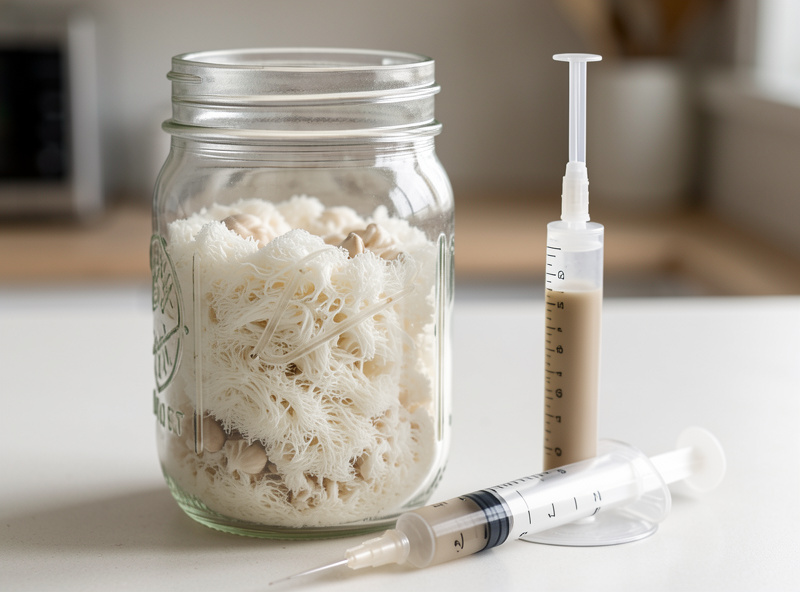
For gourmet mushroom growing, liquid culture beats a spore syringe almost every time: it is live, genetically consistent mycelium that colonises grain in days, while a spore syringe is ungerminated spores that are slower, less predictable, and prone to genetic variation. For a beginner who just wants oyster or lion’s mane on the table, the simplest path of all is buying ready-made grain spawn and skipping both.
The confusion starts at the vendor’s website, where “spore syringe,” “liquid culture syringe,” and “grain spawn” sit side by side with similar prices and almost identical-looking syringes. They are not interchangeable, and buying the wrong one for your skill level is a common first-grow mistake. This guide explains what each starting culture actually is, how to read what you are really buying, and which one fits a beginner growing edible gourmet mushrooms. Everything here is for gourmet and functional species only.
Disclosure: MycoMansion is reader-supported. As an Amazon Associate I earn from qualifying purchases made through links in this article, at no extra cost to you. I only point to gear I actually use or would buy for my own grow.
Spore Syringe vs Liquid Culture: The Core Difference
A spore syringe is sterile water suspending thousands of mushroom spores — the reproductive cells that have not yet germinated. A liquid culture (LC) syringe holds live, already-growing mycelium suspended in a sterile nutrient solution. The difference is everything: spores must germinate and find a compatible mate before they form usable mycelium — basidiomycete fungi like these run on a mating-type-locus system, so a lone germinated spore (a monokaryon) can’t fruit on its own until it fuses with a genetically compatible partner spore to form the fertile dikaryon (Kües 2000, Microbiology and Molecular Biology Reviews) — while liquid culture is already past that step, cloned from dikaryotic tissue, and ready to colonise immediately.
That single distinction drives the whole comparison. Because liquid culture is live cloned mycelium, in my own jars I usually see the first visible webbing on the grain surface within a day or two of injection, though full colonization still takes the same 1-2 weeks either way once it gets going. A spore syringe takes longer to show that first growth, produces a genetic mix (some vigorous, some weak — spores are the product of meiotic recombination between two mating-compatible parent strains, not clones), and carries a slightly higher contamination window because the longer lag gives competitors more time. A peer-reviewed comparison of oyster mushroom (Pleurotus ostreatus) spawn types backs the general pattern: liquid-based spawn is favored by growers specifically for its fast colonization and uniform distribution through substrate, compared with grain-only inoculation (Zhang et al. 2019, Mycobiology) — though that study compares finished spawn types rather than an LC-syringe-into-a-grain-jar step specifically, so I’m citing it for the general speed/uniformity pattern, not an exact day count. This maps directly onto the early phases of the mushroom life cycle — LC starts you at the mycelium stage, while a spore syringe makes you wait through germination and mating first.
Reading What You Are Actually Buying
Vendor labels are where beginners go wrong, so read them carefully: a “spore syringe” contains spores and is mainly an identification or breeding tool, while a “liquid culture syringe” contains live mycelium ready to grow. Both look like a 10cc syringe of cloudy liquid, but the label word — spore versus culture — tells you which biological stage you are buying.
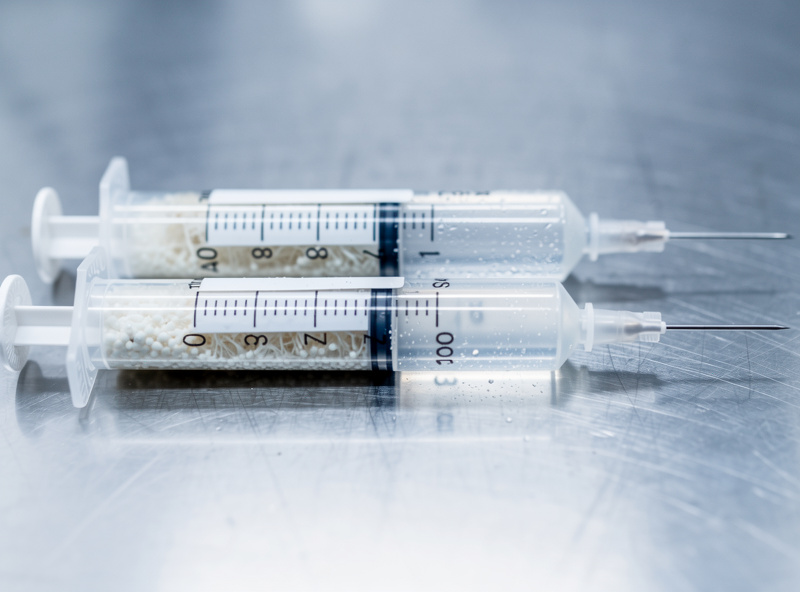
Three label cues to check before adding to cart. First, species and strain: a reputable gourmet vendor names the species (Pleurotus ostreatus) and often the strain, so vague listings are a red flag. Second, “for cultivation” versus “for microscopy” — some spore products are sold strictly as study specimens and are not intended for growing; for edible gourmet mushrooms you want cultivation-grade culture. Third, volume and freshness: liquid culture is perishable live tissue, so check the production date and buy from a vendor with turnover. When the label is ambiguous, email and ask before you buy.
The Beginner Shortcut: Buy Grain Spawn
For a true beginner, the easiest starting culture is neither a spore syringe nor a liquid culture — it is a bag of ready-to-use grain spawn, which is sterilised grain already fully colonised with live mycelium. You skip the syringe, the sterile injection, and the colonisation wait, and go straight to mixing spawn into bulk substrate. It removes the single trickiest step from your first grow.
Grain spawn is what I recommend for run one of any gourmet monotub, because it lets you learn the spawn-to-bulk inoculation and the fruiting workflow without first mastering sterile liquid transfers. Liquid culture becomes worth the small extra effort on run two or three, once you want to make your own grain spawn cheaply and clone a strain you like. The kit-versus-DIY framing for that progression is in grow kit vs DIY monotub, and the easy gourmet species to start with are ranked in easiest mushrooms to grow.
Starting Cultures Compared
The table below lays out the five ways to start a gourmet grow, from the simplest (grain spawn) to the most advanced (agar). Each row reflects how I would rank them for a beginner growing edible mushrooms — reliability and ease first, with cost and flexibility as secondary factors.
| Starting Culture | What It Is | Reliability | Best For | Beginner Verdict |
|---|---|---|---|---|
| Grain spawn (ready-made) | Colonised live grain | Highest | First monotub run | Start here |
| Liquid culture | Live mycelium in nutrient broth | High | Making your own spawn | Run two and beyond |
| Agar culture | Mycelium on a gel plate | High (skill-dependent) | Cloning and cleaning strains | Intermediate |
| Plug spawn | Colonised wooden dowels | High | Logs and outdoor beds | Outdoor growing |
| Spore syringe | Ungerminated spores in water | Variable | ID and breeding | Skip for first grow |
How to Use a Liquid Culture Syringe
To use liquid culture, you inject 1-2cc into a jar of sterilised grain through a self-healing injection port, then let the mycelium colonise the grain over 1-2 weeks before mixing it into bulk substrate. The whole transfer should happen in still air — in front of a still-air box or flow hood — with the needle flame-sterilised and the work surface wiped with 70% isopropyl. Cleanliness at this injection is the entire game.
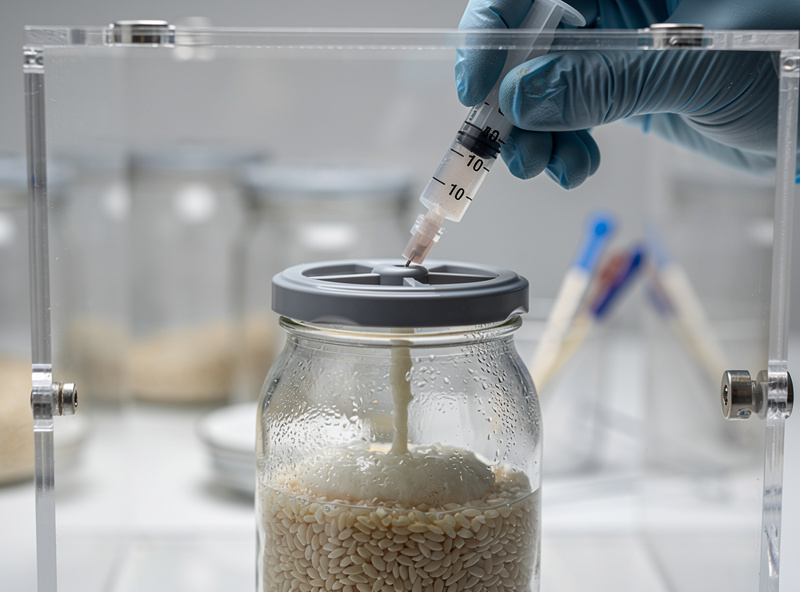
The contamination risk in liquid culture work is bacterial more than fungal — an unsterile needle or a draft introduces bacteria that cloud the broth and stall the grow. A still-air box is enough for most beginner LC transfers; a flow hood is the upgrade for high-volume work, and the decision between them is covered in still air box vs flow hood. If a transfer goes wrong, recognising the difference between healthy mycelium and contamination early is critical, which is exactly what the healthy-mycelium reference and the contamination guide are for.
What to Buy for Your First Grow
If you want the highest odds of a first harvest, buy ready-made grain spawn of an easy gourmet species and skip syringes entirely for run one. If you want to learn the sterile pipeline and eventually make your own spawn, buy a cultivation-grade liquid culture syringe of a named gourmet strain. Reserve spore syringes for when you are doing identification or strain breeding, not for a beginner’s first edible grow.
My starter shopping list reflects that order: a bag of sterilized grain spawn for the fastest path, a gourmet liquid culture syringe when you are ready to grow your own spawn, and a still air box to keep your transfers clean. For pure identification work rather than cultivation, the spore-print method in how to make a mushroom spore print covers the same spore biology without any syringe at all. The full first-year arc tying these choices together lives in the beginner guide.
Frequently Asked Questions
What is the difference between liquid culture and a spore syringe?
A spore syringe holds ungerminated spores in sterile water; they must germinate and find a genetically compatible mate before forming usable mycelium. A liquid culture syringe holds live, already-growing mycelium in nutrient broth, showing visible growth on grain within a day or two and colonising the jar over 1-2 weeks with predictable, genetically uniform results. Liquid culture is faster to start and more reliable.
Which is better for a beginner, liquid culture or grain spawn?
Ready-made grain spawn is best for a first grow. It is sterilised grain already colonised with live mycelium, so you skip syringes and sterile injection and go straight to mixing it into bulk substrate. Liquid culture becomes worthwhile on run two or three when you want to make your own spawn.
How do I tell a spore syringe from a liquid culture on a vendor label?
Read the label word: spore syringe contains spores and is mainly an identification or breeding tool; liquid culture syringe contains live mycelium for growing. Check that the listing names the species, is sold cultivation-grade rather than for-microscopy, and shows a recent production date for live cultures.
How do you use a liquid culture syringe to grow mushrooms?
Inject 1-2cc of liquid culture into a jar of sterilised grain through a self-healing injection port, working in still air with a flame-sterilised needle. Let the mycelium colonise the grain over 1-2 weeks, then mix the colonised grain spawn into bulk substrate to fruit.
Why do most gourmet growers avoid spore syringes?
Spore syringes are slower because spores must germinate first, and they produce a genetic mix where some offspring are weak. Gourmet cultivators prefer liquid culture or cloned agar because cloned mycelium is genetically uniform, faster to colonise, and lets them reproduce a strain they already know performs well.
Do I need a still air box to work with liquid culture?
For beginner volumes, yes, a still air box is recommended. It limits airborne contaminants during the injection, which is where bacterial contamination usually enters. A flow hood is the upgrade for higher-volume work, but a simple still air box is enough to keep most home liquid-culture transfers clean.