
70% isopropanol kills mushroom contamination and charcuterie spoilage organisms by the same mechanism — protein denaturation in 30 seconds wet contact. Five sterile habits transfer from my mushroom tent to my salami chamber; two do not, and one cost me a 1.2 kg coppa.
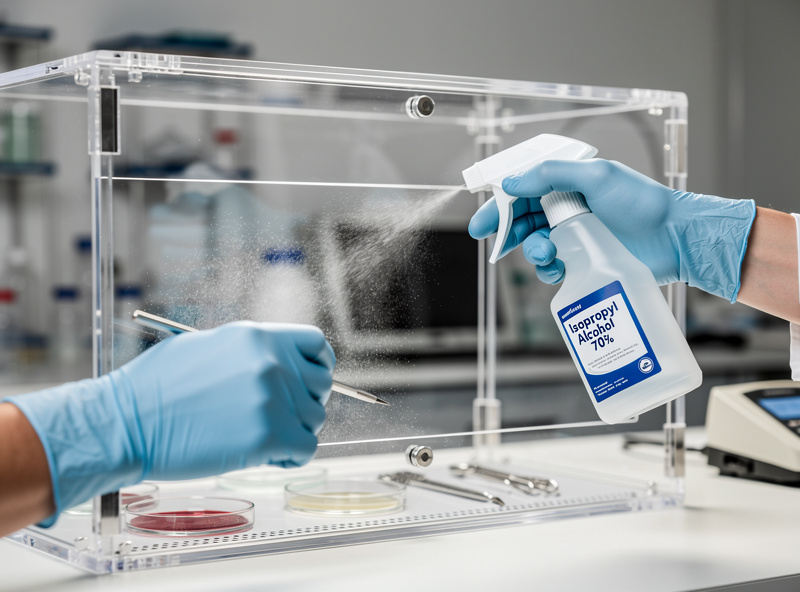
I run a 16 sq ft mushroom fruiting tent in the spare room and a 10 sq ft Inkbird ITC-308-controlled curing chamber in the basement. They share zero tools by design — a rule I wrote in red Sharpie on the basement door after the Trichoderma incident in summer 2024. The curing-specific sterile workflow lives on curingchamber.com’s troubleshooting guide; what follows is the cross-training: what mushroom cultivation taught me about salami, what it cannot teach, and where the two hobbies actively conflict.
Transferable Clean-Room Habits
Five sterile habits transfer cleanly: glove changes between hobbies, 70% IPA wipe-down between sessions, contamination-notebook logging, dedicated tool sets, and front-to-back/clean-to-dirty workflow. Each one came from a mushroom failure first and a charcuterie save second.
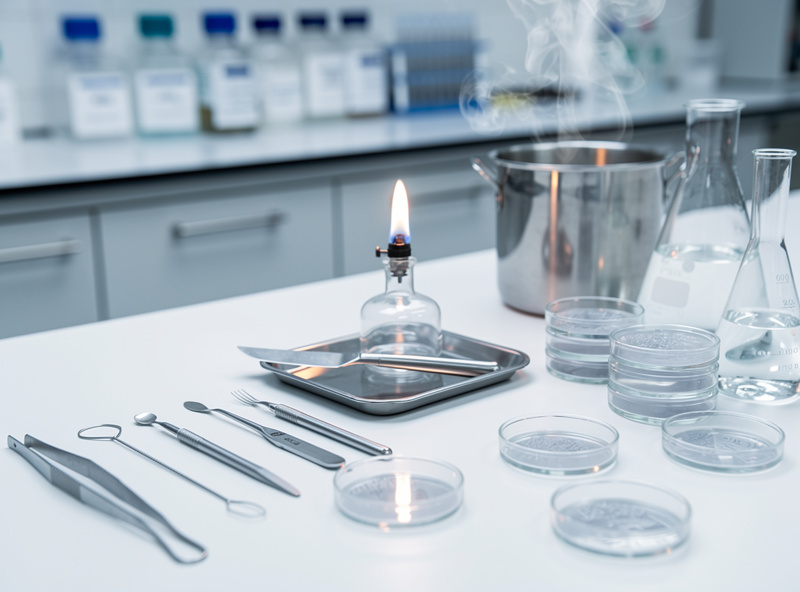
Mushroom growers learn five habits that charcuterie makers usually learn the hard way, through lost batches. First, alcohol-flame your tools: inoculating loops and scalpels get flamed between every agar transfer, and the same discipline applied to sausage-stuffing tubes, casing prickers, and trussing needles reduces contamination vector count to near zero. Second, your hands are the #1 contamination source. Glove changes between handling raw meat and touching the fermentation chamber controls are the difference between a clean salami batch and one where the pH meter probe introduced wild bacteria. Third, airflow direction matters. In a still air box (SAB) you work with arms entering from the front and product in the back, air settles downward onto the sterile field — the same principle applies to a curing chamber loading sequence where you load from the bottom up so spores from upper salami do not drift onto lower salami. Fourth, log everything. My contamination notebook has 47 entries since 2023; pattern recognition saved my next batch four times. Fifth, dedicate tools. The grain-spawn scoop never touches meat. Period.
The Five Habits That Transfer (and Two That Don’t)
Most cross-hobby advice stops at “be clean.” That’s useless. Here is the concrete enumeration after three years of running both setups in the same house.
Transfers cleanly:
- 70% IPA wipe-down on every hard surface, every session. Same bottle, same contact time (30 seconds wet), same effect. I refill 1L spray bottles from a 4L jug of MG Chemicals 70% IPA.
- Glove changes at every task boundary. Nitrile, powder-free, size M. I burn through about 200 a month between both hobbies.
- Front-to-back, clean-to-dirty workflow. In the SAB and in the curing chamber, you never reach over open product. Load low, work forward.
- Dedicated tool sets. The grain-spawn scoop never enters the basement. The casing pricker never enters the tent. Color-coded handles (blue tape for mushroom, red for meat).
- Contamination notebook. Date, batch ID, suspected organism, photo, outcome. Three years of entries makes Trichoderma vs. Cobweb identification a 5-second glance, not a 20-minute debate.
Does NOT transfer:
- Still-air-box logic for mushroom inoculation does not translate to charcuterie casing handling. A SAB is designed for tasks lasting 60–120 seconds with the operator’s arms stationary. Stuffing a salami chain takes 20 minutes of active arm movement — the SAB’s still-air assumption breaks down the moment you reach in repeatedly. Casing work happens on a clean kitchen counter wiped with IPA, not inside a box.
- Pressure-cooker sterilization of grain does not translate to meat. Mushroom grain spawn gets 90 minutes at 15 PSI to kill endospores. Meat for charcuterie gets the opposite treatment — raw, salt-cured, fermented at 75–80°F to encourage Lactobacillus. Trying to “sterilize” meat the way you sterilize grain is how you make jerky, not salami.
Biological Parallels: Mycelium and Mold Cultures
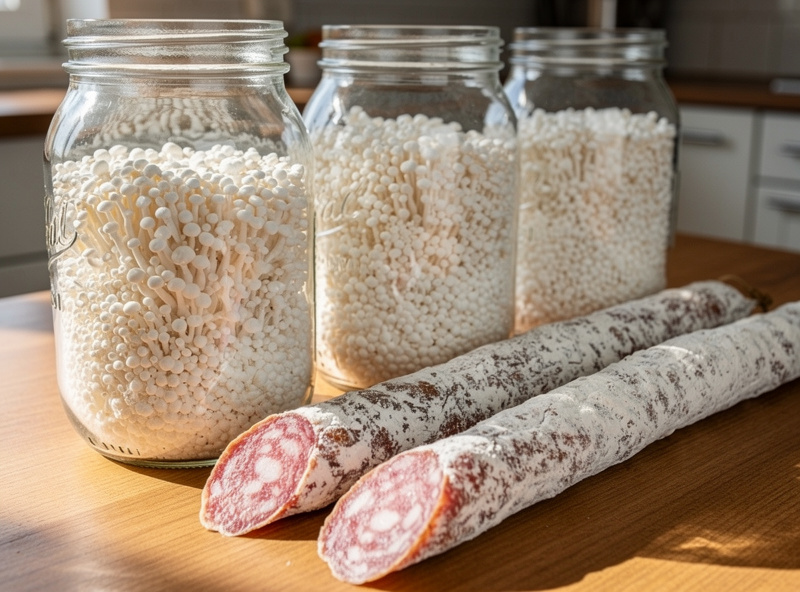
Mycelium colonizing a grain jar and Penicillium nalgiovense colonizing a salami casing are the same biological process — a filamentous fungus extending hyphae through a substrate, consuming available nutrients, and eventually sporulating — observed in two different food contexts. The temperature and humidity ranges overlap so closely (55–65°F, 75–85% RH for both mushroom fruiting and salami drying) that a mushroom fruiting chamber and a curing chamber can literally be the same converted refrigerator running on the same controller, just at different times. The key difference is substrate: sterile grain or supplemented sawdust for mushrooms, salted and fermented meat for salami. The organism does not care which it is growing on — it cares about temperature, humidity, pH, and available nutrients. Leistner and Gould’s classic 2002 hurdle-technology framework explains why salami survives where grain would rot: salt, pH drop below 5.3, water activity below 0.90, and a competitive Penicillium nalgiovense bloom together exclude the pathogens that would otherwise colonize the same warm-humid window.
Reading Contamination Across Hobbies: Color, Smell, Texture Field Guide
The most useful skill cross-trained from mushroom growing is contamination triage by sense. Here is the side-by-side I keep taped inside the basement door.
| Sense | Mushroom side (bad) | Charcuterie side (good) | Charcuterie side (bad) |
|---|---|---|---|
| Color | Fuzzy green Trichoderma; black-green Aspergillus; pink Neurospora | Even chalky-white Penicillium nalgiovense bloom | Black-spore Aspergillus niger patches; slimy gray smear; orange-pink Wallemia |
| Smell | Sharp coconut/Trichoderma; sweet rot from bacterial; ammonia from late-stage | Musty, slightly mushroom-y nalgiovense; faint cured-meat funk | Sharp sour Aspergillus niger; barnyard/ammonia putrefaction; rotten-egg sulfur |
| Texture | Cottony green that “deflates” under fingertip; powdery sporulation | Velvet-fine, evenly distributed, dry to the touch | Slick, wet, gluey; black powder that smears; soft case that gives under thumb |
| Pattern | Circular contam fronts pushing back the white mycelium edge | Uniform coverage from the inoculation spray | Localized black or gray patches especially at tied ends |
The Penicillium nalgiovense white bloom smells musty and faintly mushroom-y. Aspergillus niger smells sharp, almost sour. Cottony white mycelium pushing back fuzzy green contamination has a specific visual rhythm — concentric battle fronts — and once you have watched it on three grain jars you will spot the same front on a salami casing in a half-second glance. The grain spawn through the bag wall feels firm and slightly springy when fully colonized; under-colonized substrate feels loose and grainy. Apply the same fingertip test (through gloves) to a salami case — firm and yielding evenly is good, soft pockets are early case-hardening or putrefaction.
Named Gear, and Why
I run the cross-hobby setup on a deliberately narrow stack so I can blame failures on technique, not equipment.
- Inkbird ITC-308 — single dual-stage controller for the curing chamber. Heating element on the warm outlet, fridge compressor on the cool outlet, 1°F deadband. I picked it after the first cheaper STC-1000 swung 4°F and case-hardened a sopressata.
- Bluelab pH probe — measures salami fermentation drop from 5.8 → 5.0 over the 72-hour warm phase. I tried pH strips for a year; they read 0.3 high consistently against the probe.
- Govee H5179 hygrometers, three of them — one in the tent, one in the chamber, one as a control on the basement workbench. Cloud-logged so I can see the chamber humidity dip every time the fridge door opens.
- North Spore filter-patch spawn bags with 0.2-micron filter patches for the mushroom side. Never enter the basement.
- Boveda 75% RH packs for dried-mushroom storage; they hold the humidity steady inside vacuum-sealed jars better than salt-saturated solutions for the small volumes I deal with.
The Trichoderma Incident, Summer 2024
The lost-batch story everyone learns from once. I had a rye-grain spawn bag colonizing on top of the dryer in the laundry room, two doors down from the basement chamber. The bag’s filter patch had a hairline tear I had not noticed. I picked up the bag to inspect it, walked it down the basement stairs without sealing it in a secondary bag, and passed within three feet of the open curing chamber while loading a fresh 1.2 kg coppa. Six days later the coppa had black-green Aspergillus and unmistakable Trichoderma green fronts under what should have been a clean nalgiovense bloom. The whole muscle went in the trash. Lesson, written on the basement door: no grain bag, no spent block, no sporulating culture passes through the basement without a sealed secondary bag. The Trichoderma incident is also why I no longer run mushroom work and a fresh salami stuff on the same day. 24-hour buffer minimum.
Authority and Standards I Actually Use
Three sources sit on the shelf above my workbench. The FDA Bad Bug Book (Second Edition) chapter on Staphylococcus aureus is the one I reread before every warm-fermentation cycle — Staph thrives in the same 75–80°F window we use to drive Lactobacillus, and the salt/pH/aw hurdle stack is what stops it. The University of Wisconsin Center for Meat Process Validation’s fermentation and drying guidance spells out the same Staphylococcus-toxin-production hazard and the pH-drop/water-activity hurdle logic FSIS-regulated producers use — useful even at home as a target envelope. And Sunesen & Stahnke’s 2003 Meat Science review of Penicillium nalgiovense documents why the surface mold protects against off-flavor and undesirable mold colonization, not just looks pretty on the case. Pulled in this order, those three answer 80% of the “is my batch safe?” questions I have ever asked.
What I’d Build If Starting Both Hobbies Today
One habit, before everything else: the contamination notebook. A $4 grid-paper notebook, one line per batch, columns for date, batch ID, organism suspected, photo filename, outcome. Three years of entries makes Trichoderma identification a half-second glance instead of a 20-minute Reddit thread. Buy the Inkbird, buy the Bluelab, buy the North Spore bags — but if you only do one thing, log every batch. The notebook is the only sterile-technique tool that cross-trains itself: each entry teaches the next batch. For the charcuterie-side science — pH targets, water-activity math, casing selection by muscle, the actual fermentation curves — that depth lives on curingchamber.com’s troubleshooting guide. Read it before your first stuff.
Related Reading on the Contamination Cluster
Two sibling articles on the contamination side of this site go deeper on the mushroom half of the cross-training. The green mold photo ID guide walks through the Trichoderma-vs-everything-else triage that pattern-matches directly to Aspergillus niger triage on salami. The cobweb mold vs mycelium guide covers the wet-vs-dry-fuzz distinction that is also how you tell early Wallemia contamination from a healthy nalgiovense bloom on a casing.
Frequently Asked Questions
Can I use the same still air box for mushrooms and charcuterie?
Yes, with a thorough cleaning between uses. Wipe all surfaces with 70 percent isopropanol, run a UV-C sanitizer light for 15 minutes if available, and replace the arm-hole covers or wipe them down. The SAB provides a sterile workspace for any inoculation task regardless of whether the target is grain spawn or salami casings.
What is the most important sterile habit that transfers from mushrooms to curing?
Never reach over open product. When your arm passes over a sterile petri dish or an open grain jar, skin cells and micro-dust fall into it. The same applies to salami hanging in the chamber — reaching over a lower row to adjust an upper row drops contamination onto the lower salami. Load bottom-to-top, work front-to-back.
How do I know if my sterile technique is good enough for charcuterie?
If you can successfully grow mushrooms from spore or liquid culture to fruiting without a single contamination event, your sterile technique is adequate for charcuterie. Mushrooms are actually more contamination-sensitive than salami because the substrate (sterilized grain) has no competitive barriers. Salami has salt, pH drop, and competitive starter cultures as additional defenses.
Does a still air box help for charcuterie too?
Only for very short tasks like inoculating a culture starter or wiping a fresh mold-spray solution onto a small batch. For full salami stuffing the SAB still-air assumption breaks down after 60 to 120 seconds of active arm movement, so most charcuterie work happens on an IPA-wiped kitchen counter rather than inside a box. The SAB earns its keep for mold-spray prep, not for the stuff.
Can mushroom Trichoderma contaminate a salami chamber?
Yes, directly. Trichoderma spores are airborne, persistent, and thrive in the same 55 to 65 degree Fahrenheit window curing chambers run at. A sporulating contaminated grain bag carried through the same room as an open curing chamber can seed the chamber walls for months. Keep mushroom work and charcuterie work physically separated, and never carry a sporulating culture through the curing space without a sealed secondary bag.
What is the minimum sterilization protocol for cross-hobby tools?
Hot soapy water scrub, full air dry, 70 percent isopropanol wipe with 30 seconds wet contact time, and a flame pass for metal tools that tolerate it. For anything that has touched raw meat then dishwasher sanitize cycle before any further use. Cross-hobby tool sharing is not recommended even after sanitizing — dedicate separate sets and color-code the handles.