
The best dehydrator for mushrooms is a horizontal-airflow box with an adjustable thermostat that reaches down to about 95°F and up past 125°F. Airflow evenness and temperature control matter far more than wattage or tray count. A fixed-temperature stackable unit will case-harden your caps or dry the top tray while the bottom stays leather. That single design choice is the whole decision.
I’ve dried mushrooms three ways over the years — on a screen in front of a fan, in a cheap Nesco vertical-stack dehydrator, and finally in a horizontal-airflow box — and the gap between the last one and the first two is not subtle. On the vertical stack I used to rotate trays every hour and still ended up with a bottom layer that finished before the top. The box just works: load it, set it, walk away. This guide is how to pick the right one for gourmet mushrooms specifically, because drying a dense king oyster stem is a different problem from drying apple rings.
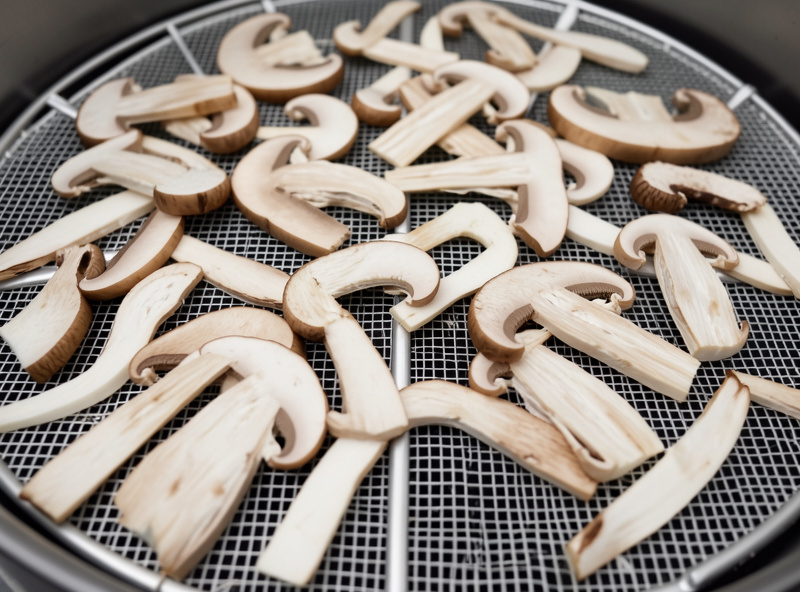
What Temperature Should You Dry Mushrooms At?
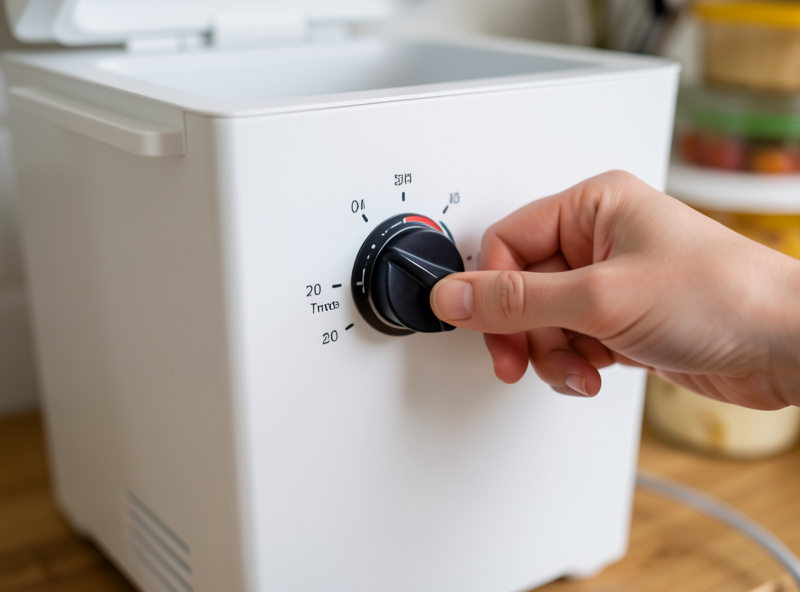
Dry gourmet mushrooms at 110–125°F (43–52°C). That range pulls water fast enough to beat spoilage but stays cool enough to preserve aroma and avoid sealing a dry crust over a wet core. Any dehydrator worth buying for mushrooms must have an adjustable thermostat covering this band — a single “on” setting is a dealbreaker.
The temptation is to crank the heat to finish faster. Don’t. Push a dehydrator to 155–160°F and the outside of a thick cap dries and hardens while the middle stays damp, which is exactly the hidden-moisture failure that grows mold in a sealed jar weeks later. I run 115°F for thin oyster and lion’s mane and 120–125°F for dense shiitake and king oyster stems, and I’d rather a batch take eight hours than gamble on a fast, uneven dry. The National Center for Home Food Preservation makes the same low-and-slow case for all home drying, and it holds double for mushrooms because their aroma compounds are heat-fragile. The reward for patience is a cap that rehydrates with its flavor intact.
Why Horizontal Airflow Beats Stackable Trays
Horizontal-airflow dehydrators — the Excalibur-style box design where a fan blows across the trays from a rear wall — dry every tray at the same rate. Vertical stackable units push air up through a central stack, so the trays nearest the heat source finish first and you’re forced to rotate constantly. For mushrooms, where you often run mixed species and thicknesses, that evenness is the whole game.
Here’s what it looks like in practice. On my old vertical stack, a full load of blue oyster came out with the bottom trays crisp and the top trays still bendy, and if I forgot to rotate, the difference got worse. The horizontal box lets me load lion’s mane, oyster, and sliced king oyster on separate trays in the same run and pull them close to together, checking the densest pieces last. The fan and thermostat sit in the back wall away from drips, which also makes cleanup easier — and cleanup matters when you’re drying something as aromatic and moisture-heavy as fresh mushrooms. If you’re drying the flushes off a productive block, like the ones I pull following my harvest and flush timing, even airflow is what lets you process a big haul in one hands-off run.
How Many Trays and What Size Do You Need?
For a single home grow tent, four to six trays of roughly 12 x 12 inches each is plenty — enough to dry a full flush in one or two runs. Buying a giant nine-tray unit for a one-tent operation just means more empty capacity to clean. Size the dehydrator to your actual harvest, not to a fantasy of it.
Mushrooms shrink dramatically as they dry — roughly 90% of a fresh mushroom is water, so a heaping tray of fresh oyster cooks down to a modest handful. That means you can load trays generously without overcrowding once you allow a little space for air to move between slices. My rule is a single layer with pieces not quite touching; pile them and the contact points stay wet. A four-to-six tray box handles the output of my oyster and lion’s mane rotation comfortably. If you’re scaling toward selling or preserving multiple species at market volume, that’s where more trays — or a different machine entirely — starts to make sense, a trade-off I weigh in the full storage and preservation gear guide.
What About Tray Material and Mesh Liners?
You want food-grade trays plus fine mesh liner screens, because small caps, torn lion’s mane tufts, and thin oyster strips fall straight through standard tray grids. The mesh liner is a cheap accessory that saves you from finding shriveled bits welded to the fan housing. It’s the single most-overlooked part of drying mushrooms.
Standard dehydrator trays have gaps sized for fruit and jerky — too wide for a lot of mushroom pieces. I run flexible polyscreen mesh sheets on every tray when I’m drying anything small, and I lay king oyster and shiitake slices with a little space between them so the surfaces dry rather than steam against each other. One caution: skip the solid “fruit leather” tray inserts for mushrooms, because they block airflow underneath and trap moisture. Some growers worry about BPA in plastic trays; if that’s you, stainless mesh trays exist and are worth the upgrade for something you’ll run this often. A set of dehydrator mesh liners costs a few dollars and pays for itself the first time you dry small caps.
As an Amazon Associate I earn from qualifying purchases.
Dehydrator vs. Oven vs. Air-Drying: What Actually Works?
A dedicated dehydrator wins for consistency, but it’s not the only way. Here’s how the realistic options compare for drying gourmet mushrooms at home.
| Method | Temp control | Evenness | Typical time | Cost | Best for |
|---|---|---|---|---|---|
| Horizontal-airflow box | Excellent | Excellent | 4–10 hrs | $150–$300 | Any species, mixed loads |
| Vertical stackable unit | Fair–good | Fair (rotate trays) | 6–12 hrs | $40–$90 | Budget, single species |
| Oven (lowest setting) | Poor (often too hot) | Poor | 3–6 hrs | $0 | One-off, watch closely |
| Air-dry on screen + fan | None (ambient) | Good in dry air | 1–3 days | $15–$40 | Thin oyster, dry climates |
The oven is the trap. Most home ovens won’t hold a temperature below 170–200°F even on their lowest setting, which cooks mushrooms instead of drying them; propping the door open helps but it’s fiddly and wastes energy. FoodSafety.gov flags home ovens as unreliable for low-temperature drying for the same reason. Air-drying genuinely works for thin oyster in a dry room — I’ve strung sliced oyster over a screen with a fan and had it crisp in a day — but it’s hostage to your kitchen humidity, and in a Swedish autumn that’s a losing bet. For anything you plan to store long-term, the controlled box is worth the money.
How Long Does It Take to Dry Mushrooms in a Dehydrator?
Expect 4–10 hours depending on species and slice thickness. Thin oyster and torn lion’s mane finish in 4–6 hours; dense shiitake caps and thick king oyster stems can take 8–10. Don’t dry by the clock — dry until a test piece snaps cleanly, then condition to confirm.
The finish test is a hard snap, not a bend. Pull one of the thickest pieces, let it cool for a minute (warm mushrooms feel more pliable than they are), and try to break it. Clean crack means done; any flex means back on the tray. Then I always run the conditioning-jar step from my full mushroom storage and preservation guide: loosely jar the cooled caps for two to three days and watch for any fog on the glass. This catches the thick king oyster stem or lion’s mane core that snapped on the outside but held water inside — the exact failure that once cost me an oyster batch. Drying species like the dense king oyster or shiitake I grow on blocks rewards this patience most, because their thickness is exactly where hidden moisture hides.
How Should You Slice and Prep Mushrooms for the Dehydrator?
Slice mushrooms to an even 6–8 mm, keep small caps whole, tear lion’s mane into tufts, and don’t wash them if you can avoid it. Even thickness is what lets a whole tray finish together; uneven pieces guarantee that something is still wet when the rest is done. Prep is half of a good dry.
The washing rule surprises people. Mushrooms are sponges — run them under the tap and they soak up water you’ll then have to spend hours driving back out, and wet caps also dry unevenly and can go slimy on the tray before the dehydrator catches up. I brush cultivated mushrooms clean with a soft brush or a dry cloth, and since I grow my own on clean substrate there’s rarely much to remove. For thickness, I use an OXO mandoline set to 6–8 mm for consistency over speed: king oyster stems sliced into coins, shiitake caps halved or left whole depending on size, oyster torn or sliced along the grain into strips. Early on I sliced a batch of king oyster by eye, uneven and mostly too thick, and ended up with a tray that was half glass-snap dry and half still leathery in the center — a mistake I don’t repeat now that I measure. Lion’s mane I pull apart into bite-sized tufts rather than slicing, because its structure shreds rather than cuts cleanly.
A few species-specific notes from my own runs. Oyster caps oxidize and can darken if they sit sliced too long, so I load them straight onto trays. Shiitake benefits from a stem-and-cap split because the stems are woody and dry slower — I often dry stems separately and grind them into powder. And whatever you do, single-layer everything: pieces touching at their edges stay damp at the contact point, and those damp spots are where a batch fails the conditioning test. Good prep upstream is why my drying runs come out even, the same way clean slicing sets up every batch off my oyster harvests.
What temperature should I dehydrate mushrooms at?
110 to 125 degrees Fahrenheit. That range dries fast enough to prevent spoilage while staying cool enough to preserve aroma and avoid sealing a dry crust over a wet core. Use the lower end for thin oyster and lion’s mane, the higher end for dense shiitake and king oyster.
Do I need a dehydrator or can I use my oven?
An oven works in a pinch but most home ovens cannot hold a temperature below 170 degrees Fahrenheit even on the lowest setting, which cooks mushrooms rather than drying them. A dedicated dehydrator with a thermostat gives far more consistent, aroma-preserving results for anything you plan to store.
How long does it take to dehydrate mushrooms?
Between 4 and 10 hours depending on species and thickness. Thin oyster and lion’s mane finish in 4 to 6 hours; dense shiitake and thick king oyster stems can take 8 to 10. Dry until a cooled test piece snaps cleanly rather than drying by a fixed time.
Why do my mushrooms fall through the dehydrator trays?
Standard dehydrator tray grids are sized for fruit and jerky, so small caps and thin strips slip through. Add fine mesh liner screens to every tray when drying mushrooms; they cost a few dollars and stop pieces from dropping into the fan housing.
Can I dry different mushroom species together?
Yes, if you use a horizontal-airflow dehydrator that dries all trays evenly. Keep each species on its own tray so you can pull them as they finish, since thin oyster dries faster than dense king oyster. Vertical stackable units make mixed loads harder because trays dry at different rates.