
Preserving mushrooms well comes down to three enemies and the gear that beats them: moisture, oxygen, and light. Dry a flush to a hard snap, pull the oxygen out with a vacuum sealer and an absorber, store it dark in glass, and gourmet mushrooms keep their flavor for one to two years. Get any link wrong and you grow mold on your own harvest.
I learned that the expensive way. The first serious oyster flush I ever dried — a fat double flush of pearl oyster off a straw bucket — went into a mason jar the same evening I pulled it from the dehydrator. It looked dry. Two weeks later the inside of that jar had fogged with condensation and a couple of caps had gone slick and sour. That batch taught me the single most important thing about mushroom storage: the preservation problem is really a moisture problem, and every piece of gear on your shelf is there to win that fight at a different stage.
This guide is the map for the whole storage side of my grow room — the same clean-process discipline I point at the sourdough starter and the salami chamber, aimed here at keeping harvests instead of losing them. I’ll walk the full workflow, from a fresh crisp cap in the fridge to a hard-dried king oyster still snapping a year later, and point you to the deep-dive on each piece of gear.
What Actually Kills Stored Mushrooms?
Four things spoil stored mushrooms: residual moisture (feeds mold), oxygen (drives rancidity and oxidation), light (bleaches color and degrades aroma compounds), and pantry pests. Of those, moisture is the one that ruins a batch in weeks rather than months, and it’s the one home growers underestimate most.
Here’s the mechanism. Mold and bacteria can’t grow without available water, measured as water activity (aw) on a 0–1 scale. Fresh mushrooms sit around 0.97 — wide open to spoilage. Bring the water activity below roughly 0.60 and there is not enough free water for mold to colonize, which is why properly dried caps are shelf-stable and slightly-dried ones are a petri dish. The National Center for Home Food Preservation makes this the core principle of all dry storage, and it’s the number every piece of gear in this guide is quietly chasing.
Oxygen is the slower enemy. Even bone-dry mushrooms hold fats and volatile aroma compounds that oxidize on contact with air; a year-old jar of oxygen-exposed dried porcini smells flat and cardboardy next to one that was vacuum-sealed with an absorber. Light accelerates the same fade. Pests — mainly the pantry moths and flour beetles that find any dried plant material — are the reason I moved everything into sealed glass and stopped trusting the flimsy zip bags a lot of grow-kit blogs recommend. FoodSafety.gov lists the same oxygen-and-light exposure risks for home-dried goods generally, which is exactly why the sealing step below is not optional. Beat those four and storage is basically solved. The rest of this guide is which tool beats which enemy.
How Dry Is “Dry Enough” for Shelf Storage?
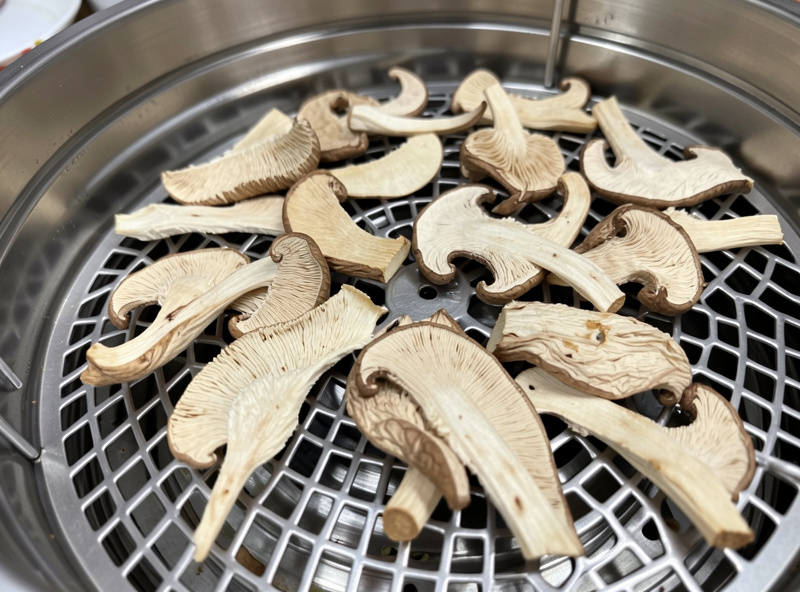
Cracker-dry. A properly dried mushroom for long-term storage should snap like a thin biscuit, not bend like leather. If a thick king oyster stem or a lion’s mane clump still flexes at all, it holds enough internal moisture to fog a jar — exactly the failure that cost me my first oyster flush.
The snap test is my field gauge because most home growers don’t own a water-activity meter (I don’t run one either — they’re commercial gear). So I dry to a hard, clean break and then use a trick I borrowed from the way I check a curing salami: the conditioning jar. Loosely fill a clear jar two-thirds with cooled dried caps, seal it, and watch the glass for two or three days. Any fog, any beads of condensation on the inside, means moisture is still equalizing out of thicker pieces — those caps go back on the trays. No fog after three days and I trust the batch for vacuum storage. It’s the single cheapest insurance step in the whole workflow and almost nobody does it.
Temperature matters here too. I dry gourmet mushrooms at 110–125°F (43–52°C) — warm enough to pull water fast before spoilage organisms get going, cool enough to preserve aroma and not case-harden the outside while the middle stays wet. Push a dehydrator to 160°F to “save time” and you seal a dry crust over a damp core, which is another sneaky route to a moldy jar. Low and patient wins, the same as everything else I grow. The full temperature-and-tray breakdown lives in my guide to the best dehydrator for mushrooms.
What Preservation Gear Do You Actually Need?
For a home gourmet grower, the honest short list is a dehydrator, glass jars, a vacuum sealer, and a handful of oxygen absorbers. Everything else — freeze dryers, chamber vacuum machines, nitrogen flushing — is a scale-up you may never need. Here’s how the common methods actually compare in my kitchen.
| Method | Gear cost | Best for | Shelf life | Texture on return | My take |
|---|---|---|---|---|---|
| Dehydrator + jar | $60–$300 | Nearly every gourmet species | 1–2 years | Excellent (rehydrated) | The workhorse; start here |
| Vacuum seal + O2 absorber | +$30–$120 | Long-term dried storage | 2–3 years | Excellent | Adds a year to any dried batch |
| Air-dry / fan + screen | $15–$40 | Thin oyster in dry climates | 6–12 months | Good | Slow, humidity-dependent |
| Freezing (sauteed first) | $0 (own a freezer) | Meaty species, near-term use | 3–6 months | Good if cooked first | Freeze raw and they turn to mush |
| Freeze dryer | $2,000–$5,000 | Preserving raw texture/color | 10+ years | Closest to fresh | Overkill for most home growers |
| Fridge (fresh, unpreserved) | $0 | Eating within the week | 5–10 days | Fresh | Not storage — just a holding pattern |
As an Amazon Associate I earn from qualifying purchases.
The pattern that jumps out after years of doing this: dehydrating plus good sealing covers 90% of what a home grower needs, at a fraction of the cost of the exotic options. A dehydrator with real temperature control and a box of wide-mouth mason jars will preserve more mushrooms, better, than a $3,000 machine you run twice a year.
How Do I Choose a Dehydrator for Mushrooms?
The two things that matter for mushrooms are an adjustable thermostat that reaches down to about 95–110°F and horizontal airflow that dries every tray evenly. Wattage and tray count are secondary. A cheap dehydrator with a single fixed “on” temperature will cook your caps or dry the top tray while the bottom stays leathery.
I run a horizontal-airflow box — the Excalibur-style design where the fan blows across the trays from the back rather than up through a stack. The difference is real: on the old vertical-stack unit I started with, I had to rotate trays every hour or the bottom finished long before the top. With horizontal flow I load lion’s mane and blue oyster on the same run and pull them together. For dense stems like king oyster I slice to a consistent 6–8 mm so nothing thick stays wet in the middle. The whole decision — temperature ranges, tray materials, mesh liners for small caps, and what to actually buy — I break down species by species in the dehydrator selection guide. If you’re deciding between drying and the deep-freeze route, the trade-offs there feed directly into whether a freeze dryer is worth it for your situation.
Long-Term Storage: Jars, Vacuum Sealing, and Oxygen Absorbers
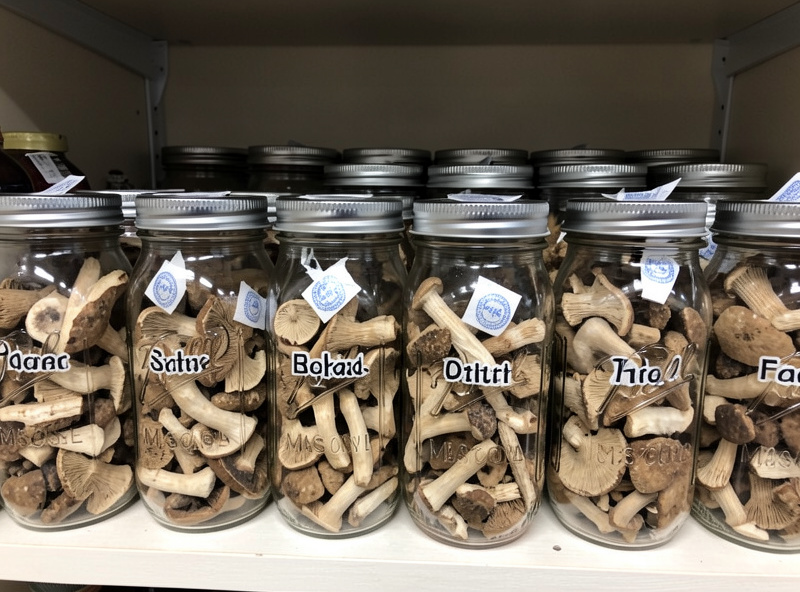
Dried mushrooms belong in airtight glass, in the dark, with the oxygen removed. Glass because it doesn’t hold odor or let pests chew through; dark because light fades aroma; oxygen removed because that’s what turns a two-year shelf life into a three-year one and keeps the flavor sharp. This is where a vacuum sealer earns its counter space.
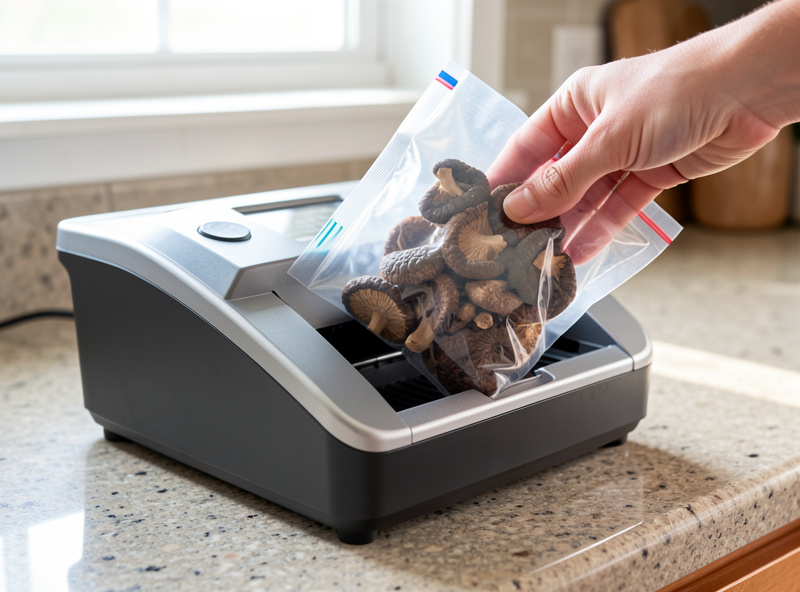
My working setup: dried caps go into wide-mouth Ball mason jars, I drop in a food-grade oxygen absorber sized to the jar, and I pull the air with a jar-sealer attachment on my FoodSaver. For batches I want to give away or stack flat, I vacuum-seal them into bags instead. One caution I learned the hard way — vacuum-sealing only is not the same as removing oxygen. A vacuum bag still holds residual air, and the plastic slowly lets a little back in over months. Pair the vacuum with an oxygen absorber packet and you get both: mechanical air removal now, chemical scavenging of the rest over time.
The two pieces here each have their own rabbit hole. Bag-versus-jar choice, which sealer handles brittle dried caps without crushing them, and reusing jars: that’s all in my walkthrough on vacuum sealing dried mushrooms. And the absorbers-and-desiccants question — which one you actually need, what “cc” rating to buy, and the real shelf-life numbers I’ve seen — is its own guide on desiccants, oxygen absorbers, and real shelf life. Short version most people get wrong: oxygen absorbers are for already-dry food, desiccants are for pulling residual humidity, and they are not interchangeable.
Keeping Fresh Mushrooms Fresh Before You Preserve Them
Not everything gets dried the day you harvest it. Fresh gourmet mushrooms hold in the fridge for five to ten days if you store them right — unwashed, in a paper bag, in the main compartment rather than the sealed crisper drawer. The mistake I see constantly is a sealed plastic clamshell: trapped condensation turns oyster caps slimy in three days.
Paper breathes, wicks surface moisture, and slows the sweating that starts the moment you cut a mushroom off the block. I keep a folded paper bag of whatever I picked that morning on the main shelf and dry the surplus that evening. If you’re trying to stretch a big flush before you can process it, the fridge-holding tricks — paper versus cloth, humidity, which species last longest — are in my guide to keeping fresh mushrooms crisp longer in the fridge. Think of the fridge as a holding pattern, not storage: it buys you a few days to get gear running, nothing more.
Is a Freeze Dryer Worth It for a Home Grower?
For most home mushroom growers, no. A home freeze dryer runs $2,000–$5,000, occupies a chunk of floor, pulls serious power, and takes 24–40 hours per batch. What it buys you is preservation that keeps raw texture, color, and a 10-plus-year shelf life — genuinely the closest thing to fresh you can store. The question is whether you preserve enough volume to justify it.
I’ve run the numbers against my own output and a good dehydrator wins on cost-per-harvest by a wide margin for a single grow tent. Where a freeze dryer starts to make sense is high volume, selling at markets, or preserving delicate species that dry poorly. I lay out the full break-even math, the power draw, and which mushrooms actually justify it in is a freeze dryer worth it for a home mushroom grower. It’s a genuine tool, not a gimmick — it’s just a scale decision, and most of us aren’t at that scale.
How Do I Bring Dried Mushrooms Back to Life?
Soak them in warm water 20–30 minutes until pliable, and save the soaking liquid — that dark liquor is concentrated mushroom stock and throwing it out wastes the best part. Dense species like dried shiitake and porcini need the full half hour; thin oyster rehydrates in ten minutes. Rehydration is where good dried storage pays off, because a properly dried, well-stored cap comes back with most of its aroma intact.
The one filter step people skip: strain the soaking liquor through a coffee filter or fine cloth, because dried mushrooms carry a little grit and spore dust that settles out. Then reduce that liquor into risotto, ramen broth, or a pan sauce. The species-by-species soak times, the grit trick, and how to tell a badly-stored cap that won’t recover are all in my guide to rehydrating dried mushrooms properly. Storage and rehydration are two ends of the same skill — store carelessly and no soak will fully bring the flavor back.
My Storage Workflow, Start to Finish
Here’s the whole chain as I actually run it, so you can see how the pieces connect. Harvest into a basket, never a sealed bag — airflow from the first minute. What I’m cooking that week goes into a paper bag in the fridge, using the fridge-holding method that keeps caps crisp. Everything else gets sliced to even thickness and loaded onto dehydrator trays the same day, dried at 110–125°F until a test cap snaps clean.
Then the conditioning jar for two to three days to catch any hidden moisture. Anything that fogs the glass goes back on the trays. Once a batch passes, it goes into wide-mouth mason jars with an oxygen absorber, vacuum-sealed with the jar attachment, labeled with species and date, and stored in a dark cupboard away from the stove’s heat. I rotate oldest-first and, honestly, most jars are empty inside a year because I’m cooking from them constantly.
That’s the same discipline that runs the rest of my microbial hobbies — lion’s mane colonizing in the grow tent, sourdough rising in the kitchen, salami losing weight in the curing chamber, clean process across every one. The gear list is short, the cost is modest, and the payoff is a shelf of your own harvest that still tastes like the day you picked it. If you want a quiet nudge on the drying side, a solid vacuum sealer with a jar attachment is the single upgrade that changed my storage results the most.
Storing Different Species: What Actually Changes
The storage rules bend by species. Thin, delicate oyster dries fast and stores easily but goes stale quickest; dense shiitake and king oyster take longer to dry but hold flavor for years; lion’s mane wants extra care because its shaggy structure traps moisture in the core. Matching your method to the mushroom is the difference between a jar that still smells alive and one that’s gone flat.
Oyster (pearl, blue, pink, phoenix) is the forgiving one — the same species I tell every beginner to start with. Sliced thin it snaps dry in a few hours and jars up fine, but its aroma is fragile, so I vacuum-seal oyster batches I want past six months. Shiitake is the opposite: dense caps that need the full drying run, but once dry they’re the most storage-stable gourmet mushroom I grow, and drying actually deepens their flavor as the compound lentinan and guanylate concentrate. Dried shiitake is my desert-island storage mushroom. King oyster stems are thick enough that I always slice to 6–8 mm and run the conditioning jar religiously — a fat stem is exactly where hidden moisture hides.
Lion’s mane is the one that’s bitten me. Its structure is a tangle of soft spines that hold water in the middle long after the surface feels dry, and I’ve pulled a “finished” lion’s mane clump that fogged the conditioning jar overnight. Now I tear larger fruits into smaller tufts before drying and give them the full snap-and-condition treatment. Reishi is a different animal entirely — too woody to eat, it’s dried hard and stored as slices or ground for tea, and because it’s genuinely dense and low-moisture once dry, it’s nearly impossible to spoil. I keep reishi slices in a jar for the recovery-tea shelf; note that any functional benefit there is what the research literature reports, not something I’d claim from my own kitchen. Wine cap and chestnut fall between oyster and shiitake — treat them like a slightly denser oyster and you won’t go wrong.
Should You Store Mushrooms as Powder?
For shiitake, porcini, and reishi, yes — powder is one of the best storage forms there is. Grinding fully dried caps in a dedicated spice grinder turns them into a shelf-stable umami dust that dissolves into broths, rubs, and pasta water, and the smaller particle size means faster, more complete drying with nowhere for moisture to hide. A jar of shiitake powder is the most-used preservation product in my kitchen.
The critical rule: only powder mushrooms that are already cracker-dry, and store the powder exactly like whole dried caps — airtight glass, dark, with an oxygen absorber. Powder has enormous surface area, so it both absorbs ambient humidity faster and oxidizes faster if you leave the jar open on the counter. I grind in small batches every month or two rather than powdering a whole harvest at once, because whole dried caps keep their aroma longer than powder does. The one mistake to avoid is grinding caps that were only mostly dry: the residual moisture clumps the powder into a damp, spoilable cake within days. Powder is a reward for drying properly, not a shortcut around it.
Catching Storage Failures Before They Ruin a Batch
Check your jars monthly and you’ll catch every storage failure while it’s still fixable. The four warning signs are condensation on the glass, a flat or musty smell, clumping, and any sign of pantry pests. Each one points to a specific cause, and three of the four are recoverable if you catch them in the first weeks.
Condensation is the emergency — it means residual moisture is still present and mold is imminent. Empty that jar immediately, spread the caps back on dehydrator trays, dry to a harder snap, and re-condition before re-jarring. A flat, cardboardy smell without condensation is aroma fade from oxygen exposure; the mushrooms are safe to eat but past their prime, which is exactly the failure a vacuum seal and oxygen absorber prevent. Clumping in whole caps points to humidity creeping in through a bad seal — check the jar lid and gasket. And if you ever see webbing, tiny larvae, or a dusty residue at the bottom, that’s pantry moths or beetles, and the whole jar is compost; freeze future batches for 48 hours before jarring if pests are a recurring problem in your pantry.
The reason I run a conditioning jar and check monthly is the same reason I never open a colonizing grain jar just to “peek” — the contamination you catch early is a lost jar, the one you miss becomes a lost harvest. That habit of watching, the hygrometer glance, the monthly jar check, is the same discipline that protects the salami in the curing chamber and the sourdough on the counter. Storage isn’t a set-and-forget step; it’s a slow, quiet part of the grow that rewards the same attention as everything upstream of it. For the front end of that chain — getting caps bone-dry in the first place — start with the right dehydrator, and lock in the back end with proper vacuum sealing.
How long do dried mushrooms last in storage?
Properly dried and jarred mushrooms keep 1 to 2 years, and vacuum-sealed with an oxygen absorber they hold flavor for 2 to 3 years. The limiting factor is not spoilage but slow loss of aroma as fats oxidize, which oxygen removal delays significantly.
Do I need a vacuum sealer if I already dry my mushrooms well?
Not to make them shelf-stable, but a vacuum sealer plus an oxygen absorber roughly adds a year of quality by removing the oxygen that fades aroma and drives rancidity. For a home grower it is the highest-value upgrade after the dehydrator itself.
What water activity do mushrooms need for safe storage?
Below about 0.60 water activity there is not enough free water for mold to grow. Home growers cannot easily measure this, so the practical test is drying to a hard cracker snap and then conditioning in a sealed jar for a few days to confirm no moisture fogs the glass.
Can I freeze fresh mushrooms instead of drying them?
You can, but freeze them raw and they turn watery and mushy on thaw. Saute or dry-saute meaty species first to drive off water, then freeze; they hold texture for 3 to 6 months. For long-term storage, drying still beats freezing on shelf life and flavor concentration.
Is a freeze dryer worth it for a home mushroom grower?
For most single-tent home growers, no. A dehydrator preserves nearly every gourmet species at a fraction of the cost. A freeze dryer only earns its 2,000 to 5,000 dollar price at high volume or for delicate species that dry poorly, where its raw texture and 10-plus-year shelf life justify the investment.
Why did my dried mushrooms grow mold in the jar?
Almost always residual moisture. Caps that look dry but still bend hold enough internal water to fog a sealed jar and feed mold within weeks. Dry to a hard snap, then condition in a loosely sealed jar for two to three days and return any batch that shows condensation to the dehydrator.
Keep Building Your Preservation Setup
- Best Dehydrator for Mushrooms: Temperature Range and Trays
- Vacuum Sealing Dried Mushrooms: Bags, Jars, and Oxygen Absorbers
- Desiccants and Oxygen Absorbers: Real Shelf Life for Dried Caps
- Keeping Fresh Mushrooms Crisp Longer in the Fridge
- Rehydrating Dried Mushrooms: Soak Times and Saving the Liquor
- Is a Freeze Dryer Worth It for a Home Mushroom Grower?