
A true chanterelle is confirmed by three things together: false gills — blunt, forking ridges that run down the stem rather than knife-edged blades — a fruity apricot smell, and pale, solid flesh all the way through. Miss any one of those and you may be holding a jack-o’-lantern, the toxic look-alike that puts foragers in the emergency room every autumn.
Chanterelles are one of the great beginner’s mushrooms because the identifying features are tactile and repeatable, not subtle. But “beginner-friendly” is not the same as “guess-friendly.” I treat every chanterelle the way I treat a culture going onto agar — I do not move forward until the features confirm each other. This piece sits under our complete field identification guide and walks through the exact confirmation routine I use, plus the look-alikes you cannot afford to confuse.
The Three Features That Confirm a Chanterelle
Identification is a stack of agreeing features, never a single one. For chanterelles the stack is short and reliable: false gills, color that runs solid through the flesh, and a distinct apricot or fruity aroma. When all three line up on a mushroom growing from soil near the right trees, you have a chanterelle. When even one disagrees, you stop.
The color most people picture is a warm egg-yolk yellow to golden orange, though species range from the pale “yellowfoot” to the rich golden chanterelle. Cap shape is irregular and wavy, often funnel-like in maturity, with the margin rolling and rippling rather than forming a clean circle. Tear the flesh and it should be solid and slightly stringy, pale inside, never hollow and never a different color at the core.
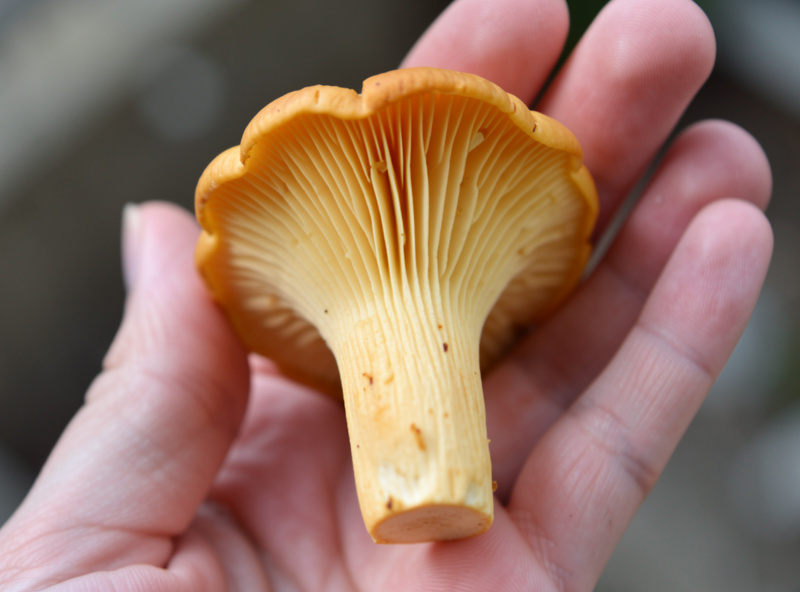
False Gills vs True Gills: The Distinction That Decides Everything
The single most important feature on a chanterelle is what it has instead of gills. Real chanterelles have false gills: shallow, blunt, vein-like ridges that fork and cross like wrinkles, and run partway down the stem. You cannot cleanly peel one off with a fingernail because it is part of the cap surface, not a separate blade.
A toxic jack-o’-lantern, by contrast, has true gills — thin, sharp, knife-edged plates that are clearly separate structures, do not fork the way false gills do, and can be picked at individually. Train your thumb on this difference on known specimens before you ever rely on it in the field. Run a fingertip across the underside: ridges that feel like blunt folds say chanterelle; crisp blades that catch your nail say walk away. This one tactile test does more work than any phone app.
Where and When Chanterelles Grow
Chanterelles are mycorrhizal, meaning they live in partnership with tree roots rather than rotting wood. That ecology shows up in how they grow: they push up singly or scattered directly from the soil, often in loose troops across a hillside, under oak, beech, birch, and conifers depending on region. They do not grow in dense clumps fused at a common base, and they do not grow out of standing trunks or stumps.
Season runs through the warm, wet months — summer into autumn across most temperate regions, peaking a few days after good soaking rains. Because they are tied to specific trees, productive patches recur in the same spots year after year, which makes chanterelles a “learn one good wood and return to it” mushroom. That growth habit — scattered, from soil, never clumped on wood — is itself a frontline ID feature, because the dangerous look-alike breaks every part of it.
There is a useful corollary here for new foragers: habitat narrows the field before you ever pick anything up. If a bright orange mushroom is erupting in a tight bouquet from a stump or the base of a trunk, you do not need to debate the gills — the growth habit alone has already told you it is not a chanterelle. I find that thinking about ecology first, features second, prevents most of the wishful identifications that get beginners into trouble. A chanterelle behaves like a chanterelle long before you crouch down to read its underside.
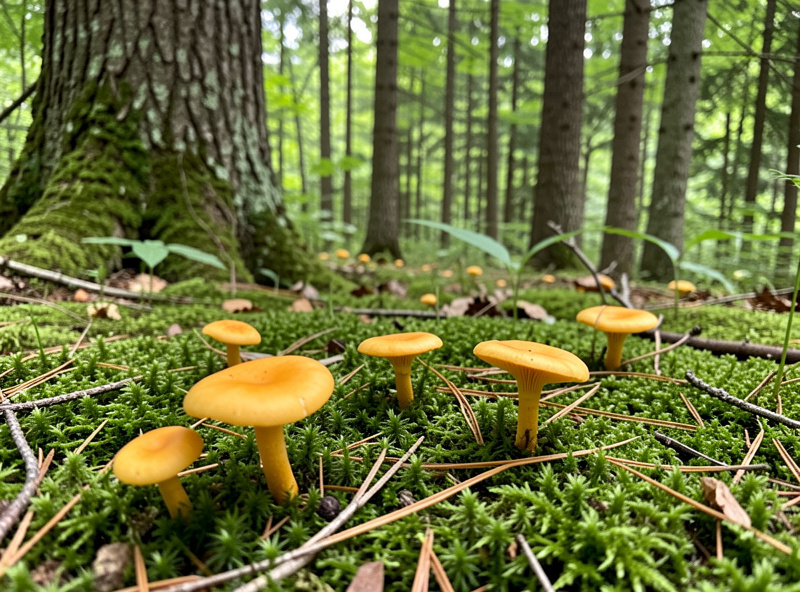
The Look-Alikes That Send People to the Hospital
Two mushrooms get mistaken for chanterelles, and one of them is genuinely dangerous. The jack-o’-lantern (Omphalotus) is the serious one: a vivid orange mushroom that grows in large, dense clusters fused at the base, on or around wood — stumps, the foot of living trees, or buried roots that make it look deceptively soil-borne. It has true sharp gills, orange flesh throughout, and causes severe vomiting and cramping. It is not usually fatal, but it will ruin a week and frighten you badly.
The false chanterelle (Hygrophoropsis) is the milder mimic: more orange, with thinner, more blade-like and repeatedly forked gills, often growing on conifer woody debris. It is widely considered best avoided rather than reliably edible. The table below lines up the three side by side on the features that actually separate them.
| Feature | True Chanterelle | Jack-o’-Lantern (toxic) | False Chanterelle (avoid) |
|---|---|---|---|
| Underside | False gills: blunt forking ridges, decurrent | True gills: thin, sharp, non-forking blades | Thin, soft, repeatedly forked gills |
| Growth habit | Single or scattered, from soil | Dense clusters fused at base, on or near wood | Small groups on conifer wood and debris |
| Flesh inside | Pale, solid, slightly stringy | Orange throughout | Pale orange, soft |
| Smell | Fruity, apricot-like | Faint or none | Faint, unremarkable |
| Edibility | Choice edible | Toxic — severe GI illness | Best avoided |
A Safe Identification Routine You Can Repeat
Here is the order I run every time, and it never changes. Confirm false gills by touch. Confirm the mushroom is growing singly from soil, not clumped on wood. Smell it for that apricot note. Slice it to confirm pale, solid flesh. If you want a fourth check, take a spore print — chanterelles drop a pale yellow to cream print. Only when every check agrees does it go in the basket, and even then I keep first-time finds separate until a second pair of experienced eyes or a local expert confirms them.
No app, no photo match, and no single feature substitutes for that agreeing stack. The discipline that keeps a sterile culture clean is the same one that keeps a forager safe: never trust one signal, and when in doubt, throw it out. If you ever eat a mushroom and feel ill, contact Poison Control or emergency services immediately rather than waiting.
Harvesting and Handling Without Wrecking the Patch
Once a chanterelle is confirmed, how you pick it determines whether the patch produces for you again. I cut or gently twist the mushroom free at ground level rather than digging, which leaves the underground mycelial network — the actual long-lived organism — undisturbed to fruit next season. The visible mushroom is just the fruiting body; the part that matters is below the soil, and there is no reason to damage it for a single harvest.
Chanterelles are sturdier than morels but still hold grit in those ridged false gills, so I brush off loose debris in the field and resist the urge to wash them until just before cooking, because they soak up water readily and turn soggy in the pan. A flat basket keeps them from crushing on the walk out. They keep a few days refrigerated in a paper bag rather than plastic, and they take well to the freezer once sauteed — the full storage playbook lives in our kitchen preservation guide. Take only what you will use, leave the smallest pins to mature, and a good chanterelle wood will feed you for years.
Frequently Asked Questions
What is the difference between false gills and true gills?
False gills, found on real chanterelles, are blunt vein-like ridges that fork and run down the stem and cannot be cleanly peeled off. True gills, found on the toxic jack-o’-lantern, are thin sharp knife-edged plates that are clearly separate and do not fork.
How do I tell a chanterelle from a jack-o’-lantern?
Chanterelles have false gills, grow singly from soil, and smell of apricot with pale solid flesh. Jack-o’-lanterns have true sharp gills, grow in dense clusters on or near wood, and are orange throughout. The clustered-on-wood habit is the clearest warning sign.
Do chanterelles smell like apricots?
Yes. A distinct fruity, apricot-like aroma is one of the three confirming features of a true chanterelle. The smell is not present in the toxic and avoid-list look-alikes, which is why it is a useful part of the identification stack.
What color spore print do chanterelles have?
Chanterelles produce a pale yellow to cream-colored spore print. Taking a print is a useful fourth confirmation step after checking the false gills, growth habit, smell, and solid pale flesh.
Are chanterelles safe for beginners to forage?
Chanterelles are considered one of the more beginner-friendly edibles because their features are tactile and repeatable, but only when every feature is confirmed together. Beginners should have first finds verified by an experienced forager or local expert before eating.
Where do chanterelles grow?
Chanterelles are mycorrhizal and grow from soil in partnership with tree roots, scattered under oak, beech, birch, and conifers. They appear through the warm wet months from summer into autumn, peaking a few days after soaking rain.