
Morels fruit for a few short weeks each spring, and the window opens when the soil temperature at a 4-inch depth holds between roughly 50 and 60°F (10–16°C). Find that overlap near dying elms, ash, and old apple trees, and you find morels. Everything else in morel hunting is just refining where you put your boots.
I forage these the same way I run everything else on the bench — method first, luck second. A morel hunt that produces every year is not about a secret spot. It is about reading trees, ground, and temperature well enough that the secret spot finds you. This guide is the field side of our broader complete field identification guide: how to actually locate the things. For the look-alike side — and morels have one dangerous twin — I keep that in its own dedicated piece, linked below, because it matters too much to bury in a paragraph here.
When Morels Fruit: Read the Soil, Not the Calendar
Morels are a soil-temperature event, not a date on the calendar. The flush begins when 4-inch soil temps stabilize in the low 50s°F and tapers as they push past the low 60s. Air temperature lies to you; ground temperature does not, which is why I trust a cheap soil thermometer pushed into a south-facing slope over any almanac.
The practical sequence most seasons follows the same rhythm: daytime highs reach the 60s°F, nights stop dropping below the 40s, and you get a warm rain. That rain is the trigger I watch for. Three or four days after the first soaking spring rain that lands on warm ground, I start walking. South-facing slopes warm first and fruit first; north-facing slopes run a week or two behind, which is genuinely useful — it means one set of woods gives you a staggered season if you simply follow the warmth uphill and around the compass as the weeks pass.
Where to Look: The Trees Tell You Everything
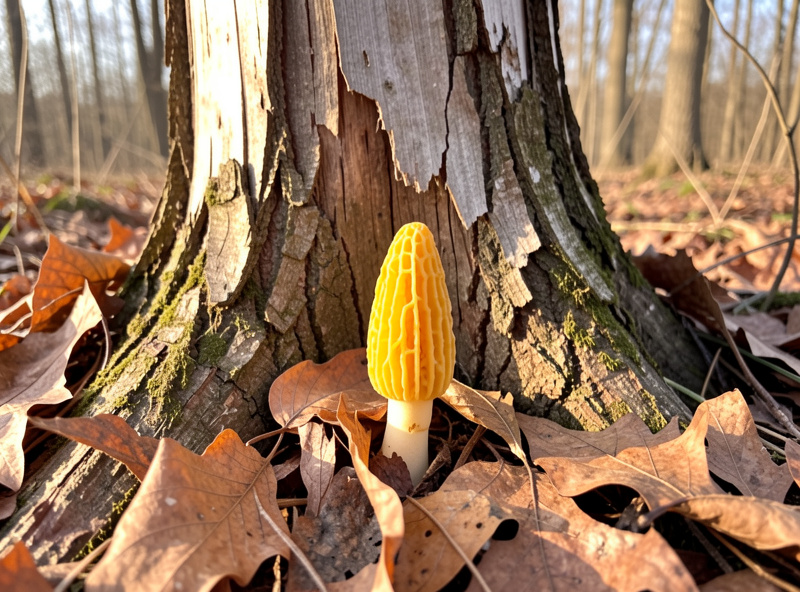
Morels live in relationship with specific trees, and learning those trees is the single highest-leverage skill in the hunt. The classic producer across much of North America is the dying American elm — not a healthy one, and not one that has been dead for years, but a recently dead or dying elm with bark just beginning to slip off the trunk. That narrow window, the season the tree gives up, is when the ground beneath it fruits hardest.
Beyond elm, I work old apple orchards, ash, cottonwood, sycamore, and tulip poplar depending on region. Abandoned homestead apple trees are a reliable bet that hunters overlook because the orchard looks like nothing. Black morels also associate with conifers and, famously, with recent burn sites — ground that burned the previous summer can carpet with black morels the following spring. If you hunt where wildfire passed last year, that is the first place I would walk.
Ground cover matters as much as the canopy. I look at the edges: where the leaf litter is thin, around the drip line of the host tree, on the lips of old creek banks, near rotting logs, and in the transition zones between two habitats. Morels reward the hunter who walks edges rather than marching straight through the middle of a stand.
How to Actually Hunt: Slow Down and Work the Ground
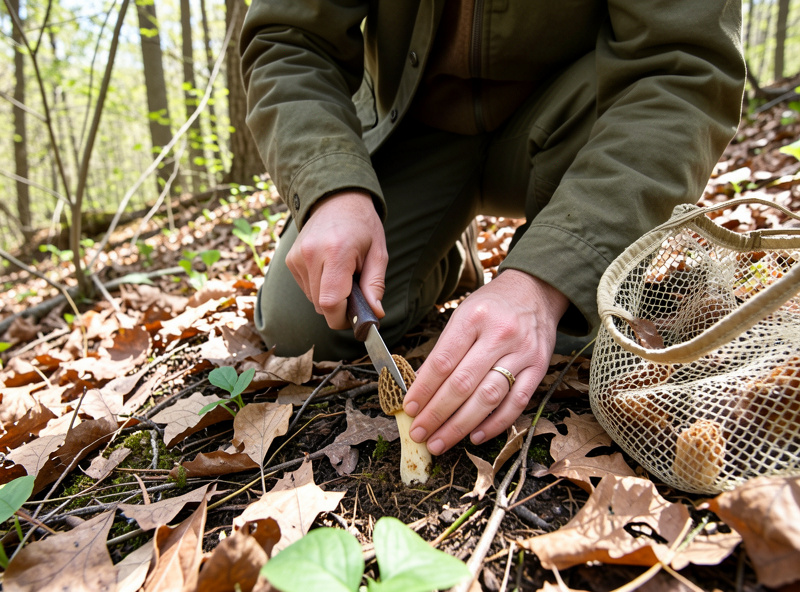
The mistake nearly every new hunter makes is walking too fast. Morels are masters of camouflage — a yellow morel against sun-dappled leaf litter is almost invisible until your eye calibrates. The fix is mechanical: slow to half the pace that feels natural, scan a small arc of ground, take three steps, scan again. Once you spot the first one, stop walking entirely and look around your feet, because morels fruit in loose groups and there are almost always more within arm’s reach.
I carry a mesh bag rather than a solid bucket, and that is not a small detail. Carrying your finds in mesh lets spores sift back down through the woods as you walk — whether or not it measurably reseeds a patch, it costs nothing and it is the kind of low-effort stewardship that keeps a hobby honest. I cut or pinch morels at the base rather than uprooting them, brush off the worst of the dirt in the field, and never strip a patch bare. The full kit I carry is broken down in the foraging gear guide, but the short version is: mesh bag, a small knife, and a soil thermometer earn their place; everything else is optional.
Yellow, Black, and Gray: Knowing the True Morels
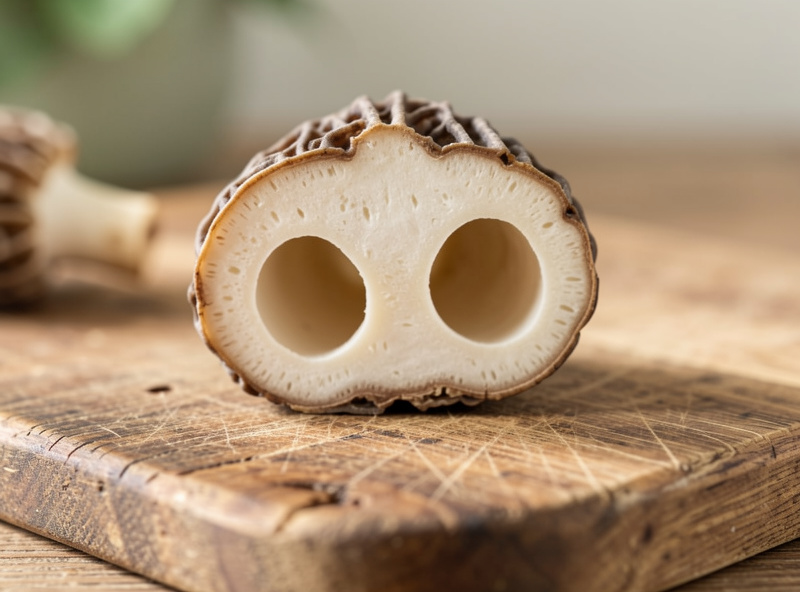
The morels worth carrying home share one structural signature that defines the genus: when you slice one lengthwise, it is completely hollow from the tip of the cap to the bottom of the stem, a single continuous chamber, and the bottom edge of the cap is fused to the stem. That hollow interior and attached cap is the family trait you confirm on every single mushroom before it goes near a pan.
The common true morels shade into one another more than the names suggest. “Gray” morels are typically young yellows; the cap darkens and the body pales and enlarges as it matures into the classic “yellow.” Black morels run darker with more sharply ridged caps and tend to favor conifers and burn sites. Half-free morels have a cap that hangs skirt-like, attached only partway down. They are all edible when properly cooked — but “edible when properly cooked” is doing heavy lifting in that sentence, and it leads straight into the only part of morel hunting I refuse to soft-pedal.
The One Safety Rule That Outranks Everything Else
Never eat a morel you have not positively identified, and never eat any morel raw or undercooked. True morels contain compounds that can cause stomach upset until thoroughly cooked, and there is a dangerous look-alike — the false morel — that contains a toxin chemically related to rocket fuel and has caused fatalities. The single feature that protects you is that hollow interior: true morels are hollow inside, false morels are filled with cottony or chambered tissue. I will not condense the full false-morel comparison here because it deserves its own careful read — see the dedicated morel look-alike guide before you eat anything from your first few hunts.
The discipline that protects a foraging basket is the same one that protects every culture jar on my bench: when in doubt, throw it out. There is no flush of mushrooms worth a hospital trip. If you ever suspect you have eaten a misidentified mushroom, contact Poison Control or emergency services immediately rather than waiting to see how you feel.
Bringing the Haul Home
Morels are fragile and they do not keep long, so handle them gently and plan to deal with them within a day or two. A quick brush in the field, a soak in lightly salted water at home to evict any insects, and a thorough cook is the standard path — the full method lives in our guide to cooking morels safely. If you out-hunt your appetite, the techniques in the kitchen preservation guide will carry the surplus into next winter, and dried morels arguably taste better than fresh. A good problem to have, and the goal of every spring walk.
Frequently Asked Questions
What soil temperature do morels need to fruit?
Morels begin fruiting when soil temperature at roughly a 4-inch depth stabilizes in the low 50s Fahrenheit (about 10 to 16 degrees Celsius) and taper off as it climbs past the low 60s. A soil thermometer is far more reliable than the calendar.
What trees should I look for when hunting morels?
Recently dead or dying American elms with slipping bark are the classic producer, along with old apple orchards, ash, cottonwood, sycamore, and tulip poplar. Black morels also favor conifers and recent burn sites from the previous year’s wildfires.
How can I tell a true morel from a false morel?
Slice it lengthwise. A true morel is completely hollow from cap tip to stem base as one continuous chamber, with the cap fused to the stem. A false morel is filled with cottony or chambered tissue and is toxic. Always confirm before eating.
Can you eat morels raw?
No. True morels must be thoroughly cooked. Raw or undercooked morels contain compounds that cause stomach upset, and a small number of people react even to cooked morels. Never eat any wild mushroom raw without certainty about both its identity and its preparation.
Why do morels fruit so close together?
Morels typically emerge in loose groups tied to a host tree’s root zone or a favorable patch of soil. When you spot one, stop walking and search the immediate area carefully, because there are almost always more within a few feet.