
Morels must be cooked thoroughly and never eaten raw. True morels contain heat-labile toxins that cause nausea, vomiting, and stomach cramps when raw or undercooked, and thorough cooking is what neutralizes them — the exact minute count isn’t a precisely nailed-down scientific threshold, which is why I lean toward cooking a little longer rather than a little less. Get the cook right, avoid the look-alikes, and a morel is one of the finest things you can put in a pan — but the safety steps are not optional.
I forage morels in spring rather than cultivate them — they resist home cultivation in a way the species on my blocks do not — so I treat every basket as wild food: identify with certainty, clean carefully, and cook fully. Here is the complete safe-handling and cooking method, including the false-morel warning that is the genuinely dangerous part.
Why Morels Are Never Eaten Raw
Even correctly identified true morels are toxic raw. Here I want to be precise rather than confident-sounding: the peer-reviewed literature is honest that the exact toxin(s) responsible for true-morel raw-toxicity syndrome are not fully identified — unidentified hemolysins are the leading working hypothesis for the gastrointestinal symptoms, and a separate, rarer neurological syndrome has been documented after eating large quantities (up to roughly 600g) raw or undercooked. This is a genuinely different, unconfirmed-toxin picture from false morels, where the toxin (gyromitrin, below) is definitively identified — worth keeping straight since conflating the two blurs the exact distinction that matters here. Whatever the mechanism, thorough cooking is what neutralizes it, which is why morels are a choice edible when cooked and a guaranteed bad night when not.
The rule is simple: every morel that reaches the plate has been cooked all the way through, not just warmed. A confident butter sauté until fully cooked and browned (below) is the standard home method and the one I use; a peer-reviewed toxicology review describes the more conservative, extra-cautious approach as boiling for at least 10 minutes and discarding the cooking water, which I’d reach for with a large haul, a first-time eater in the house, or any specimen I’m not 100 percent confident about. Do not nibble a raw one to “taste the variety,” do not toss them into a salad, and do not serve them rare in the centre. This raw-toxicity issue is genuine and species-wide, unlike the milder digestibility reason behind cooking cultivated species such as oyster mushrooms — with morels it is a real toxin, not just chitin. A 2025 outbreak investigation found that every restaurant using a genuinely thorough cooking method — sautéing, boiling, or otherwise fully heating the mushrooms — had zero illness cases, while raw or barely-cooked preparations were the common thread in every case.
There is also individual sensitivity to consider: a minority of people react badly to morels even when they are properly cooked, and some report stomach upset when morels are eaten with alcohol. The first time you eat morels, have a small portion, skip the wine with that meal, and wait a day before a full serving. This is standard caution for any wild mushroom new to your own body.
True Morels vs False Morels: The Critical ID
The dangerous mistake is confusing a true morel with a false morel (Gyromitra species), which contains gyromitrin — a compound the body converts to monomethylhydrazine, the same chemical used in rocket fuel (confirmed via StatPearls/NCBI). False-morel poisoning can cause severe liver and nervous-system damage and has been fatal. No cooking method makes them reliably safe, so the only safe rule is: do not eat false morels.
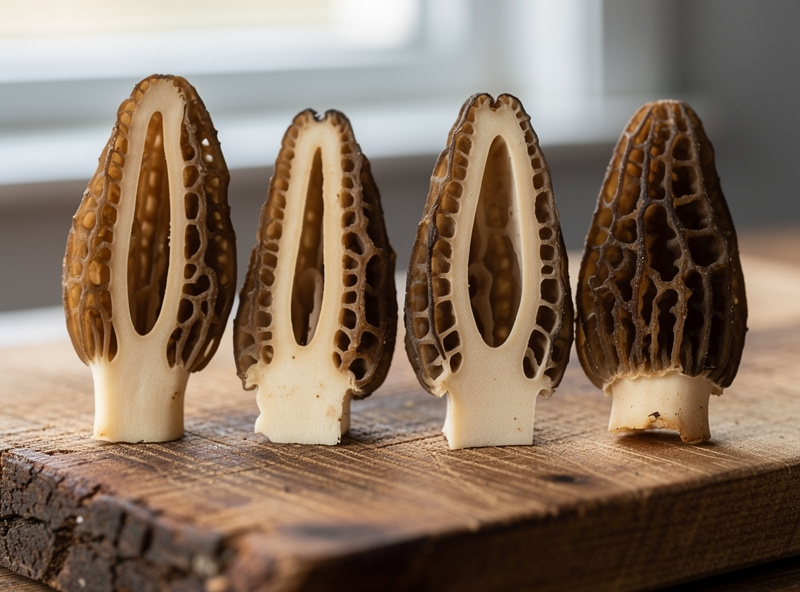
The two are told apart by a few unmistakable features, summarised in the table below. The single most decisive test is to slice the mushroom in half from top to bottom: a true morel is completely hollow inside, one continuous empty chamber from cap to stem base. A false morel is stuffed, cottony, or chambered inside, never cleanly hollow.
| Feature | True Morel (Morchella) | False Morel (Gyromitra) |
|---|---|---|
| Cap surface | Pitted honeycomb ridges | Wavy, lobed, brain-like |
| Interior (cut lengthwise) | Completely hollow | Stuffed, cottony, or chambered |
| Cap attachment | Bottom fused to stem | Cap hangs free from stem |
| Cap shape | Conical to rounded, even | Irregular, saddle or blob |
| Toxin | Heat-labile (destroyed by cooking) | Gyromitrin / MMH (not safely removed) |
| Verdict | Choice edible when fully cooked | Do not eat — discard |
If a specimen is not cleanly hollow, or the cap dangles free like a skirt rather than fusing to the stem, it is not a true morel — discard it. When you are still learning the difference, work through the detailed photo comparison in morel mushroom look-alikes and the broader rules in the mushroom foraging guide before eating a single one. Certain identification comes first; cooking technique is meaningless on the wrong mushroom.
Cleaning Morels Before Cooking
Morels need cleaning because their pitted caps trap grit, soil, and insects. Slice each morel in half lengthwise — this both confirms the hollow interior one more time and opens the pits for cleaning. Swish the halves briefly in a bowl of cool lightly-salted water to flush out bugs and dirt, lift them out, then spread on a towel and pat dry. Do not soak them for long; morels are porous and will waterlog.
A short salted-water swish followed by thorough drying is the balance I have settled on: long enough to dislodge the grit and any larvae hiding in the pits, short enough not to drown the flavour or leave them too wet to sear. Dry morels sear; wet morels steam. If you plan to dry your haul instead of cooking it fresh, that method is in how to dry mushrooms for storage — and rehydrated dried morels must still be cooked thoroughly.
How to Cook Morels
The classic and best preparation is a simple butter sauté: heat butter in a pan over medium-high, add the halved cleaned morels in a single layer, and cook, turning, until they are fully cooked through — no longer glistening or translucent anywhere, edges browned, not just warmed through. In my kitchen that’s rarely less than 8-10 minutes for a normal batch, and I’d rather run it long than short. Season with salt and a little thyme at the end. Judge doneness by how they look, not by a stopwatch — a thin, small morel cooks through faster than a thick one, and “browned and no longer translucent” is the real target underneath any minute count.
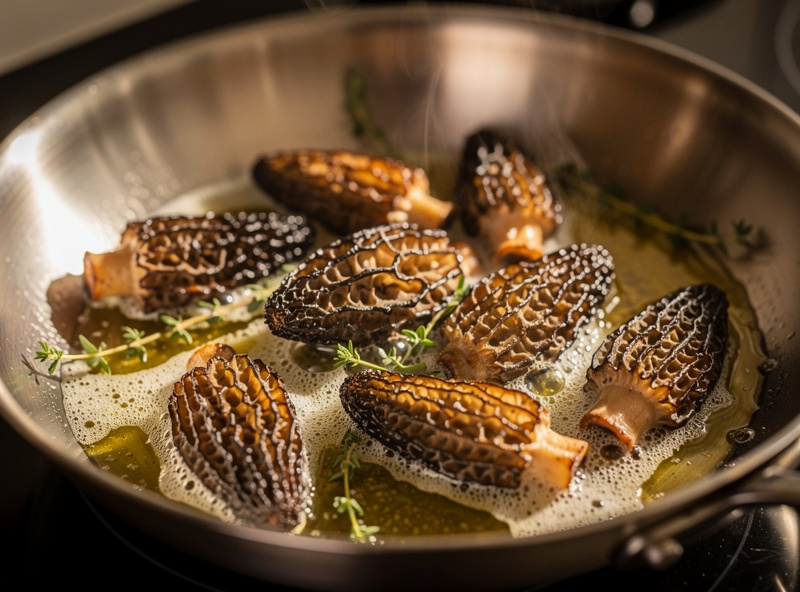
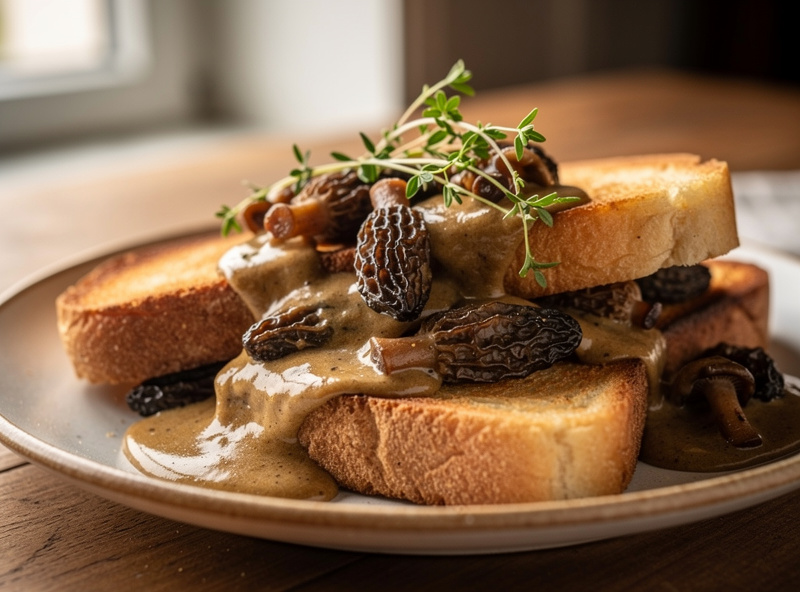
From that base, morels shine in a cream sauce finished with a splash of dry sherry over chicken or pasta, folded into a spring risotto, or piled onto toast. Whatever the dish, the morels go in early enough to get their full cook before serving — never added raw at the end as a garnish. Avoid deep-frying them in a thick batter unless you have already sautéed them through, because a batter shell can insulate the inside from reaching a safe cooked temperature.
Cook in batches rather than crowding the pan, the same way you would cook oyster mushrooms — a packed pan steams and you lose both the browning and the confidence that every piece cooked through. With morels, an evenly cooked batch is a safety matter as much as a flavour one.
Storing a Morel Haul
Fresh morels are fleeting — they keep only 3 to 5 days in the fridge in a paper bag, so a good haul needs preserving fast. Drying is the traditional and best method: morels dry beautifully and rehydrate into an intensely flavoured ingredient, and the soaking liquid becomes a superb stock base. Cook rehydrated morels just as thoroughly as fresh ones.
Morels also freeze well if you par-cook them first, following the same par-cook-then-vacuum-pack routine in how to freeze mushrooms. Whichever route you choose, the broader preservation system that keeps a foraged spring haul usable all year is mapped out in the cooking and preservation hub. Never preserve a morel you would not confidently eat fresh — preservation does not fix a questionable identification.
Gear I reach for: a stainless sauté pan for an even full-through cook, a colander and bowl for the salted-water swish, and a food dehydrator for drying a spring haul.
Disclosure: MycoMansion is reader-supported. As an Amazon Associate I earn from qualifying purchases made through links in this article, at no extra cost to you. I only point to gear I actually use or would buy for my own kitchen.
Frequently Asked Questions
Can you eat morel mushrooms raw?
No. Even correctly identified true morels are toxic raw. The exact toxin isn’t fully identified in the scientific literature, but they contain heat-sensitive compounds (likely hemolysins) that cause nausea, vomiting, and stomach cramps when eaten raw or undercooked, plus a rarer neurological reaction after large raw servings. Cook morels thoroughly until no longer translucent and browned at the edges. Never taste a raw morel or serve them rare in the centre.
How long do you need to cook morels?
There is no precisely established minute count in the scientific literature, so lean conservative. A butter saute usually takes 8 to 10 minutes over medium-high heat until fully cooked through, no longer translucent, and browned at the edges. A peer-reviewed toxicology review describes an extra-cautious alternative: boiling for at least 10 minutes and discarding the cooking water. Cook in batches rather than crowding the pan, so every piece cooks through evenly.
How do you tell a true morel from a false morel?
Slice it lengthwise: a true morel is completely hollow inside, one continuous empty chamber, with a pitted honeycomb cap fused to the stem. A false morel (Gyromitra) is stuffed or cottony inside with a wavy, brain-like cap that hangs free from the stem. If it is not cleanly hollow, discard it.
Are false morels poisonous?
Yes, and potentially fatally so. False morels contain gyromitrin, which the body converts to monomethylhydrazine, causing severe liver and nervous-system damage. No cooking method makes them reliably safe, and the toxin can even be hazardous as vapour during cooking. Do not eat false morels under any circumstances.
Why do morels make some people sick even when cooked?
A minority of people have an individual sensitivity to morels even when properly cooked, and some react when morels are eaten with alcohol. The first time you eat them, have a small portion, skip alcohol with that meal, and wait a day before a full serving to check your own tolerance.
How do you clean morel mushrooms?
Slice each morel in half lengthwise to confirm the hollow interior and open the pits, then swish briefly in cool lightly-salted water to flush out grit and insects. Lift them out, spread on a towel, and pat dry. Do not soak them long, because porous morels waterlog and then steam instead of searing.
Related Articles
- Morel Mushroom Look-Alikes: How to Tell False Morels From the Real Thing
- Mushroom Foraging: The Complete Field Identification Guide
- Mushroom Cooking and Preservation: The Complete Kitchen Guide
- How to Dry Mushrooms for Storage: Dehydrator vs Oven vs Air Dry
- How to Freeze Mushrooms: Par-Cook, Vacuum-Pack, and Store