
For home mushroom fruiting, a 4-tier wire shelf wrapped in a plastic Martha-style cover beats a sealed grow tent for most species, because mushrooms need constant fresh-air exchange and a tent fights you on humidity control. After running both a true Martha tent and a repurposed Vivosun-style grow tent side by side for seasons, I keep coming back to the same verdict: the right “tent” is whichever one lets you hold 85-95% humidity while still venting CO2 several times an hour. The brand name on the zipper matters far less than airflow and your humidifier setup.
This guide compares the Martha approach against repurposed cannabis-style grow tents (Vivosun, Gorilla) specifically for fruiting gourmet mushrooms, and walks through the setup that actually fruits clean flushes. It sits under the broader home mushroom equipment guide alongside sterilization and monitoring gear.
What a Fruiting Tent Actually Does
A fruiting chamber has one job: hold high humidity and stable temperature while allowing frequent fresh-air exchange. Mushrooms breathe oxygen and exhale CO2 the same as we do, and high CO2 causes leggy, deformed fruits with tiny caps. So the chamber has to be humid but not stagnant — the central tension of every fruiting setup. Most beginners get the humidity right and forget the air, then wonder why their oyster clusters look like long stems with no caps.
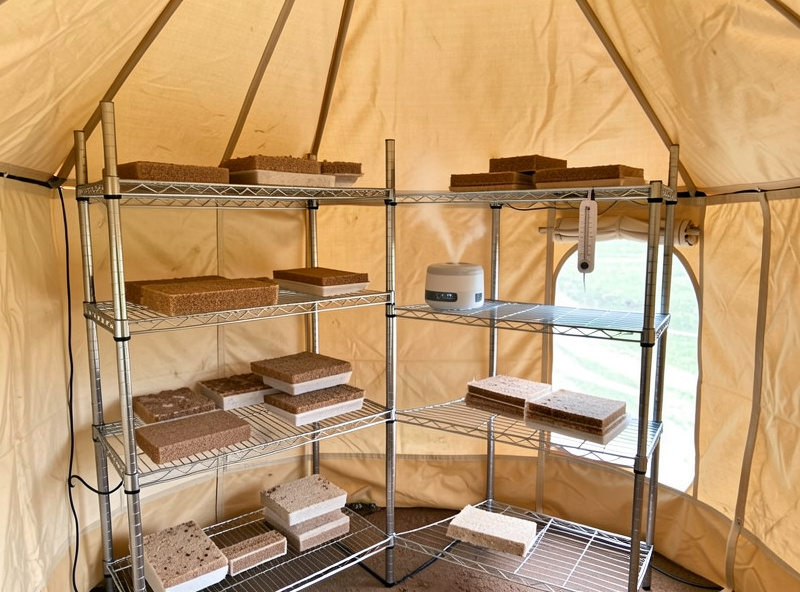
The Martha tent solves this elegantly: it is a vertical wire shelf with a clear or frosted cover, an ultrasonic humidifier feeding mist in, and small gaps plus a circulation fan creating passive air movement. The vertical shelving means you can fruit five or six blocks in a one-square-meter footprint — the best space-to-yield ratio in home growing. For the apartment-scale version of this, see the small-space setup guide.
Martha vs Grow Tent: The Real Difference
A “Martha” is just a clear-zip plastic greenhouse over a 4-5 tier wire rack — cheap, light-transmitting, and easy to wipe down. A grow tent (Vivosun, Gorilla, AC Infinity) is a rigid-pole fabric box built for cannabis: opaque, light-proof, with ducting ports and a sturdier frame. Both can fruit mushrooms, but they push you toward different workflows.
The clear Martha cover lets you watch pins form without unzipping — and every time you open a chamber to check, you dump humidity and dry the delicate pins. The opaque grow tent forces you to open it to inspect, which is a real disadvantage for a moisture-sensitive process. On the other hand, a grow tent’s rigid frame and ducting ports make it trivial to add an inline fan for scheduled fresh-air exchange, and the build quality is far higher. My honest take: Martha for visibility and value, grow tent if you want a bombproof frame and already own one.
| Feature | Martha Tent | Vivosun-Style Grow Tent | Gorilla-Style Grow Tent |
|---|---|---|---|
| Cover | Clear/frosted plastic | Opaque fabric (light-proof) | Opaque heavy fabric |
| Visibility (check pins) | See in without opening | Must unzip to inspect | Must unzip to inspect |
| Frame durability | Light wire shelf | Sturdy poles | Heaviest-duty poles |
| Ducting / FAE ports | DIY gaps + fan | Built-in ports | Built-in ports |
| Footprint efficiency | Excellent (vertical) | Good | Good |
| Best for | Most home growers | Repurposers, durability | Heavy loads, longevity |
Humidity: The Part That Makes or Breaks It
Whatever cover you choose, the chamber is only as good as its humidity control. I run an ultrasonic humidifier on a humidistat to hold 85-95% relative humidity during pinning and fruiting, and I watch a calibrated hygrometer obsessively. Cheap built-in hygrometers lie by 10-15 points, which is enough to ruin a flush — getting an accurate read is non-negotiable, and I cover that in the hygrometer guide.
The humidifier should mist into the chamber, not directly onto the blocks, and the mist needs a small fan to distribute it so you do not get a wet zone and a dry zone. I keep a layer of perlite or a wet towel in the base for buffering humidity between mist cycles. The single most common beginner failure here is letting the humidifier free-run without a humidistat — you end up with standing water, soaked substrate, and bacterial blotch on the caps.
Fresh-Air Exchange Without Drying Out
Fresh-air exchange (FAE) is the counterweight to humidity. Too little and CO2 builds, giving you stems with no caps; too much and you dry the pins before they develop. The art is short, frequent air swaps rather than one big blast. In a Martha I use a small clip fan on a timer cycling a few minutes per hour; in a grow tent I run a low inline duct fan on a similar schedule.
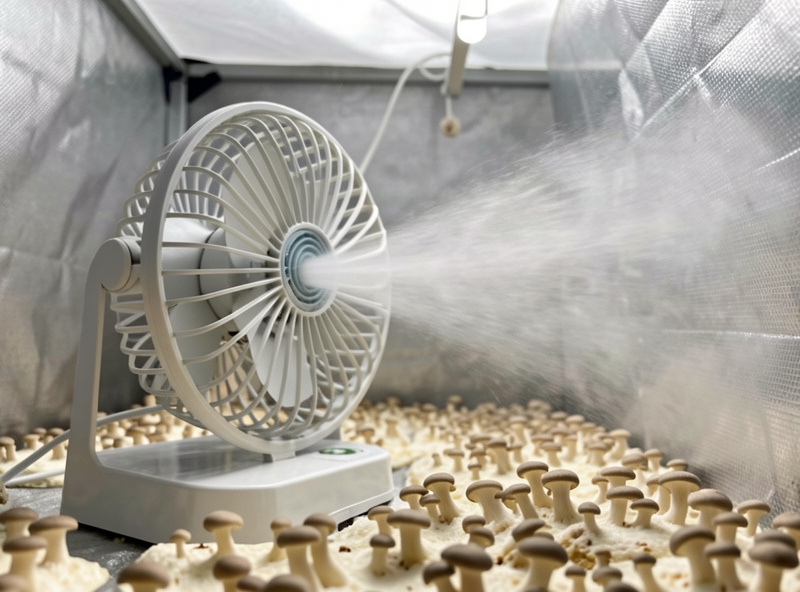
Species change the dial. Oyster is forgiving and tolerates higher CO2; lion’s mane wants more air and lower CO2 to avoid forming a coral-like mess; king oyster needs strong FAE for thick stems. There is no single setting — you read the fruits. Long stems, tiny caps means more air; aborting pins and dry edges means more humidity, less air. After enough flushes you stop reading the gauge and start reading the mushrooms.
Buying and Setting Up: What I’d Tell a Beginner
If you are starting from nothing, the cheapest reliable path is a 4-tier wire shelf and a clear zip cover — the classic Martha. Add an ultrasonic humidifier on a humidistat, a small clip fan on a timer, and a calibrated hygrometer, and you have a complete fruiting environment. As an Amazon Associate I earn from qualifying purchases.
If you want a rigid, long-lived box and don’t mind opening it to inspect, a small grow tent with built-in ducting ports gives you cleaner FAE integration. Either way, set the chamber somewhere temperature-stable — not a drafty garage that swings 20 degrees overnight — and keep it clean. The same contamination discipline that protects my grain jars protects the fruiting chamber: wipe it down between grows, and never let old substrate sit and mold inside.
Frequently Asked Questions
Is a Martha tent better than a grow tent for mushrooms?
For most home growers, yes. The clear cover lets you watch pins form without opening the chamber and drying them out, and the vertical wire shelving fruits more blocks per square meter. A grow tent wins only on frame durability and built-in ducting ports.
What humidity do mushrooms need in a fruiting tent?
Hold 85 to 95 percent relative humidity during pinning and fruiting, measured with a calibrated hygrometer. Run an ultrasonic humidifier on a humidistat and mist into the chamber rather than onto the blocks, with a small fan distributing the moisture evenly.
Why are my mushrooms growing long stems with tiny caps?
That is the classic sign of too much CO2 and not enough fresh-air exchange. Add short, frequent air swaps with a fan on a timer, a few minutes per hour. The goal is humid but not stagnant air so pins develop full caps instead of stretching.
Can I use a cannabis grow tent for mushrooms?
Yes. Vivosun and Gorilla style tents fruit mushrooms fine and their ducting ports make fresh-air exchange easy to wire up. The main downside is the opaque cover, which forces you to unzip and inspect, dumping humidity each time you check on the pins.
Do I need a fan in my mushroom fruiting tent?
Yes. Without air movement, CO2 pools and humidity stratifies into wet and dry zones. A small clip fan or inline duct fan on a timer, cycling a few minutes per hour, gives the fresh-air exchange that produces full caps and even fruiting across all your blocks.