
Yes, you can grow mushrooms in a cold basement through winter — in fact a 50–58°F basement is close to ideal for fruiting oyster and shiitake. The catch is colonization: grain spawn and fresh blocks need roughly 70–75°F to colonize at a reasonable pace, so winter growing is really about adding warmth to one small zone while letting the rest of the room stay cold.
My grow space is in Sweden, so I’ve fought this every year. The first winter I treated the cold basement as a single problem and lost weeks to grain jars that just sat there, barely creeping, while cobweb mold — which is perfectly happy in the cold — got a head start. Once I split the room into a warm colonization pocket and a cold fruiting shelf, winter stopped being a season I dreaded and became the easiest fruiting weather I get all year. Here’s how to run both zones in the same chilly room.
Can Mushrooms Really Grow in a Cold Basement?
They can, and cool-loving species grow better there than in a warm room upstairs. A basement holding 52–58°F all winter is squarely in the fruiting band for blue oyster, pearl oyster, and block shiitake, and the naturally high humidity of a below-grade space means you fight the air less than you would in a dry heated room. This is the single biggest thing beginners get backwards: cold is a fruiting friend.
What cold is not friendly to is the sealed, warm phase of the grow. Colonization — grain spawn myceliating, a fresh block running white — is a warm-weather process that happens inside a bag where humidity doesn’t matter. Drop that process to 54°F and it doesn’t fail, it just slows to a crawl, and slow colonization is dangerous colonization because it hands time to any contaminant that tolerates the cold. So the mental model for the whole winter is two climates: a warm box for colonizing, the cold room itself for fruiting. Get that split right and everything downstream gets easier. The broader logic of why the two phases want opposite conditions is laid out in my guide to grow room climate control.
What Temperature Is Too Cold for Mushrooms?
For fruiting, most gourmet mushrooms slow dramatically below about 50°F and effectively pause near freezing, but cold rarely kills a healthy block outright — it just stalls it until things warm up. For colonization, anything under about 65°F starts costing you real time; at 54°F a rye grain jar that would colonize in ten days on a heat mat can take three weeks or more.
I’ve measured this on my own shelf with a min/max thermometer at block height, and the number that matters is the one at the block, not the one on the wall. A basement wall thermometer reading 58°F often sits over a floor-level shelf running 52°F, because cold air pools low. That 6-degree gap is the difference between an oyster block pinning happily and one sulking for a week. The cold isn’t the enemy; the invisible cold pocket you didn’t measure is. If your grain and blocks are stalling, put a thermometer physically where they sit for 48 hours before you change anything else.
One species note: shiitake blocks actually want a cold shock to trigger fruiting, so a winter basement can force a flush the way a cold-water soak does — a trick I lean on and describe in my write-up on soak-shocking shiitake into a flush. Cold, timed right, is a tool.
How Do You Keep Grain Spawn Colonizing in Winter?
Build one warm pocket and put all your colonizing work in it. A seedling heat mat under a thermostat probe, holding a shelf or tub at a dead-stable 75°F, is the whole solution — it turns a cold basement into a room with one warm island where grain jars, fresh blocks, and liquid culture all run at summer speed while everything else stays cold.
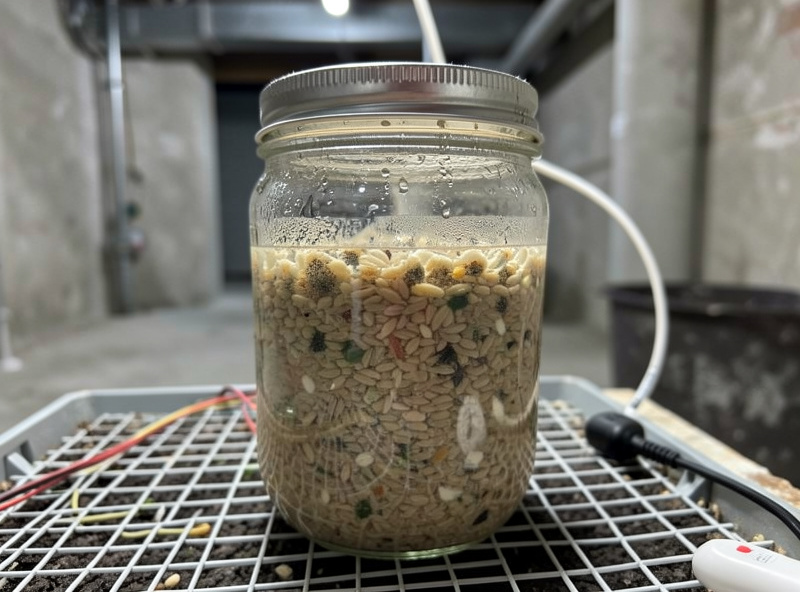
My setup is boring and it works: a VIVOSUN seedling heat mat for the gentle, even bottom heat, wired through an Inkbird ITC-308 thermostat with its probe taped at jar height so it’s controlling the temperature the grain actually feels, not the air three inches away. I set it to 75°F with a 1-degree swing and forget it. The reason I insist on a thermostat rather than a bare heat mat is that an unregulated mat under a small tub can drift up past 90°F, and that cooks the culture — I explain the sizing and wiring in detail in my notes on heat mats and thermostats for incubation, and the full enclosure build is in my DIY incubation chamber write-up. If you want to buy one component to start, a thermostatically controlled seedling heat mat with a thermostat is the piece that makes winter colonization possible.
As an Amazon Associate I earn from qualifying purchases.
Which Mushrooms Fruit Best in a Cold Basement?
Oyster and shiitake are the winter workhorses. Blue and pearl oyster fruit thick and stubby at 52–62°F — the cold actually improves their texture — and block shiitake, which wants a cool spell to pin, treats a winter basement as a natural trigger. King oyster also does well in the low 60s. Save the warm-lovers — pink oyster, reishi — for summer.
The reason cold suits oyster is worth understanding, because it changes how you shop for spawn. In a warm room, oyster tends to long-stem and reach; in the cold it stays compact, and the caps come in denser and darker. I’ve pulled some of my best-looking blue oyster flushes in January off a block sitting at 55°F with nothing but ambient basement humidity and a bit of fan. Match the species to the season and the room does half the work for you — the full species-by-temperature breakdown sits in my grow room climate control guide. If your basement is genuinely frigid, near or below 45°F, most things pause; that’s when you either heat a fruiting tent or switch to a purely seasonal, wait-for-spring approach.
Why Does Winter Humidity Behave Differently?
Cold air holds far less water than warm air, so the same humidifier setting that held a comfortable 88% in autumn can dump soaking condensation in a cold tent in January. That’s the counterintuitive winter trap: the fix for a cold, humid basement is usually less active humidity, not more, because the cold surfaces are already condensing water out of the air onto your blocks.
Standing water on a block surface is exactly what bacterial blotch wants — a slimy, yellow-brown film that ruins caps. In a cold fruiting space the walls of a tent, the plastic of a tub, and the block surface all run colder than the humid air, so moisture condenses there constantly. The move is to run the humidifier less, keep a little air circulating to prevent dead-stagnant pockets, and wipe standing water off surfaces rather than letting it sit. My automated approach uses a controller so the humidifier only fires when the hygrometer actually calls for it — I wired that up in my humidity and FAE controller guide — and in winter that controller spends most of its time off. If you prep bulk substrate in winter without a stove, the cold lime-bath method pairs well with the low-tech seasonal setup.
How Do You Insulate a Grow Tent in an Unheated Basement?
If you want to fruit warm-side species or just stabilize a swinging basement, insulate a small tent rather than trying to heat the whole room. A cheap grow tent or a Martha-style shelf wrapped in foil-faced foam board becomes a stable micro-climate you can hold a few degrees above ambient with almost no energy, because you’re only conditioning a cubic meter, not a cellar.
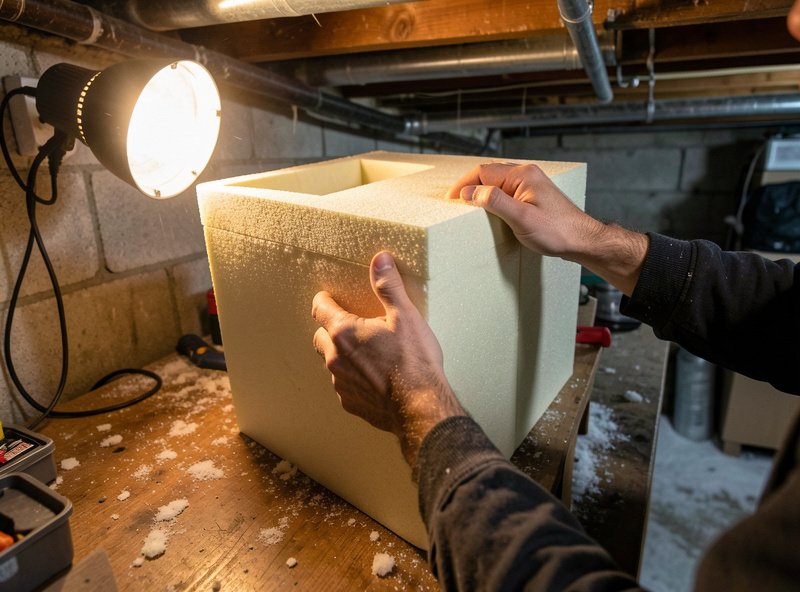
I line the outside of my fruiting tent with 25 mm foil-faced foam board in the coldest months, seams taped, which knocks the day-night temperature swing down noticeably and lets a small heat source hold a stable band. A gentle heat source — a small reptile heat mat on the floor of the tent through the same thermostat, never a bare space heater that dries and roasts — nudges the tent up without wrecking humidity. The whole point is a small, insulated, controllable box; converting a mini greenhouse the same way works beautifully, which I covered in my mini-greenhouse fruiting room write-up. Insulate the small box, condition the small box, leave the cold room cold.
The Winter Mistake That Cost Me a Flush
My worst winter loss came from misreading the humidity. It was a hard January — the basement had dropped to about 48°F — and I saw the tent hygrometer reading a bit low, so I did the obvious dumb thing and cranked the ultrasonic humidifier up and left it running overnight. I came down the next morning to a fruiting tent that had rained on itself: standing water pooled in the tub, condensation sheeting off the cold plastic walls, and my nose caught it before my eyes did — that faint sour, wet-cardboard smell that means bacteria, not the clean anise-sweet smell of healthy oyster. Within two days the young pins had gone slick and yellow with bacterial blotch. The whole flush was compost.
The lesson was the counterintuitive one: in the cold, the humidifier is not your friend, it’s a flood risk. Cold surfaces condense water on their own, and adding more just guarantees standing water. Since then my winter rule is to run the humidifier in short bursts if at all, keep a fan gently moving air so nothing sits wet, and trust the naturally damp basement to do most of the humidity work. I haven’t lost a winter flush to blotch since. Cold-season growing rewards restraint, not effort.
Is a cold basement good or bad for growing mushrooms?
A cold basement is excellent for fruiting cool-loving species like oyster and shiitake, which thrive at 52 to 62 degrees Fahrenheit, and its naturally high humidity helps too. It is bad for colonization, since grain spawn and fresh blocks need about 70 to 75 degrees to run at a good pace. The solution is a small heated colonization zone in an otherwise cold room.
How cold is too cold to grow mushrooms in winter?
Fruiting slows sharply below about 50 degrees Fahrenheit and effectively pauses near freezing, but cold rarely kills a healthy block outright. Colonization suffers below 65 degrees, taking two to three times longer at 54 than at 75. Below about 45 degrees most species pause, and you either heat a small insulated tent or wait for a warmer season.
How do I colonize grain spawn in a cold room?
Use a seedling heat mat controlled by a thermostat, with the probe placed at jar height, holding a small shelf or tub at a stable 75 degrees Fahrenheit. This creates one warm island in a cold room so grain jars and blocks colonize at normal speed. A bare heat mat without a thermostat can overheat and cook the culture, so the controller is essential.
Why is there so much condensation in my winter grow tent?
Cold air holds much less moisture than warm air, so cold tent walls and block surfaces condense water out of humid air constantly. Running a humidifier at summer settings makes it worse and causes standing water, which invites bacterial blotch. In winter, run the humidifier in short bursts or not at all and keep gentle air movement to prevent standing water.
What mushrooms grow best in winter?
Blue and pearl oyster and block shiitake are the best winter growers because they fruit well in cool temperatures and shiitake even needs a cold spell to trigger fruiting. King oyster also does well in the low 60s. Save warm-loving species like pink oyster and reishi for summer, since they stall in a cold basement.
Further Reading
Winter growing is one branch of the bigger climate picture, and university programs are the soundest sources for the underlying numbers — the Cornell Small Farms Program and University of Minnesota Extension both publish grounded specialty-mushroom material. From here, keep building:
- Mushroom grow room climate control — the full picture the winter zones fit into.
- Soak-shocking shiitake into a flush — use winter cold to trigger fruiting.
- Heat mats and thermostats for incubation — build the warm colonization pocket.
- Converting a mini greenhouse into a fruiting room — a small insulated box to condition.
If I were setting up for my first cold-season grow today, I’d buy the thermostat-controlled heat mat before anything else, put a min/max thermometer at block height, and fruit oyster on the cold shelf while the grain colonizes on the warm one. Two zones, one cold room — that’s the whole trick.