
Pearl and pink oyster mushrooms colonize garden waste, coffee grounds, and pasteurized straw in 14-21 days in a 5-gallon bucket. Five pounds of garden waste produces 1.5-2.5 lb of fresh oyster mushrooms over 2-3 flushes, plus composted substrate that enriches the next bed.
Oyster mounds are one of three outdoor systems worth running together — logs and wine cap beds fill the other two; see my outdoor mushroom growing guide for the combined plan.
Mushroom cultivation has a reputation for being technical — laminar flow hoods, pressure cookers, agar plates. Oyster mushrooms break that mold. They are aggressive enough that pasteurized straw and coffee grounds at room temperature in a perforated bucket consistently produce mushrooms with no sterile lab work. This guide covers the substrate prep, the bucket-tek and column-tek setups that work in a kitchen or garage, and the garden integration that closes the loop on coffee grounds, straw mulch, and woody pruning waste.
Why Oyster Mushrooms Specifically
Three properties make oyster mushrooms the right entry-level cultivar for garden-to-fungi work. First, aggressive colonization: oyster mycelium outgrows most contaminating molds, which lets you skip the sterilization steps required for shiitake or lion’s mane. Second, broad substrate tolerance: they grow on straw, coffee grounds, sawdust, cardboard, paper, and most woody waste, with virtually no other cultivated mushroom matching this range. Third, fast yields: 21-30 days from start to first harvest, with a second flush 10-14 days later. By comparison, a shiitake log takes 12-18 months to first fruit.
The yield economics are concrete. A 5-gallon bucket of pasteurized straw plus 250 g of grain spawn ($8-$12) typically produces 1.5-2.5 lb of fresh oyster mushrooms across 2-3 flushes, total cost about $0.20-$0.30 per ounce of finished mushroom. Grocery store oyster mushrooms run $4-$7 per ounce. The math works as soon as you produce more than 6 oz from a single bucket.
Substrate Options That Use Garden and Kitchen Waste
Spent Coffee Grounds (Highest Yield, Easiest Start)
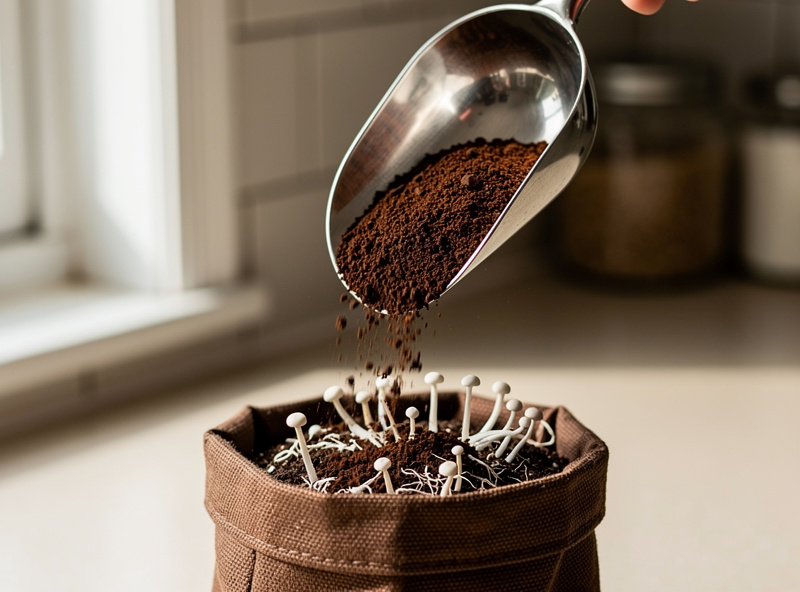
Used coffee grounds are the simplest substrate available — they come pre-pasteurized by the brewing process, hold moisture well, and are stored for free in any kitchen — but pure coffee-only substrates fail 60-70% of the time without supplementation. The catch is they need to be used or refrigerated within 24 hours of brewing or contamination accelerates. Most home setups collect grounds for 5-7 days in a sealed container in the fridge until you have enough for a batch.
Mix ratio: 4 parts spent coffee grounds + 1 part pasteurized straw or hardwood pellets, by weight. Inoculate with 5-10% by weight of grain spawn. Pack loosely into a 1-2 gallon container with 4-6 air slits for fruiting. First flush in 14-18 days at 65-72 °F.
Pasteurized Wheat Straw (Highest Volume, Outdoor-Friendly)
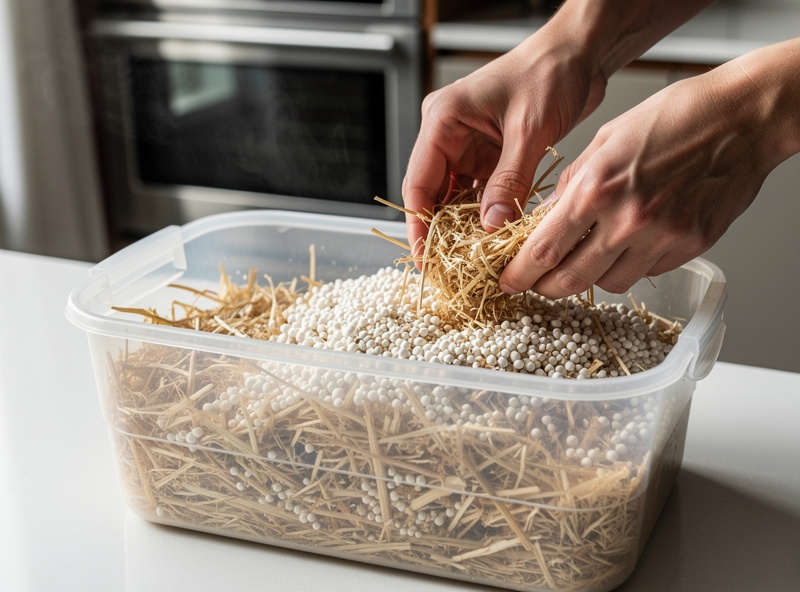
The classic oyster substrate. Pasteurized in 165-180 °F water for 1-2 hours (a turkey fryer or 5-gallon stockpot works), drained to ~65% moisture content (squeeze test: a fistful drips a few drops, not a stream). Layer with grain spawn at 5-10% in a 5-gallon bucket with 1/2-inch holes drilled every 4 inches. First flush in 18-25 days.
This is the right substrate for any garden with a regular straw mulch supply. Bonus: spent substrate after fruiting is excellent garden mulch — partially decomposed, rich in microbial life, and an active soil-builder.
Hardwood Pruning Waste (Slowest, Highest Long-Term Yield)
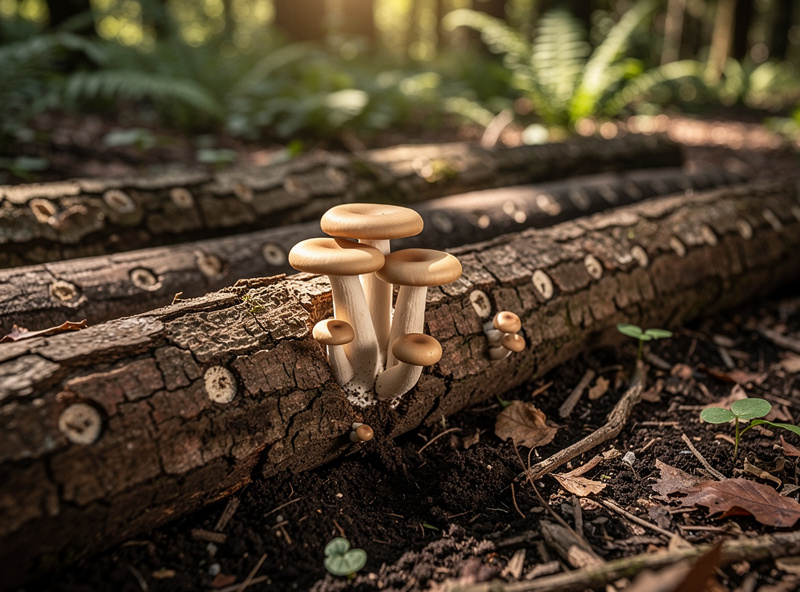
Oyster mushrooms grow on small woody waste from oak, beech, maple, and most non-resinous hardwood pruning. The setup is “log-tek”: drill 5/16-inch holes 6 inches apart in 4-6 inch diameter logs, hammer in dowel spawn ($25 per 100 dowels), seal with cheese wax, stack in a shaded spot for 6-12 months until first fruit. Yields continue for 4-6 years per log.
For homes with regular pruning waste from fruit trees, ornamentals, or coppice work, log-tek is the most rewarding long-term setup. Pair with our outdoor mushroom growing guide for the broader log inoculation workflow.
The 5-Gallon Bucket Method (Step by Step)
The canonical home setup. Total active time: 2 hours. Total elapsed time to first harvest: 21-30 days. Total cost (after equipment): $8-$15 per bucket.
Day 0 (preparation, 90 minutes):
- Drill 12-16 holes (1/2 inch diameter) around the bucket in a hex pattern, every 4 inches.
- Pasteurize the straw or substrate: hold at 165-180 °F for 1-2 hours, drain.
- Cool to room temperature (under 80 °F) — too hot kills the spawn.
- Layer in the bucket: 2 inches substrate, sprinkle grain spawn, 2 inches substrate, sprinkle, repeat.
- Seal with the lid (lightly, not air-tight). Set in a 65-72 °F room out of direct sun.
Days 7-14 (colonization): White mycelium spreads through the substrate. Mostly hands-off; check that the bucket has not dried out (it should not in a sealed setup).
Days 14-21 (pinning): Small mushroom primordia (“pins”) form at the holes. Move the bucket to a higher-humidity environment if available (a bathroom shower works), or mist the openings 2-3 times a day.
Days 18-25 (first harvest): Cut mushrooms off when caps are 80% open. Refrigerate, eat within a week.
Day 25-40 (second flush): Soak the bucket in cold water for 12 hours, drain, place back in the fruiting environment. Second flush forms in 10-14 days. Often a third flush follows; yield diminishes by 30-50% each flush.
The Garden Integration: Spent Substrate as Soil Amendment
The best part of the garden-to-fungi loop is what happens after fruiting. For indoor monotub growing with a different substrate approach, read our CVG substrate recipe. Spent oyster mushroom substrate is one of the most valuable garden amendments available — it has been pasteurized, broken down by mycelium, and is now a living soil-microbiome accelerator. Tilled into a vegetable bed at 1-2 inches depth, it improves soil structure, water retention, and microbial activity for at least 12-18 months.
The full nitrogen-and-carbon math behind why this works is in CityRooted’s complete soil and compost guide — that hub covers the C:N ratios that determine whether a soil amendment feeds plants or competes with them, and spent mushroom substrate sits in the sweet spot. Pair with the broader best compost for vegetable garden guide for what else to add to a bed in spring.
For garden waste flowing INTO the mushroom system: collect non-resinous pruning waste, spent coffee grounds, cardboard, and used straw mulch in a sealed bin. Process every 4-6 weeks into bucket batches. Once you reach a steady-state flow of 1-2 buckets every 3 weeks, the household produces 2-4 lb of fresh mushrooms per month from waste that was going into the compost or trash.
Substrate Comparison Table
| Substrate | Pasteurization | First Flush | Total Yield | Setup Cost | Best For |
|---|---|---|---|---|---|
| Spent coffee grounds + 20% straw | None (already pasteurized) | 14-18 days | 1.5-2 lb / bucket | $8-$12 | Beginners, kitchen-scale |
| Pasteurized wheat straw | 165-180 °F, 1-2 hr | 18-25 days | 2-3 lb / bucket | $10-$15 | Highest yield indoor |
| Hardwood log inoculation | None (sealed with wax) | 6-12 months | 1-3 lb / log / year × 4-6 yr | $25-$40 per 5 logs | Long-term outdoor |
| Cardboard (laminated) | Hot water soak | 21-28 days | 0.8-1.5 lb / setup | $5-$8 | Tiny-space experimentation |
| Hardwood sawdust + bran | Sterilized in pressure cooker | 14-21 days | 2-3 lb / bag | $12-$18 per bag | Production scale |
Common Failure Modes (And How to Avoid Them)
Five issues account for almost every failed bucket — caught early, most are fixable if you can tell contamination from healthy mycelium:
- Substrate too wet or too dry. Squeeze test target: a fistful drips 2-3 drops, not a stream and not nothing. Wet substrate grows green mold (Trichoderma); dry substrate fails to colonize.
- Spawn added too hot. Pasteurized substrate must be cooled below 80 °F before adding spawn. Heat kills mycelium instantly.
- Contamination from non-pasteurized additions. Adding fresh garden waste or unpasteurized coffee grounds at any step lets contamination in. Pasteurize everything except commercially-spent grounds.
- Wrong fruiting temperature. Pearl oyster fruits at 60-72 °F; pink oyster at 75-85 °F; phoenix oyster at 65-75 °F. Hot summer kitchens need pink oyster strain; cool basements need phoenix or pearl.
- No fresh air exchange during fruiting. CO2 buildup distorts mushroom shape (long stems, tiny caps). Open the bucket lid 1-2 minutes per day during pinning, or transfer to a humidity tent with passive air exchange.
For broader troubleshooting on contamination, mold identification, and substrate diagnostics, see our contamination and troubleshooting hub.
Frequently Asked Questions
What is the easiest mushroom to grow at home?
Pearl oyster (Pleurotus ostreatus) on spent coffee grounds plus pasteurized straw in a 5-gallon bucket. No sterile lab equipment needed, first flush in 14 to 18 days, total cost under 15 dollars per bucket. Pink oyster is similar but prefers warmer temperatures (75 to 85 F).
Can I really grow mushrooms on coffee grounds?
Yes, very successfully. Spent coffee grounds come pre-pasteurized by the brewing process and oyster mycelium colonizes them aggressively. Mix at 4 parts grounds to 1 part pasteurized straw, inoculate with 5 to 10 percent grain spawn by weight, fruit in 14 to 18 days.
How much yield should I expect from one 5-gallon bucket?
1.5 to 2.5 pounds of fresh oyster mushrooms across 2 to 3 flushes from a typical pasteurized straw plus coffee grounds bucket. The first flush is largest (60 to 70 percent of total); each subsequent flush yields 30 to 50 percent less than the previous.
What can I do with spent mushroom substrate?
Till it into vegetable beds at 1 to 2 inches depth as a soil amendment. Spent oyster substrate is pasteurized, broken down by mycelium, and rich in microbial life. It improves soil structure, water retention, and microbial activity for at least 12 to 18 months. One of the most valuable garden amendments available.
Do I need a sterile setup or pressure cooker?
Not for oyster mushrooms specifically. Their aggressive colonization outpaces most contamination on simply-pasteurized substrate. Pressure cooker sterilization is necessary for shiitake, lion’s mane, and other cultivars. The pasteurization needed for oysters is a 1 to 2 hour hot water bath at 165 to 180 F.
How long does it take from setup to first harvest?
21 to 30 days for indoor bucket cultivation. 14 to 18 days on coffee grounds, 18 to 25 days on pasteurized straw. Outdoor log-tek takes 6 to 12 months to first fruit but produces for 4 to 6 years per log.