
Mushroom seasoning powder is the most useful thing I make from a dried harvest: take fully dried shiitake and porcini, grind them in a dedicated spice grinder for 60 seconds, and you have a fine umami powder that makes soups, eggs, popcorn, and pan sauces taste like they simmered for hours. A teaspoon does the work of a stock cube with none of the additives.
There are really two different mushroom powders, and conflating them is the usual mistake. Culinary umami powder comes from savoury species like shiitake, porcini, and dried oyster, and it goes in food. Medicinal powder comes from lion’s mane, reishi, and turkey tail, and it goes in tea or capsules — that is a separate workflow covered in the medicinal mushrooms home guide. This article is about the seasoning kind.
Start With Fully Dried Mushrooms
You can only powder snap-dry mushrooms — any residual moisture turns the grinder into a gummy paste and the finished powder will clump and spoil. Dry slices at 45-50 C until they snap rather than bend (under 8 percent moisture), exactly as for storage. If your stored dried mushrooms have softened from humidity, run them back through the dehydrator for an hour before grinding.
The species that make the best seasoning powder are the ones with concentrated savoury flavour: shiitake is the backbone — the drying process itself is what produces its guanylate, the umami compound fresh shiitake barely carries (see the mechanism explained by a Japanese dried-shiitake producer) — dried porcini adds a nutty woodland note, and dried oyster rounds it out with body. In my own drying runs, lion’s mane and other delicate-aromatic species never make a seasoning powder worth keeping; whatever gives them their character doesn’t survive grinding and storage the way shiitake’s umami compounds do, which is why I only powder those species for the medicinal-tea route. The full drying method is in how to dry mushrooms for storage.
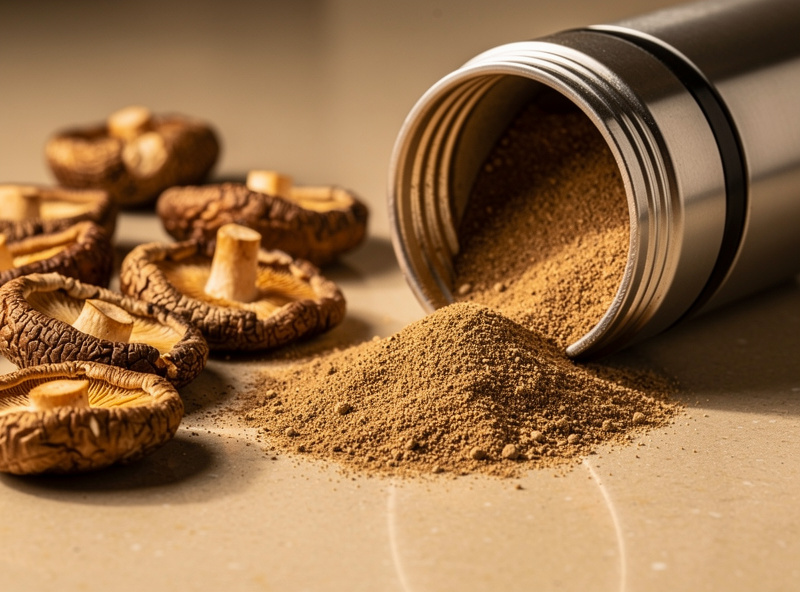
Snap a slice in half before grinding — if it bends or feels cool and leathery, it is not dry enough. This dryness test takes two seconds and saves a ruined batch. Mushrooms from my own blocks are easy to dry to this point; foraged porcini sometimes needs a longer run because it comes in thicker.
Use a Dedicated Grinder
Grind mushroom powder only in a grinder reserved for it. A cheap electric coffee/spice grinder turns dried slices into fine powder in about 60 seconds, but residual coffee oils will taint the mushroom flavour and, worse, residual mushroom flavour ruins your coffee. I keep a second 15-dollar grinder that grinds nothing but dried mushroom, and it has paid for itself many times over.
For the finest powder, pulse in short bursts to avoid heating the powder (which drives off aroma), then sieve through a fine-mesh strainer and re-grind the coarse fraction. This isn’t just a kitchen superstition — food-science research on grinding other aromatic plant material (a peer-reviewed study on cumin is the clearest example) consistently finds that heat generated during grinding degrades volatile aromatic compounds faster than a cool, short-burst grind does, which is exactly why the pulse-and-rest technique matters here too. The sieved ultra-fine powder dissolves seamlessly into sauces and broths without a gritty texture. A blade grinder is fine; you do not need anything more specialised for kitchen quantities.
Seasoning Blends Worth Making
Once you have the base umami powder, a handful of blends cover almost every use. The table below is my working set, with the species mix and the dishes each one suits best.
| Blend | Best Species Mix | Add-Ins | Use On | Shelf Life |
|---|---|---|---|---|
| Pure umami powder | Shiitake + porcini | None | Soups, sauces, risotto | 6-12 months |
| Mushroom salt | Shiitake + oyster | 3:1 flaky salt | Eggs, popcorn, fries | 12 months |
| Umami bouillon | Shiitake + porcini + oyster | Dried garlic, onion, salt | Instant broth, gravy base | 6-9 months |
| Steak and roast rub | Porcini-heavy | Black pepper, thyme, salt | Beef, lamb, roast veg | 6 months |
| Finishing dust | Shiitake | None (ultra-fine sieved) | Pasta, scrambled eggs | 6-8 weeks (best) |
| Ramen seasoning | Shiitake + porcini | Sesame, dried seaweed, salt | Noodles, rice bowls | 6 months |
Mushroom salt is the gateway blend: grind dried shiitake and oyster, mix three parts flaky salt to one part powder, and you have a finishing salt that makes a fried egg taste extraordinary. The porcini steak rub is the one guests ask about — porcini-heavy powder with cracked pepper and thyme, pressed onto beef before searing, builds a savoury crust no plain salt-and-pepper matches.
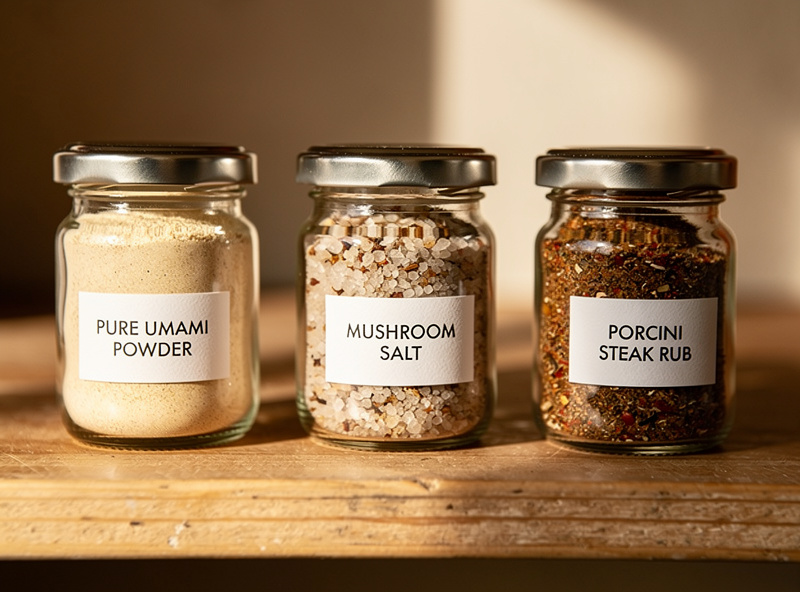
An umami bouillon blend — mushroom powder with dried garlic, onion, and salt — turns a mug of hot water into instant savoury broth and replaces commercial stock cubes entirely. It is also the fastest way to deepen a soup or gravy that tastes flat. For full liquid stock from scraps rather than an instant powder, see mushroom stock and broth.
How to Use Mushroom Seasoning Powder
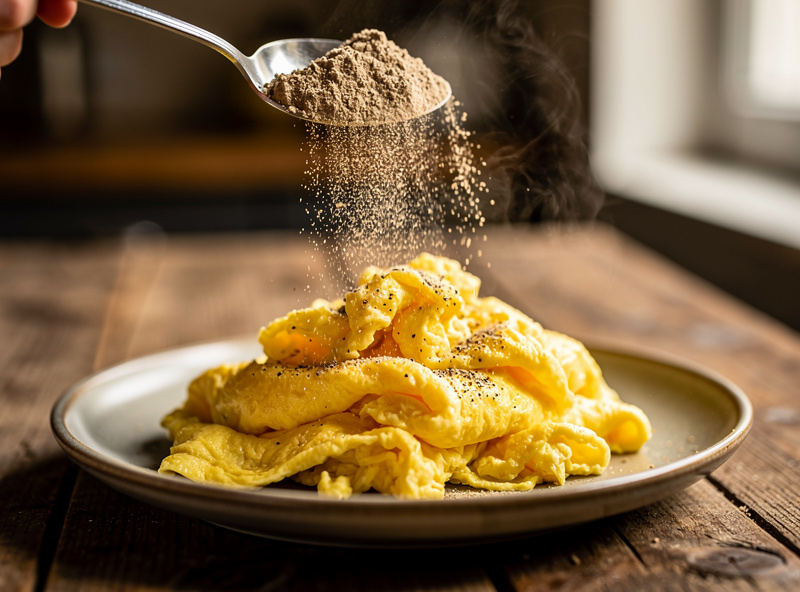
Mushroom powder works as a savoury amplifier almost anywhere you want depth without adding obvious mushroom pieces. Stir a teaspoon into pasta sauce, chilli, or risotto in the last few minutes; dust it over scrambled eggs or popcorn as a finishing seasoning; whisk it into gravy or a pan sauce as both flavour and a light thickener, since the powder absorbs liquid and adds body.
The one rule is to add it toward the end of cooking when used as a finishing seasoning — prolonged boiling dulls the aromatic top notes. As a base flavour in a long-simmered stew, add it early; as a finishing dust on a plated dish, add it last. A little goes a long way: half a teaspoon noticeably lifts a dish for two, and a full teaspoon can dominate. It also pairs naturally with the dishes in shiitake recipes, where a dusting of the powder reinforces the fresh caps.
Storage and Shelf Life
Mushroom powder has a shorter shelf life than whole dried slices because grinding multiplies the surface area exposed to oxygen, which accelerates oxidation and flavour loss. Whole dried slices keep 2-3 years; ground powder holds good quality for 6-12 months in an airtight jar, but the bright aromatic notes are best within the first 8 weeks. My rule is to grind only what I will use in two months and keep the rest as whole slices.
Store powder in a small airtight glass jar, away from light and heat, with the lid kept tight between uses — every opening in a humid kitchen lets moisture in, and damp powder clumps and stales fast. A tiny food-grade silica or oxygen absorber in the jar extends quality. Label each jar with the blend and grind date so you use the oldest first, the same dated-rotation discipline that runs the whole preservation pantry.
Gear I reach for: a dedicated electric spice grinder kept for mushrooms only, a set of small glass spice jars for the blends, and a fine-mesh sieve for sifting out ultra-fine finishing dust.
Disclosure: MycoMansion is reader-supported. As an Amazon Associate I earn from qualifying purchases made through links in this article, at no extra cost to you. I only point to gear I actually use or would buy for my own kitchen.
Frequently Asked Questions
What mushrooms make the best seasoning powder?
Shiitake is the backbone because its guanylate gives the deepest umami, with dried porcini for a nutty woodland note and dried oyster for body. Avoid delicate-aromatic species like lion’s mane for seasoning, since powdering disperses their volatile flavour. Those species are better powdered only for medicinal tea or capsules.
How do you make mushroom powder?
Dry mushrooms until they snap rather than bend, then grind the slices in a dedicated spice grinder for about 60 seconds until fine. For the smoothest powder, pulse in short bursts, sieve through a fine-mesh strainer, and re-grind the coarse fraction. Store in an airtight glass jar away from light.
Can you use a coffee grinder for mushroom powder?
Yes, but use one reserved only for mushrooms. A cheap electric coffee or spice grinder powders dried slices in 60 seconds, but residual coffee oils will taint the mushroom flavour and residual mushroom flavour ruins coffee. A dedicated second grinder solves it for about 15 dollars.
How long does mushroom powder last?
Mushroom powder keeps good quality for 6 to 12 months in an airtight jar, though the bright aromatic notes are best within the first 8 weeks. Grinding multiplies the surface area exposed to oxygen, so powder oxidises faster than whole slices, which keep 2 to 3 years. Grind only what you will use soon.
How do you make mushroom salt?
Grind dried shiitake and oyster to a fine powder, then mix three parts flaky salt to one part mushroom powder. The result is a finishing salt that lifts fried eggs, popcorn, and fries. Keep it in an airtight jar; the salt helps preserve it, so it lasts up to 12 months.
When do you add mushroom powder while cooking?
Add it early as a base flavour in long-simmered stews and sauces, but add it at the end when using it as a finishing seasoning, because prolonged boiling dulls the aromatic top notes. Half a teaspoon lifts a dish for two; it also lightly thickens sauces because the powder absorbs liquid.