
Mushroom jerky is the most addictive thing I make from a king oyster harvest: slice the dense stems into strips, marinate them in soy, maple, and smoke, and dehydrate until chewy. The result is a savoury, smoky, genuinely meaty snack with real pull and bite. King oyster is the species that makes it work — its solid stem holds a jerky texture nothing else quite matches.
This is a different process from drying mushrooms for storage. Pantry drying takes slices to a brittle snap at low temperature for years of shelf life; jerky is dried hotter, marinated, and stopped earlier at a pliable, chewy stage. It is a snack that keeps for weeks, not a preserved staple — a distinction worth understanding before you start, and one that the cooking and preservation hub lays out across all the methods.
Best Mushrooms for Jerky
The best jerky mushroom is king oyster, because its dense, solid stem slices into meaty strips that hold a satisfying chew. Oyster mushrooms work well too — torn into strips they crisp at the edges and stay chewy in the middle — and shiitake caps make a firmer, more intense jerky. Soft, watery species do not have the body to become jerky; they just shrivel.
King oyster is my default for the meatiest result: sliced lengthwise into 5 mm planks or cross-cut into thick coins, it dehydrates into strips with a texture people genuinely mistake for meat jerky. Oyster fronds give a more delicate, bacon-like chew, and shiitake brings the deepest umami of the three. All of these are species I grow, and the same density that makes king oyster great for jerky is what makes it sear like a scallop in how to cook oyster mushrooms.
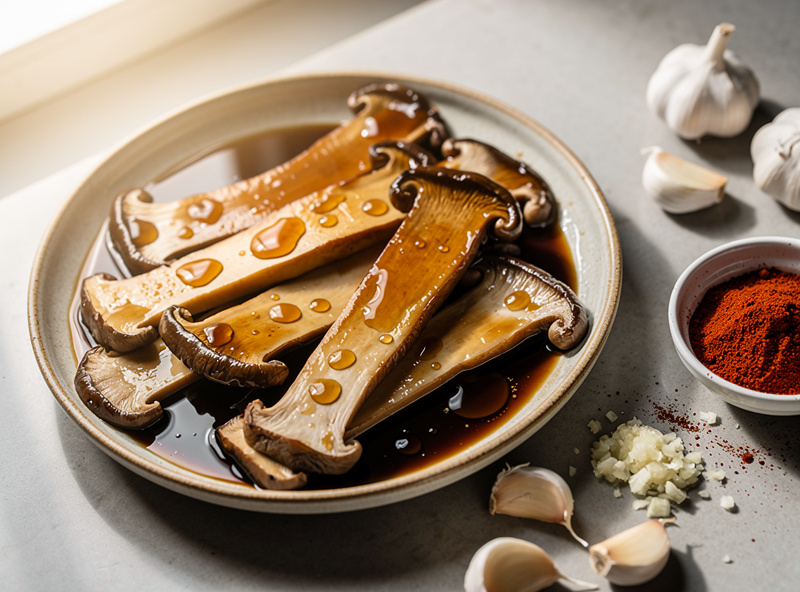
Whatever species you use, cut for chew: too thin and the jerky turns brittle and snaps, too thick and the centre stays damp and never sets. A 5 mm thickness is the sweet spot for king oyster planks; oyster fronds can go as they tear naturally; shiitake caps go whole or halved depending on size.
The Marinade
A good mushroom jerky marinade balances salt, sweet, smoke, and umami. My standard mix for 500 grams of sliced mushrooms: 4 tablespoons soy sauce, 1 tablespoon maple syrup or brown sugar, 1 teaspoon liquid smoke, 1 teaspoon smoked paprika, 2 cloves crushed garlic, and plenty of black pepper. Toss the slices through it and marinate for at least 30 minutes, or up to overnight in the fridge for a deeper-flavoured result.
Do not over-marinate delicate oyster fronds — they soak up liquid fast and turn too salty and soggy past a couple of hours, while dense king oyster happily takes an overnight soak. Before dehydrating, lift the slices out and pat them with a paper towel; surface marinade that is too wet just steams and slows the dry. The flavour levers here — smoked paprika, soy, maple — are the same ones that build a good mushroom seasoning blend.
Jerky by Species and Cut
Each species has a cut, marinate time, and dehydrate window that gives the best chew. The table below is my working reference, built from drying batch after batch off my own blocks.
| Species | Cut | Marinate Time | Dehydrate | Chew Result |
|---|---|---|---|---|
| King oyster | 5 mm planks or coins | 2 hr to overnight | 60 C, 6-8 hr | Meaty, dense pull |
| Oyster | Torn fronds | 30-60 min | 60 C, 4-6 hr | Bacon-like, crisp edge |
| Shiitake | Whole or halved caps | 1-2 hr | 60 C, 5-7 hr | Firm, deep umami |
| Lion’s mane | Pulled chunks | 1 hr | 60 C, 5-7 hr | Stringy, tender chew |
| Maitake | Separated fronds | 1 hr | 60 C, 5-6 hr | Crisp-chewy, ruffled |
| Cremini/button | Thick slices | 1 hr | 60 C, 5-6 hr | Compact, mild |
Notice the dehydrate temperature is 60 C — hotter than the 45-50 C used for pantry drying. Jerky is not aiming for the brittle, fully-dried snap that gives slices a multi-year shelf life; it is stopped while still pliable and chewy. That higher temperature and shorter, marinated dry is exactly what separates a jerky from a storage slice in how to dry mushrooms for storage.
Dehydrating to the Right Texture
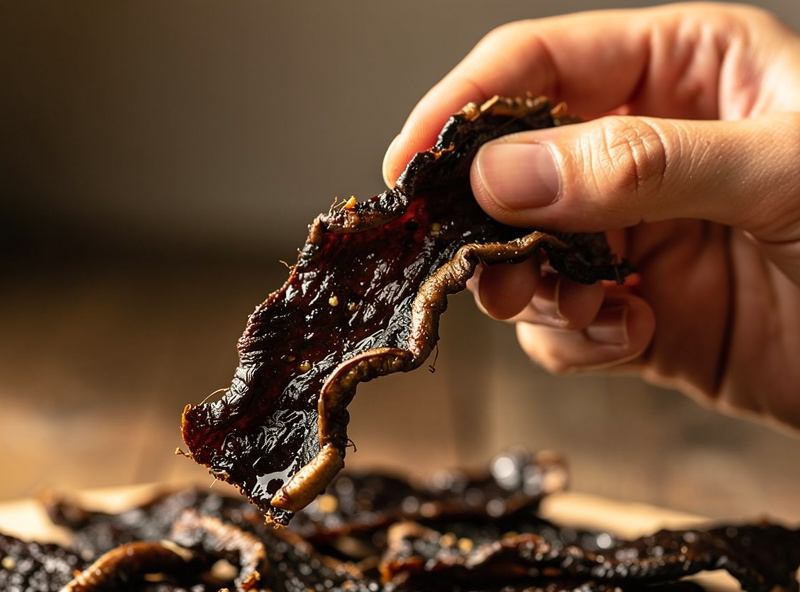
Dehydrate marinated mushrooms at 60 C until they are leathery and chewy but not brittle — usually 4 to 8 hours depending on species and thickness. The target texture bends and tears rather than snapping; if a piece cracks cleanly it has gone too far and become a crisp. Check from the 4-hour mark and pull pieces as they reach the right pull, since edges finish before centres.
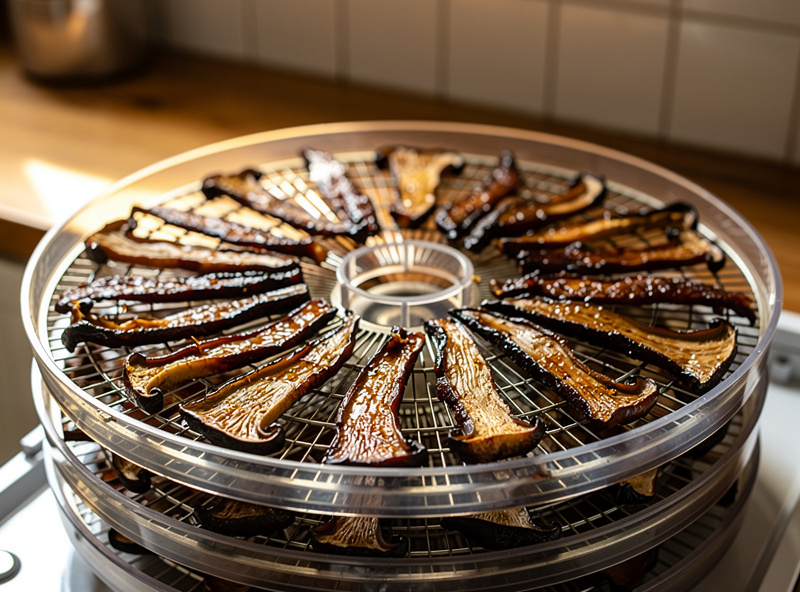
No dehydrator? An oven on its lowest setting with the door propped open a crack works, though it uses far more energy and the temperature is harder to hold steady — lay the strips on a wire rack over a tray and check often. The long, low dehydrate cooks the mushrooms through as it dries them, so these cultivated gourmet species are fully safe to eat straight off the tray once they reach a chewy, leathery finish.
The biggest mistake is under-drying: a piece that still feels moist or cool in the centre will mold within days. Each strip should be uniformly pliable and dry to the touch, with no damp spots, before it comes off the tray. A few extra minutes is always safer than pulling a batch that is still wet inside — the same moisture-equalisation logic behind why the National Center for Home Food Preservation has home dehydrators condition and re-check fully-dried foods before packing them away. Jerky holds more residual moisture than a pantry-dried slice by design, which is exactly why it needs the fridge or freezer instead of a shelf.
Storing Mushroom Jerky
Because jerky keeps some moisture and carries oil and sugar from the marinade, it is not shelf-stable like fully-dried slices — there is no official standard for this exact product, since it sits between a dehydrated food and a fresh one, so treat any storage number as a working estimate rather than a guarantee. In my own kitchen, an airtight container in the fridge holds a batch for about two weeks and it freezes well for a few months, but I check every piece for off-smell, sliminess, or any fuzzy spot before eating from an older batch, the same way NCHFP’s general dried-food storage guidance treats any moisture-related spoilage as a discard, not a “cook it off” situation. At room temperature it will only last a few days, so treat it as a fresh snack rather than a pantry preserve.
For longer keeping, vacuum-sealing and freezing is the move — the same portion-and-seal routine used for everything else in how to freeze mushrooms. Frozen jerky thaws in minutes at room temperature and keeps its chew. If you want a truly shelf-stable mushroom snack instead, dry plain unmarinated slices to a full brittle snap for the pantry and rehydrate them to cook, which is a different goal entirely.
Gear I reach for: a multi-tray temperature-adjustable dehydrator for an even chew, a lidded mixing bowl for marinating, and a vacuum sealer for freezing batches that outlast a fridge week.
Disclosure: MycoMansion is reader-supported. As an Amazon Associate I earn from qualifying purchases made through links in this article, at no extra cost to you. I only point to gear I actually use or would buy for my own kitchen.
Frequently Asked Questions
What is the best mushroom for jerky?
King oyster is the best, because its dense, solid stem slices into meaty strips that hold a satisfying chew people mistake for meat jerky. Oyster mushrooms torn into fronds give a bacon-like result, and shiitake caps make a firmer, deeply umami jerky. Soft, watery species lack the body and just shrivel.
What temperature do you dehydrate mushroom jerky at?
Dehydrate at 60 C for 4 to 8 hours until the strips are leathery and chewy but not brittle. This is hotter than the 45-50 C used for pantry drying, because jerky is stopped while still pliable rather than dried to a full brittle snap. Pull pieces as they reach the right chew.
How do you know when mushroom jerky is done?
It should bend and tear rather than snap. If a piece cracks cleanly it has overdried into a crisp; if it still feels moist or cool in the centre it needs longer and will mold if stored. Each strip should be uniformly pliable and dry to the touch with no damp spots.
How long does mushroom jerky last?
Because it keeps some moisture and carries oil and sugar from the marinade, mushroom jerky is not shelf-stable like fully-dried mushrooms, and there is no official standard for this exact product. As a working estimate from my own kitchen, an airtight container in the fridge holds it for about two weeks and it freezes well for a few months, but check every piece for off-smell, sliminess, or any fuzzy spot before eating an older batch. At room temperature it lasts only a few days, so treat it as a fresh snack.
Do you need to cook mushrooms before making jerky?
No. The long, low dehydrate at 60 C cooks the mushrooms through as it dries them, so cultivated gourmet species like king oyster, oyster, and shiitake are safe to eat straight off the tray once chewy. Just marinate the raw slices, pat off excess liquid, and dehydrate.
What goes in a mushroom jerky marinade?
A balance of salt, sweet, smoke, and umami: soy sauce, maple syrup or brown sugar, liquid smoke, smoked paprika, crushed garlic, and black pepper. Marinate dense king oyster up to overnight, but only 30-60 minutes for delicate oyster fronds, which turn soggy and oversalted if soaked too long.