
For grain spawn and supplemented sawdust, a pressure cooker that holds 15 PSI for 90 to 150 minutes is the dividing line between mushroom growing that works and a shelf of green-mold jars. Anything pasteurized at 160-180°F instead of pressure-sterilized at 250°F leaves bacterial endospores alive, and those are the ones that wreck a nutritious grain. After years of running a large stovetop canner for every jar of rye and every block of Masters Mix, I have a hard opinion: the canner is the single most important sterilization tool in a gourmet grow room, and most beginners buy the wrong size.
This guide is about the equipment and the numbers — what a pressure cooker actually does to a substrate, the PSI and time targets I run for grain versus sawdust, and how to pick a canner that will not bottleneck your batches. It pairs with the broader complete home mushroom equipment guide, which maps where the canner sits in the whole sterile chain.
Why Pressure, Not Just Heat
Water boils at 212°F at sea level, and that temperature alone will not kill the heat-resistant bacterial endospores that live on grain and sawdust. A pressure cooker holds steam under pressure so the water inside climbs to roughly 250°F at 15 PSI — the temperature that actually denatures those spores. That ~38°F gap is the entire reason nutrient-dense substrates need sterilization, not pasteurization.
The distinction matters because it determines your gear. Loose straw and bulk CVG can ride a hot-water pasteurization bath at 160-180°F because they are low-nutrient and the competing microbes lose to a fast-colonizing oyster. Grain and supplemented sawdust are a feast — any survivor outgrows your mycelium. I learned this the expensive way, killing a full canner load of rye early on because I let the gauge sit at 11 PSI instead of 15 and assumed “close enough” would do. It did not. For the full bulk-substrate logic, the substrate guide walks through which substrate gets which treatment.
PSI and Time Targets I Actually Run
Standard sterilization for home mushroom work is 15 PSI held for a duration set by the load and jar size. The PSI is non-negotiable; the time scales with how much mass the heat has to penetrate to the center of the jar. These are the numbers I run on my own canner, at near-sea-level elevation.
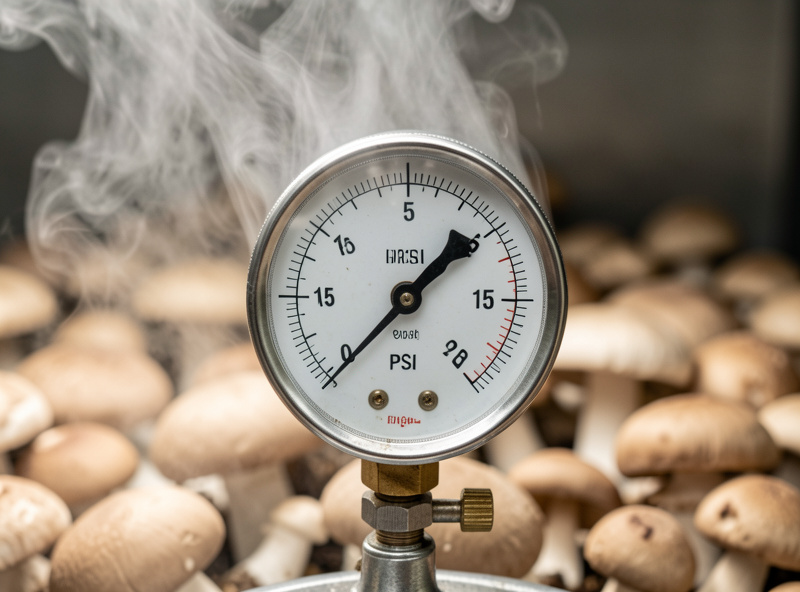
For grain spawn (quart and half-gallon jars of rye, milo, or WBS), I hold 15 PSI for 90 minutes minimum, and I bump quart jars packed tight to 120 minutes for insurance. For supplemented sawdust fruiting blocks in filter-patch bags, the dense mass needs 150 minutes at 15 PSI to reach core temperature — sawdust is a far worse heat conductor than grain. Liquid culture jars and agar are quicker: 15 PSI for 30 minutes is plenty because they are thin and watery.
Critical detail beginners miss: time starts when the gauge reaches 15 PSI, not when you light the burner. The 20-40 minute ramp-up and the slow natural cool-down are not part of the hold, though they do add useful thermal dwell. Never quick-release a mushroom load — let it cool naturally so jar seals re-form and you do not suck in room air through the filter as it depressurizes.
Altitude Changes the Numbers
Pressure cookers reach lower internal temperatures at higher elevations because the surrounding air pressure is lower. At sea level, 15 PSI gauge pressure gets you to ~250°F. Above roughly 1,000 feet, you compensate by adding pressure: most canning authorities call for 15 PSI weighted gauge regardless, or for dial gauges, stepping up to keep the true temperature at 250°F.
If you are growing at altitude, the safe move is a weighted-gauge canner that locks to 15 PSI mechanically, plus adding 15-30 minutes to the hold times above. I run a dial-gauge canner and have it tested for accuracy annually — a gauge reading 15 when the chamber is really at 13 is the silent cause of “I sterilized it and it still contaminated” complaints. When in doubt, sterilize longer; you cannot over-sterilize grain in any way that matters to a home grower.
Picking a Canner That Won’t Bottleneck You
The mistake I see constantly is buying a small 6-quart “pressure cooker” instead of a real pressure canner. The difference matters: a tall canner holds a meaningful number of jars per run, and your throughput is set by how many jars you can sterilize per cycle, not by how fast you can prep grain. A 23-quart canner that fits 7 quart jars per load turns a weekend of spawn into one cycle instead of four.
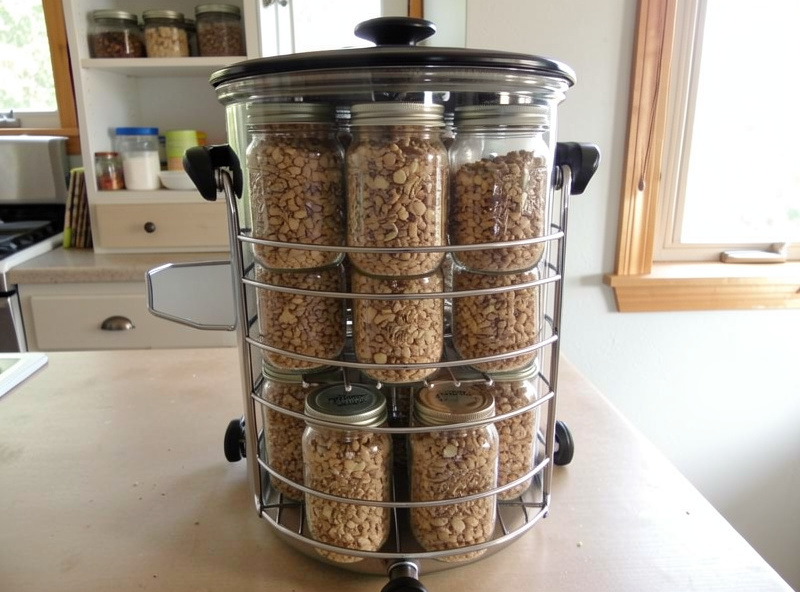
Things that genuinely matter when choosing: a real gauge (weighted gauge is the most foolproof; dial gauge is fine if you test it), a tall body that stacks quart jars, a thick aluminum or stainless base that sits flat on your burner, and a capacity that matches your batch size. If you run a large stovetop pressure canner rather than a tiny cooker, you stop treating sterilization as the limiting step. As an Amazon Associate I earn from qualifying purchases.
Two accessories earn their keep: a canning jar rack to keep jars off the direct-heat base (jars touching the bottom can crack or scorch), and an inch of water in the base so the canner never boils dry mid-cycle — a dry canner ruins the seal and can warp the base.
| Substrate / Load | PSI | Hold Time at 15 PSI | Notes |
|---|---|---|---|
| Quart grain spawn jars (rye/milo) | 15 | 90-120 min | Tightly packed jars go to 120 |
| Half-gallon grain jars | 15 | 120 min | More mass, longer core penetration |
| Supplemented sawdust blocks (bags) | 15 | 150 min | Sawdust conducts heat poorly |
| Liquid culture / agar jars | 15 | 30 min | Thin, watery loads heat fast |
| At altitude (1,000+ ft) | 15 (weighted) | +15-30 min | Add time to hit true 250°F |
Loading and Cooling Without Contaminating
How you load and unload matters as much as the hold. I do not overfill grain jars — two-thirds full leaves headspace so the grain hydrates evenly and steam can move. Lids go on with a modified self-healing injection port and micropore tape, finger-tight, never sealed hard; a hard-sealed jar can build internal pressure and crack. The tape lets steam exchange during the cycle and filters air on the way down.
After the hold, I kill the heat and walk away for hours. The canner has to drop to room pressure on its own and the jars should cool to handling temperature before they leave the canner. I move them straight to a clean still-air box or under the flow hood for any further work — the moment a sterilized jar hits open room air is the moment contamination risk spikes. Pairing the canner with proper sterile transfer is the whole point; sterilizing perfectly and then opening a jar on the kitchen counter undoes the work.
That same clean-process discipline runs across my whole bench — the canner sterilizes mushroom grain the same week the sourdough starter gets fed and the curing chamber holds its humidity. Patience under pressure, literally.
Frequently Asked Questions
Can I use a regular Instant Pot to sterilize grain spawn?
An Instant Pot reaches only about 11-12 PSI, not the 15 PSI that hits 250 degrees. It works for small liquid culture or agar loads if you extend the time, but for grain spawn the lower temperature leaves endospores alive. A true 15 PSI canner is far more reliable.
How long do I sterilize grain spawn at 15 PSI?
Hold 15 PSI for 90 minutes minimum for quart jars, 120 minutes for tightly packed quarts or half-gallon jars. Timing starts when the gauge reaches 15 PSI, not when you turn on the burner. Let the canner cool naturally afterward.
What is the difference between sterilization and pasteurization for mushrooms?
Sterilization at 250 degrees and 15 PSI kills bacterial endospores and is required for nutrient-dense grain and supplemented sawdust. Pasteurization at 160-180 degrees only reduces microbe load and is used for low-nutrient bulk substrates like straw and CVG.
Why did my jars contaminate even after pressure cooking?
The most common causes are a gauge reading high while the chamber sits below 15 PSI, too short a hold time, or contamination during transfer after sterilization. Have your dial gauge tested annually and do all open work in a still air box or flow hood.
Do I need a pressure canner or is a pressure cooker enough?
A tall pressure canner holds far more jars per cycle, so it is what scales a grow room. A small cooker works for a few jars but bottlenecks throughput. Capacity, a real 15 PSI gauge, and a flat sturdy base are what matter most.
Can you over-sterilize mushroom substrate?
Not in any way that matters to a home grower. Extra time at 15 PSI does not harm grain or sawdust, and erring long is the safe choice when you are unsure about gauge accuracy or altitude. Under-sterilizing is the real and far more common failure.