
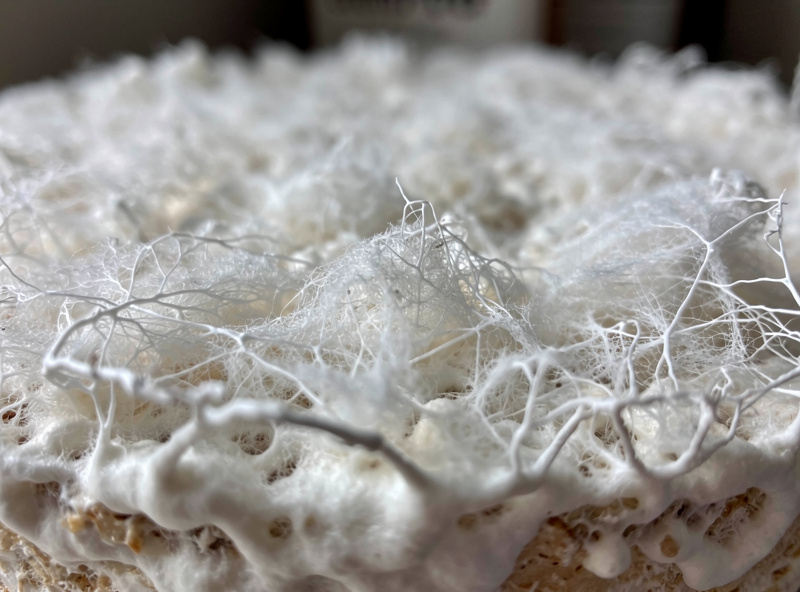
You did everything right. The substrate colonized clean, white and healthy, you moved it to fruiting conditions… and then nothing pins. Instead the surface keeps thickening into a dense, fuzzy white mat, or it knots up into hard, lumpy, distorted masses that never become real mushrooms. That is overlay and stroma — and unlike a green-mold jar, this is not a contamination you toss. It is the mycelium itself growing the wrong way because the environment told it to. The good news in that: it is almost always fixable, because you control the levers.
I have hit both of these on my own blocks and tubs, and once you understand what the mycelium is responding to, the fix is usually straightforward. Here is what overlay and stroma actually are, how to tell them apart from healthy growth and from each other, and the specific environmental corrections that turn a stalled surface back into a pinning one.
Overlay vs. stroma: not the same problem
People lump these together, but they are distinct, with overlapping causes and slightly different fixes. Knowing which one you are looking at tells you which lever to pull.
| What you see | What it is | Root cause |
|---|---|---|
| Thick, fuzzy, cottony white mat over the surface, no pins | Overlay (aerial mycelium) | Too much humidity / too little fresh air exchange |
| Hard, lumpy, knotted or crusty distorted masses, no normal caps | Stroma (abnormal myceliated mass) | High CO2, poor FAE, sometimes weak/aging genetics |
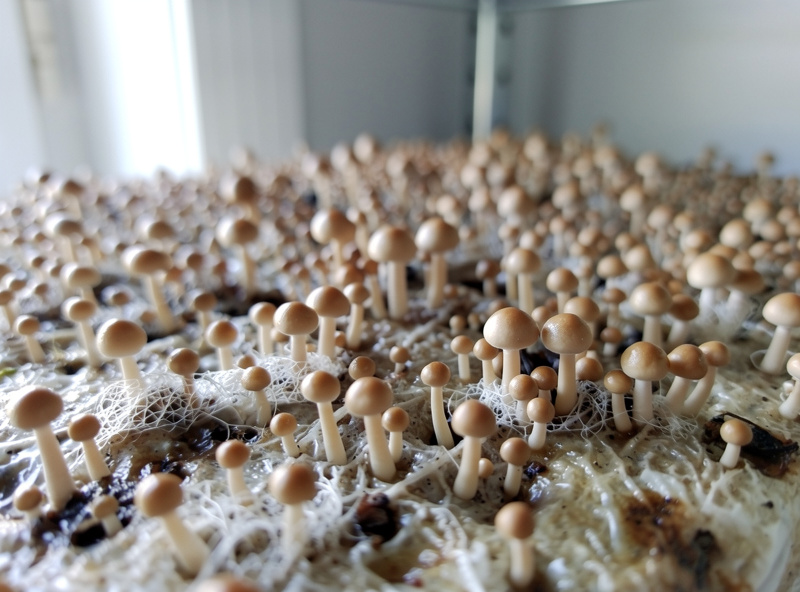
| Thin, wispy white surface with tiny pinheads forming | Healthy hyphal knotting → primordia | Correct FAE/humidity balance — leave it alone |
Overlay is mycelium that grows up and out into a fluffy aerial mat instead of switching to reproductive mode and pinning. Stroma is more severe and stubborn: the mycelium forms abnormal, often hardened or lumpy masses that never organize into proper fruiting bodies. Both are the same underlying message from the mushroom — conditions are telling me to keep growing vegetatively, not to fruit.
The single biggest cause: not enough fresh air exchange
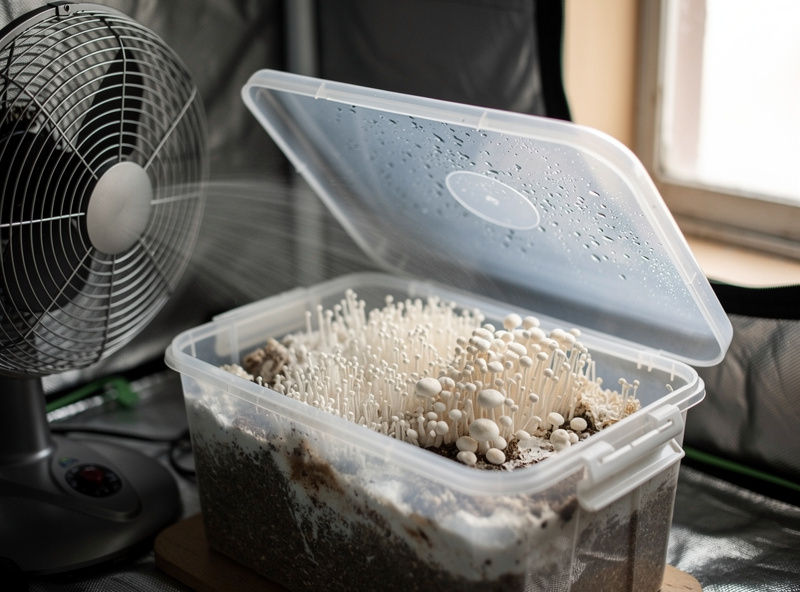
If I had to bet on one cause for either problem, it is inadequate fresh air exchange (FAE). When mycelium colonizes, it breathes out CO2, and a sealed or poorly ventilated chamber lets that CO2 pool right at the substrate surface. High surface CO2 is a “keep growing, don’t fruit” signal — it suppresses pinning and drives the mycelium into aerial overlay or, worse, stroma. The fix is more air: more frequent fanning, a small intake/exhaust setup, or simply opening the chamber more often. The mistake people make is the opposite — they see the surface struggling and seal it up tighter to “protect humidity,” which makes the CO2 problem worse.
The companion cause is humidity that is too high with too little air movement. Saturated, stagnant air encourages the fuzzy aerial growth of overlay. You want high humidity with air exchange, not a sealed sweatbox. Getting that balance right is the core skill of running a fruiting chamber — the same tension I dig into in the guide on monitoring fruiting-chamber conditions.
Telling it apart from a contaminant
Before you spend days adjusting air, make sure you are actually looking at overlay and not a mold dressed up as fuzz. This trips up new growers because cobweb mold, in particular, can look like a wispy white overlay at a glance. The tells are speed, texture, and smell. Overlay is the same bright, healthy white as your colonized mycelium and it grows at the same steady, unhurried pace. Cobweb mold is greyer, wispier, and grows alarmingly fast — it can sheet across a surface overnight in a way real mycelium never does. And neither overlay nor stroma smells bad: healthy mycelium and its overgrowth smell faintly mushroomy. A sour or musty smell means you are dealing with contamination, not an environmental stall, and that changes the response entirely. When in doubt, watch the growth rate for a day — nothing healthy explodes across the tub the way an aggressive mold does.
Fixing overlay
Overlay is the easier of the two to recover. Walk the levers in this order:
- Increase FAE first. Fan more often, increase your exhaust, or crack the chamber more frequently. This addresses the root cause — surface CO2 — directly.
- Lower humidity slightly and add air movement. Knock the chamber back from saturated to merely high, with gentle circulation so the surface is not sitting in dead, wet air.
- Introduce light if it has none. Many gourmet species use light as a fruiting cue; a sealed dark tub can sit in overlay until it gets indirect light.
- If the overlay is matted thick, you can gently disturb or mist-and-fan the surface to break the aerial crust and encourage the mycelium to consolidate toward pinning.
Given a few days of corrected conditions, overlay usually relents and the surface begins to knot up into primordia. Patience matters — the mycelium needs time to respond to the new signals.
Fixing stroma — and when to cut your losses
Stroma is more stubborn. The same corrections apply — aggressively increase FAE, dial humidity to high-not-saturated, ensure light — and a mild stroma will often still organize into normal pins once CO2 drops. But stroma has a second possible cause that overlay does not: genetics. A weak, aged, or senescent culture is more prone to stroma even in decent conditions. So if you correct the environment hard and a block keeps throwing hard, lumpy, distorted masses, the problem may not be your chamber — it may be a tired culture.
That is the honest call: environmental stroma is fixable, genetic stroma often is not, and after correcting conditions and giving it real time, a block still locked in stroma is one I retire rather than fight indefinitely. When the culture is the suspect, the answer is to go back to a fresh, vigorous source — which is exactly why I keep clean master cultures and clone standout fruits, so I always have lively genetics to fall back on. A faded culture is a quiet, recurring cause of grief that a fresh clone simply erases.
How species change the picture
Not every mushroom is equally prone to these problems, and knowing your species’ tendencies helps you read a stalled surface. Oyster mushrooms are relatively forgiving and pin readily, but they are also heavy CO2 producers, so in a tight chamber they will overlay fast if you under-ventilate — the most common beginner overlay I see is an oyster tub that needed twice the fanning it got. King oyster is the opposite kind of fussy: it genuinely wants a brief higher-CO2 phase to form its thick stems and then sharp FAE to cap them, so dialing it in is about timing the air, not just maximizing it. Lion’s mane rarely stromas but will sit in a slightly overlaid, fuzzy state if the air is dead, and responds quickly to better circulation. Knowing which way your species leans tells you whether to push FAE hard or stage it.
This is also where the substrate and the colonization quality feed in. A block that colonized fully and vigorously has the energy to fruit decisively when conditions flip; a block that barely colonized, or sat too long, comes to fruiting already tired and is far more likely to stall in overlay or stroma. So a surprising amount of overlay prevention happens upstream — clean, complete, timely colonization on a well-made substrate sets the stage, and then the right fruiting environment lets it perform.
Preventing it next time
Once you have fought overlay once, you prevent it by building FAE into the plan rather than reacting to a stall. When I move a block or tub to fruiting, I commit to real air exchange from the start — regular fanning or a low-level intake/exhaust, gentle circulation so no pocket of CO2 settles on the surface, high humidity that is refreshed rather than sealed, and indirect light for the species that cue on it. The mistake is treating the fruiting chamber as a humidity box; it is really an air-and-humidity balance, and the moment you start managing it as airflow first, overlay and stroma become rare events instead of recurring ones. Watching the surface daily in those first fruiting days lets you catch a thickening mat early, when one or two more fanning cycles a day is all it takes to redirect the mycelium toward pins.
Neither overlay nor stroma is contamination, and that is the encouraging frame to keep. Nothing foreign got in; the mycelium is healthy and is simply reading the room. Give it the right room — air, balanced humidity, light, and vigorous genetics — and it does what it is built to do. If you want to confirm you are not actually looking at a contaminant masquerading as bad growth, the contamination guide walks the differences, and getting the substrate right in the first place gives the mycelium the vigor to fruit cleanly once conditions are dialed.