
If you have grown grain spawn for any length of time, you have met the wet spot. A jar that looked clean for ten days suddenly develops a translucent, greasy-looking zone near the bottom, the grain clumps into a soggy mass, and when you crack the lid there is a smell somewhere between sour apples and old dishwater. That is bacterial contamination, and on my bench it is the single most common reason a grain jar goes in the bin. The good news is that it is also the most preventable kind of contamination there is, because bacteria almost never beat a properly run pressure canner — they get in through the cracks in your process, not your luck.
I have killed enough jars to a sour wet spot to stop treating it as bad fortune and start treating it as a checklist failure. This guide is the version of that checklist I wish I had when I started: how to recognize bacterial contamination with confidence, how to separate it from the molds it gets confused with, and the specific points in the sterile chain where wet spot actually enters.
What the wet spot actually is
“Wet spot” is the home-grower nickname for grain spawn colonized by bacteria — most often Bacillus species, the spore-forming bacteria that survive in under-cooked grain. The name describes exactly what you see: a wet, slimy, often slightly grey or amber patch where the mycelium should be running clean and white. Bacillus spores are heat-resistant. That single fact explains nearly every wet-spot batch I have ever had. A mold spore floating in your room is fragile; a Bacillus endospore sitting inside a grain kernel that never reached full sterilizing temperature will shrug off a sloppy pressure-canner run and wake up days later when the grain is moist, warm, and uncontested.
That is why bacterial contamination is fundamentally a sterilization problem, while mold is more often a transfer or air problem. When I get a wet spot, I do not look at my still-air box first — I look at how I cooked that grain.
How to ID it: the three-sense test
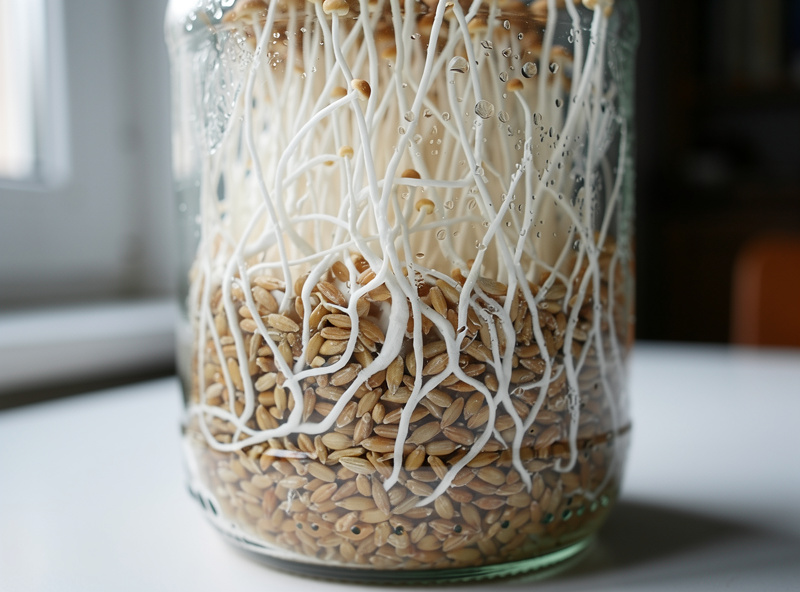
Bacterial contamination announces itself through sight, smell, and texture, and you want all three before you call it. Healthy mycelium is dry, fluffy, and bright white, running in defined rhizomorphic strands or a soft tomentose fuzz across dry-looking grain. A wet spot reverses every one of those qualities.
- Sight: a translucent, wet, often greyish or yellow-amber zone, usually starting at the bottom of the jar where moisture pools. The grain looks slick and clumped rather than individual and dry. Sometimes a slimy sheen, sometimes a faint colored liquid.
- Smell: the diagnostic clincher. Clean grain spawn smells faintly of fresh mushroom or bread dough. A wet spot smells sour, fermented, like rotten apples, sour milk, or a gym bag. If a jar makes you recoil, trust your nose — that sour note is bacteria.
- Texture: wet and gummy. Where healthy spawn shakes loose into individual kernels, contaminated grain congeals.
The smell test is the one I rely on most. I have learned the hard way not to take a deep sniff right at the lid — waft it toward you. And never open a jar you suspect is heavily contaminated indoors near your other cultures; bag it sealed and take it outside.
Wet spot vs. the molds it gets confused with
New growers panic and toss healthy jars, or worse, keep contaminated ones, because they cannot tell bacterial wet spot apart from mold or from harmless mycelial features. Here is the triage table I use at the bench. The contamination call is the highest-stakes skill in cultivation, so I want it dialed before I ever open a jar.
| What you see | Most likely cause | Smell | Verdict |
|---|---|---|---|
| Wet, slimy, grey/amber zone, grain clumped | Bacterial wet spot (Bacillus) | Sour, fermented, foul | Toss — sealed, outdoors |
| Forest-green powdery patch on white | Trichoderma (green mold) | Earthy/musty or none | Toss — aggressive |
| Wispy, fast grey cobweb growth | Cobweb mold (Dactylium) | Often none | Toss or spot-treat early |
| Dry, fluffy, bright white strands | Healthy mycelium | Fresh mushroom/dough | Keep |
| Yellowish liquid droplets ON white mycelium | Metabolite (mycelium “sweat”) | Mushroomy | Usually fine |
That last row trips up almost everyone. Healthy mycelium sometimes exudes clear-to-amber droplets of metabolic water — growers call it “mycelial sweat.” It sits on top of clean white growth and smells of mushroom, not sour. That is not bacteria. The distinction is the white network underneath and the smell. If you want a deeper visual on the mold side, I keep a full breakdown in my guide on telling cobweb mold from mycelium, and the whole contamination landscape is mapped in the mushroom contamination guide.
Where wet spot actually gets in
Bacteria do not float onto your grain from the air the way mold spores do — they ride in inside the grain and survive a weak cook. So when I diagnose a wet-spot batch, I work backward through the sterilization chain.
1. Under-cooked grain (the number-one cause)
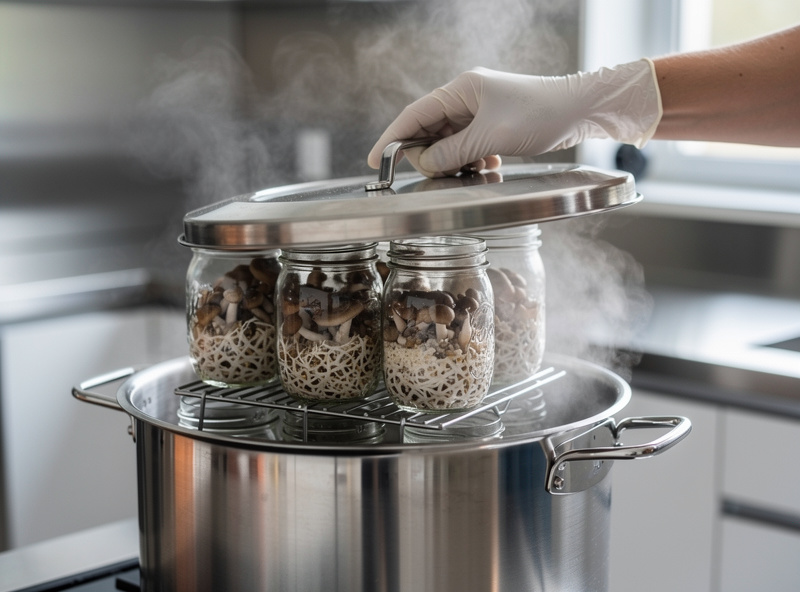
This is where the vast majority of my wet spots have come from, and almost always for one of two reasons: the canner did not hold pressure long enough, or the jars were packed so tight that steam never penetrated the center. Bacillus endospores demand real sterilizing conditions. I run grain spawn at 15 PSI for 90 minutes once the canner is fully up to pressure and venting steam — and I time from full pressure, not from when I turned the burner on. Bigger jar loads or denser grain get the full 90 minutes without exception.
The other half of this is hydration. Over-hydrated grain is the wet spot’s best friend. Grain that is too wet pools free water at the bottom of the jar, and that standing water is exactly the environment Bacillus wants. I hydrate to field capacity — grain that is fully imbibed but with no free water sloshing in the jar. The classic check: tilt a finished jar and no water should run.
2. The grain itself
Some grains carry a heavier Bacillus load and need a longer or staged cook. I have had the best, most consistent results with rye berries and milo (sorghum). A pre-soak helps enormously: soaking grain 12–24 hours before cooking actually encourages dormant Bacillus spores to germinate into vulnerable vegetative cells, which the pressure cook then kills outright. Skipping the soak leaves more dormant spores intact. A proper pre-soak is one of the quietest, most effective steps in the whole grain-prep routine.
3. Transfer and lid contamination
Less common for wet spot than for mold, but it happens: if your liquid culture or grain-to-grain source was already faintly bacterial, you inoculate the contamination straight in. This is one more reason to start from clean culture — agar work lets you actually see a bacterial colony before it ever reaches grain, which is the whole argument for starting cultures on plates rather than blindly from a syringe. Self-healing injection-port lids and good micropore filtering keep the lid honest after the cook.
What to do when you find one
Toss it. There is no rinsing, no salvaging, no “letting the mycelium outrun it” with a wet spot — bacteria in grain win, and a contaminated jar is a spore bomb sitting next to your clean ones. My protocol: seal the jar in a bag without opening it indoors, take it outside, and bin it or pressure-cook it again to neutralize before disposal. Then wipe the incubation shelf with 70% isopropyl, because the real risk is a leaking jar seeding the others.
The one judgment call is a jar that is borderline at the bottom but clean elsewhere. I do not transfer out of it. A grain-to-grain from a partly bacterial jar carries the bacteria along; you are just buying time. Start clean instead.
Prevention, in the order that matters
If I had to rank the levers by how much they actually cut my wet-spot rate, the order is unambiguous: full sterilization time first, correct hydration second, grain choice and pre-soak third, transfer hygiene a distant fourth. Most growers chase the fourth (more alcohol, fancier flow setups) while neglecting the first, and then wonder why bacteria keep winning. Cook the grain right and to field capacity, and the wet spot mostly disappears from your life. The same clean-process discipline that protects the substrate is the one that protects every patient-microbial corner of the workshop — the sourdough starter and the curing chamber answer to the exact same rules.
Frequently Asked Questions
Can I save a jar with a small wet spot?
No. Bacterial contamination in grain is not something mycelium outruns, and transferring out of a partly affected jar carries the bacteria with it. Seal it, take it outside, and bin it. Start clean rather than gambling a whole batch on a borderline jar.
What does a wet spot smell like?
Sour and fermented, like rotten apples, sour milk, or a gym-bag funk. Clean grain spawn smells faintly of fresh mushroom or bread dough. The sour note is the single most reliable bacterial tell, so waft the jar toward you rather than sniffing right at the lid.
Why do I keep getting bacterial contamination even though I sterilize?
Almost always under-cooked grain or over-hydration. Bacillus spores are heat-resistant, so time the pressure canner from full pressure (90 minutes at 15 PSI for grain) and avoid dense jar packing. Then hydrate only to field capacity, with no free water pooling at the bottom.
Is the yellow liquid on my mycelium bacteria?
Usually not. Healthy mycelium sometimes exudes clear-to-amber droplets of metabolic water, called mycelial sweat, which sit on top of clean white growth and smell mushroomy. Bacterial wet spot is wet, slimy grain with no clean white network and a sour smell.
Does pre-soaking grain reduce bacterial contamination?
Yes. Soaking grain 12 to 24 hours before cooking nudges dormant Bacillus endospores into vulnerable vegetative cells that the pressure cook then kills. Skipping the soak leaves more heat-resistant spores intact, which is a common reason a cook that looks long enough still fails.