
Lion’s mane (Hericium erinaceus) is one of the most rewarding medicinal mushrooms I grow at home — fussier than oyster, which is still the right first species if you don’t have humidity control dialed in yet, but a realistic second project once you do. On my own bench, a 5 lb sterilised hardwood-sawdust block runs a typical first flush of 200–350 grams in 14–21 days.
Lion’s mane sits inside a wider list of home-cultivable species — turkey tail, reishi, cordyceps, maitake — covered in my hub on growing medicinal mushrooms at home.
This guide covers the substrate selection, the spawn-to-fruit timeline, the conditions that produce dense cauliflower-shape clusters versus stringy spiky growth, the daily care protocol, and harvest timing. For those who work cultivated lion’s mane into a sauna-recovery routine — a combination that lives in my own weekly rhythm, not a clinical protocol — the infrared sauna health benefits guide covers the cardiovascular and cognitive research separately.
Substrate Selection
Lion’s mane is a wood-decay fungus, which means it grows on hardwood-based substrates. The standard recipes:
- 5 lb HMS (Hardwood-Master-Substrate): 80% hardwood sawdust, 20% wheat bran, 65% hydration. Preferred for highest yield.
- Supplemented hardwood pellets: 50% hardwood fuel pellets soaked, 25% bran, 25% coir. Cheaper and more available; yields 70–80% of HMS.
- Pre-pasteurised straw + sawdust block: Lion’s mane fruits on straw but produces stringy flushes; not recommended.
Avoid pure agar (works but trivial yield), coffee grounds alone (lion’s mane prefers wood), and any substrate with antifungal preservatives.
The 80/20 sawdust-to-bran ratio isn’t arbitrary — push the bran higher and you get faster colonisation but a much higher contamination risk (more available nitrogen feeds Trichoderma and bacteria just as readily as it feeds the lion’s mane); drop it too low and colonisation drags out to the point where competitors get a foothold before the mycelium can outrun them. I’ve drifted the ratio a few points either way on different blocks and the sweet spot really is narrow for this species compared to how forgiving oyster substrate is.
Sterilisation: 90 minutes at 15 PSI in a pressure cooker for grain spawn, 2.5 hours at 15 PSI for HMS bulk substrate. Pasteurisation alone (60 °C for 60 minutes) is insufficient; lion’s mane needs sterile substrate to outcompete contaminants.
Spawn-to-Fruit Timeline
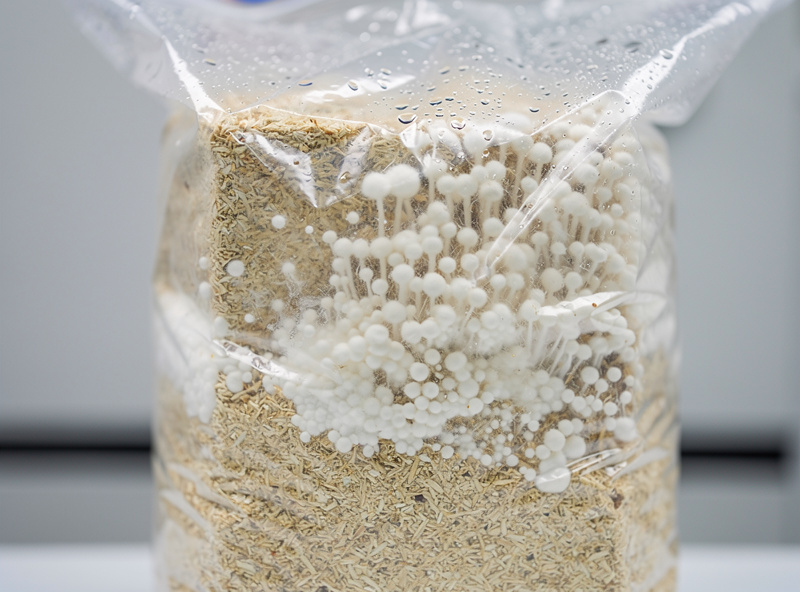
From inoculated grain spawn to first harvest, expect 25–40 days:
- Days 1–14: Colonisation. White mycelium spreads across the substrate. Keep at 21–24 °C in a dark drawer or chamber. No fresh air, no humidity changes.
- Days 14–18: Pin formation. Small white pin-like primordia appear on the substrate surface. Move to fruiting conditions.
- Days 18–25: Active fruiting. Dense cauliflower clusters form and grow rapidly (3–5 mm per day).
- Days 22–28: Harvest. Cut at the base when individual spines (teeth) reach 3–6 mm length.
- Days 35–50: Second flush. Smaller (50–100 g) but still worthwhile.
For consistent fruiting, the trigger to move from colonisation to fruiting conditions is fully white mycelium across the entire visible surface plus the appearance of the first primordium. Moving too early stalls; moving too late causes overlay (mycelium grows so dense it inhibits fruiting).
Conditions: The Numbers That Matter
Lion’s mane fruits within a tighter window than oyster mushrooms. The targets:
- Temperature: 18–22 °C. Above 24 °C produces stringy thin teeth; below 16 °C stalls fruiting.
- Humidity: 85–95% RH. Below 80% produces dry crusty clusters; above 96% triggers bacterial blotch.
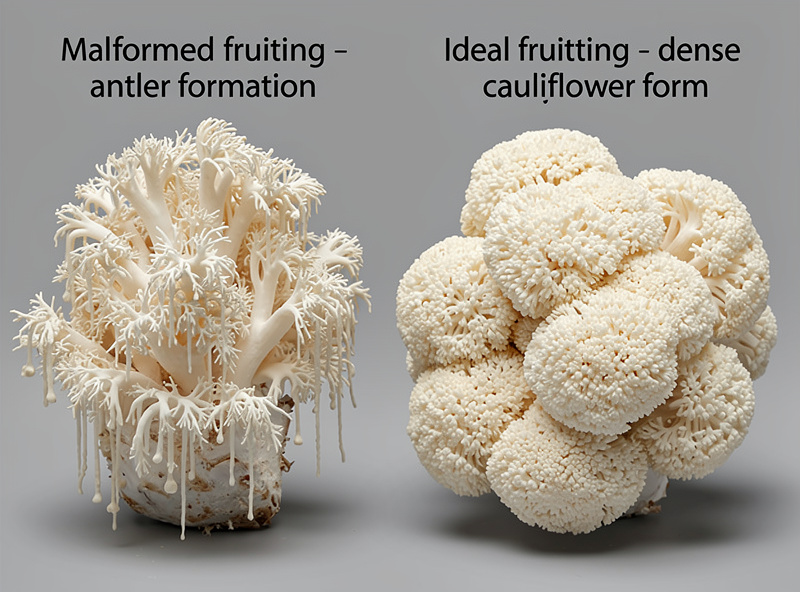
- CO2: under 1000 ppm. Lion’s mane is sensitive; high CO2 produces “antler” malformation (long thin spikes instead of dense clusters).
- Light: 12 hours of indirect ambient light or 50–100 lux of LED. Light triggers normal cluster shape; total darkness produces antler malformation.
- Fresh air exchange: 4–6 air changes per hour during fruiting.
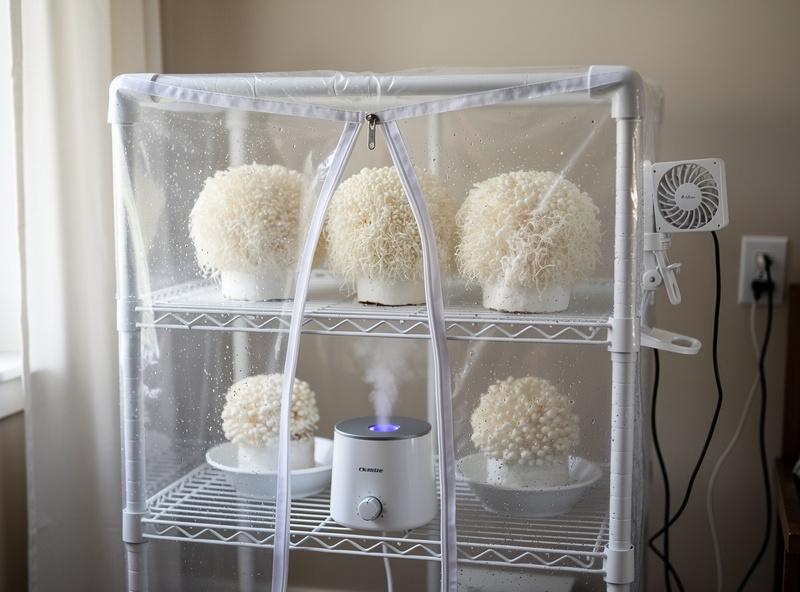
For most home growers, a Martha tent (PVC frame plus polythene) with a small humidifier on a hygrostat plus a 5 cm ducting fan with timer-controlled fresh-air exchange handles all five parameters in a 60×60×120 cm footprint. Total cost ~$150 in components — close to the tent I run for my own lion’s mane blocks, separate from the oyster tent.
Daily Care Protocol
Lion’s mane needs more daily attention than oyster mushrooms during fruiting:
- Morning: Mist the chamber walls (NOT the mushrooms directly — water on teeth causes spotting). Verify humidity at target. Open and brief-fan the tent if CO2 looks high (condensation hanging on walls without breaking).
- Midday: Check temperature; lion’s mane tolerates a brief 1–2 °C swing but extended swings stall growth. Fan exchange.
- Evening: Mist again, check primordium and cluster development. Document size for harvest timing.
Total daily attention time: 5–10 minutes. The reward for the consistency is dense round clusters that look like the catalogue photos — the blocks I let slide on misting always come out stringier and smaller. Inconsistent daily care produces edible but visually disappointing flushes — still useful for cooking and extraction, just not photogenic.
Harvest Timing
Harvest before spores release. The signs:
- Individual teeth (the spike-like projections) reach 3–6 mm
- Cluster surface starts releasing a fine white powder (early sporulation)
- Cluster colour shifts from pure white to slightly cream
- The base feels firm not soft when squeezed gently
Hericenones and erinacines are the compounds researchers have studied for nerve-growth-factor-stimulating effects — see the Alzheimer’s Drug Discovery Foundation’s review of the Mori et al. 2009 mild-cognitive-impairment trial, and the hippocampal neurotransmission study in PMC. That’s research framing, not a personal health claim — I grow lion’s mane for the kitchen and the tea shelf, and harvest just before sporulation because that’s when the clusters are freshest and best-textured, not because I have a lab-verified compound-retention number to back a precise percentage.
Cut with a sharp knife at the substrate-cluster interface; don’t pull (damages the substrate and kills second-flush potential).
Post-Harvest Handling
Fresh lion’s mane keeps 5–7 days refrigerated in a paper bag (NOT plastic). For longer storage:
- Drying: Slice and dehydrate at 50 °C for 8–12 hours. Stores 12+ months; rehydrates well in soup or tea.
- Tincture (1:5 dual extraction): Equal weight fresh mushroom in 80% ethanol for 4 weeks, then water-extract the remaining marc at 80 °C for 4 hours. This is the dual-extraction method I run on my own recovery-tea-shelf batches — a home-cultivator convention for pulling both the alcohol-soluble and water-soluble fractions, not a clinical protocol.
- Cooking: Pan-sear with butter for 8–10 minutes; the texture mimics cooked seafood.
For the cooking and preservation methods that preserve medicinal compound content, see the cooking and preservation cluster.
Common Problems
- Antler malformation (long thin spikes, no clusters) — CO2 too high. Increase fresh air exchange.
- Spotting on teeth — water droplets sat on teeth too long. Mist walls only, never mushrooms directly.
- Stalled colonisation — substrate moisture wrong (squeeze test should produce 1–2 drops, not stream of water).
- Bacterial blotch (slimy yellow patches) — humidity too high or insufficient air exchange. Lower humidity 5%, increase fan time.
- Green mould (Trichoderma) — sterilisation failed or unclean inoculation. Discard the entire block; do not try to salvage.
The contamination and troubleshooting cluster covers contamination identification in detail.
Antler malformation is the problem I get asked about most, and in my experience it’s almost never the tent’s fault the first time someone sees it — it’s usually a lid or seal that’s been “good enough” for oyster tubs for months and only reveals its leaks under lion’s mane’s tighter CO2 tolerance. Before adding a bigger fan, check every seam with a smoke pen or an incense stick on a still day; a slow leak that lets stale air pool near the block will beat any fan you add on top of it.
When Lion’s Mane Isn’t the Right First Mushroom
Skip lion’s mane and grow pearl oysters first if you don’t have a fruiting chamber with humidity control (oysters tolerate 70% RH, lion’s mane doesn’t), if your room temperature varies more than 4 °C (lion’s mane is sensitive), or if you only want eating mushrooms (oysters yield 2–3× more by weight per substrate kg). Lion’s mane is the right choice when you want medicinal-grade mushroom for tincture or daily consumption, when the gourmet flavour and texture matter, and when you have stable conditions.
Frequently Asked Questions
How long does lion’s mane take to grow?
From inoculated grain spawn to first harvest takes 25 to 40 days. Colonisation runs 14 days, pin formation through fruiting takes another 7 to 10 days, and harvest is at days 22 to 28. A second smaller flush comes 35 to 50 days after inoculation.
What temperature is best for fruiting lion’s mane?
Eighteen to twenty-two degrees Celsius is the practical sweet spot. Above twenty-four the teeth grow stringy and thin. Below sixteen fruiting stalls. The narrower the temperature range you can hold, the more uniform the cluster shape will be.
Can I grow lion’s mane on coffee grounds?
It will grow but produces low yield and stringy clusters. Lion’s mane is a wood-decay fungus and prefers hardwood sawdust supplemented with bran. Use coffee grounds for oyster mushrooms instead; lion’s mane on hardwood substrate produces 3 to 5 times more usable mushroom.
Why is my lion’s mane growing as long thin spikes instead of round clusters?
Carbon dioxide is too high in the fruiting chamber. Increase fresh air exchange to 4 to 6 air changes per hour. Lion’s mane is more CO2-sensitive than other gourmet mushrooms; antler malformation is a near-universal sign of insufficient ventilation.
Do I need a pressure cooker to grow lion’s mane?
Yes for the substrate. Hardwood sawdust supplemented with bran needs sterilisation at fifteen PSI for two and a half hours; pasteurisation alone is insufficient because lion’s mane is a slow coloniser and contaminants outcompete it on non-sterile substrate.
How much lion’s mane will a 5 pound block produce?
Two hundred to three hundred and fifty grams of fresh mushroom on the first flush, plus fifty to one hundred grams on a second flush. Total per five pound block runs roughly two hundred and fifty to four hundred and fifty grams across both flushes.
Should I refrigerate lion’s mane after harvest?
Yes in a paper bag, not plastic. Plastic traps moisture and accelerates spoilage. In a paper bag refrigerated at four degrees Celsius, fresh lion’s mane keeps five to seven days. For longer storage, dehydrate at fifty degrees Celsius for eight to twelve hours.