
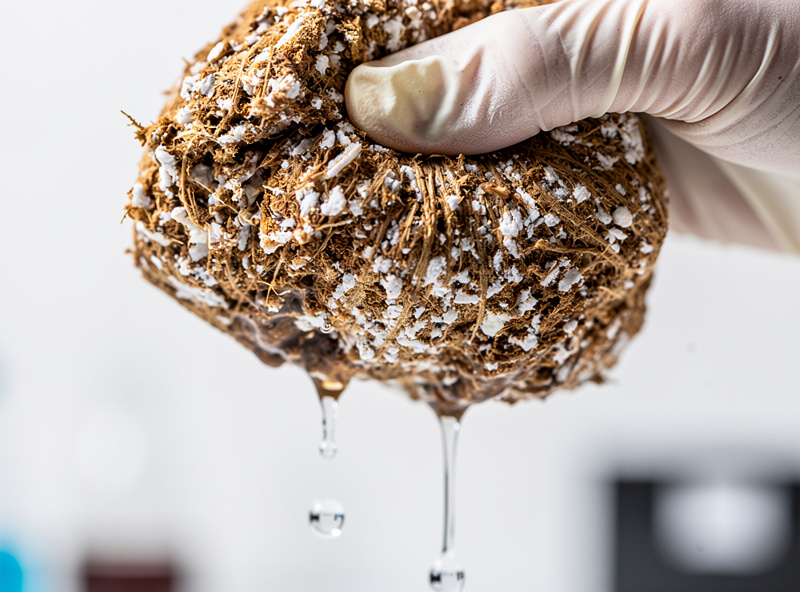
Mushroom substrate is at field capacity when it holds the maximum water it can without dripping under gravity — about 60-65 percent moisture by weight for most substrates. The fast field test is the squeeze test: a hard squeeze of a handful should release two or three drops of water, no more and no less.
Substrate moisture is the variable that quietly decides more batches than contamination does. Too wet and the substrate pools, goes anaerobic, and your mycelium drowns in a bacterial bloom; too dry and it colonizes slowly, unevenly, and refuses to pin. Field capacity is the target every substrate aims for, and the squeeze test is how I hit it without a meter. This guide covers what field capacity actually means, how to test it by feel and by weight, the moisture targets for each substrate I run, and how to rescue a batch that lands too wet or too dry.
What Field Capacity Means
Field capacity is the moisture state where a substrate is saturated with all the water it can hold against gravity, but not so wet that free water runs out. For most mushroom substrates that lands at 60-65 percent moisture by weight. It is the sweet spot between a substrate too dry to colonize and one so wet it suffocates.
The term comes from soil science, and it transfers cleanly to substrate. Virginia Tech Cooperative Extension defines field capacity in soil the same way growers use it here: the water remaining after 48-72 hours of free drainage following saturation, held weakly enough that it stays available rather than draining away or evaporating (Virginia Tech Extension BSE-194). Picture a sponge: lift a soaked sponge and water streams out — that is above field capacity. Let it drip until the dripping stops and it is heavy but not leaking — that is field capacity. Mycelium needs that balance because it breathes. Fungal hyphae require oxygen in the pore spaces between substrate particles, and water fills those pores. At field capacity the particles are coated and the substrate is moist throughout, but air still moves through the gaps. Push past it and water displaces the air, the substrate goes anaerobic, and bacteria take over from the fungus. The whole substrate-by-species picture builds on this foundation, mapped in the parent mushroom substrate guide.
The Squeeze Test, Step by Step
Grab a full handful of mixed substrate, close your fist, and squeeze as hard as you can. The right result is two or three drops of water escaping between your fingers. A steady stream means it is too wet; no drops at all means it is too dry. Adjust and re-test until you get those two or three drops.
I run this test on every single batch, because it is faster and more reliable than any recipe. It is not a home-grower shortcut either — Penn State Extension’s own guidance for button-mushroom compost uses the identical squeeze-until-it-drips method, though their compost target runs wetter at 70-73 percent because compost holds water differently than sawdust, coir, or straw (Penn State Extension). The gourmet substrates I run land drier, at that 60-65 percent band, but the squeeze-and-adjust method is the same one extension agronomists use on compost by the ton. Squeeze hard — a gentle squeeze under-reads and you will fool yourself into thinking a wet substrate is fine. Test from the middle of the tub, not the surface, since the top dries first. If it streams, I mix in a handful of dry material — dry pellets, more coir, extra straw — and re-test. If it crumbles and yields nothing, I mist in a little water, fold it through, wait ten minutes for it to absorb, and test again. The wait matters: substrates like coir and pellets absorb slowly, and correcting too fast is how you overshoot into soggy. Trust the squeeze, not the printed number — I once trusted a recipe over the test, hit 72 percent moisture on a twelve-block batch, and four of them puddled at the bottom of the bag and failed.
Measuring Moisture by Weight
For precision, calculate it by weight: to hit 65 percent moisture, the hydrated substrate should weigh the dry weight divided by 0.35. So 1 kilogram of dry material becomes about 2.85 kilograms hydrated. Weigh dry, hydrate, and weigh again to confirm you are in the 60-65 percent band.
This is worth doing once for each substrate so you learn what field capacity feels like in your hands, then the squeeze test takes over for daily work. The math is simple: moisture percentage is the weight of water divided by the total wet weight. At 65 percent moisture, 35 percent of the wet weight is dry matter, so hydrated weight equals dry weight divided by 0.35. For 1 kg of dry pellets and bran that is roughly 2.85 kg finished; at a gentler 60 percent it is 2.5 kg. A cheap kitchen gram scale is all you need. I find new growers benefit enormously from weighing their first few batches — it calibrates the hand so the squeeze test becomes trustworthy, and after that I rarely weigh at all.
Moisture Targets by Substrate
Most substrates target the same 60-65 percent band, but how they get there and how they behave differs. Pellets need a hot soak and swell dramatically; coir absorbs slowly and over-waters if you rush it; grain spawn runs drier than bulk substrate on purpose. Here is how each one behaves.
| Substrate | Target moisture | Hydration method | Squeeze-test feel |
|---|---|---|---|
| Masters Mix / supplemented sawdust | 60-65% | Hot water over pellets, swell 10 min, add bran | 2-3 drops, springy |
| Pasteurized straw | 65-70% | Soak then drain in mesh bag | 3-4 drops, no stream |
| CVG (coir, verm, gypsum) | 60-65% | Add water, wait 1 hour, re-check | 2-3 drops, holds a clump |
| Coffee grounds + straw | 60-65% | Grounds arrive wet; add dry straw to balance | 2-3 drops, dense |
| Grain spawn | ~45-50% | Simmer then dry the surface (no surface water) | 0 drops, kernels separate |
Two rows deserve a flag. Straw tolerates the wet end of the range because its hollow structure drains and stays aerated even at 65-70 percent — the full pasteurize-and-drain routine is in my straw pasteurization guide. Grain spawn is the deliberate exception: it runs noticeably drier with a dry, rattly surface, because surface moisture on grain breeds bacteria. Do not apply the bulk-substrate squeeze test to grain — wet grain is a contamination disaster.
Too Wet: The Signs and the Fix
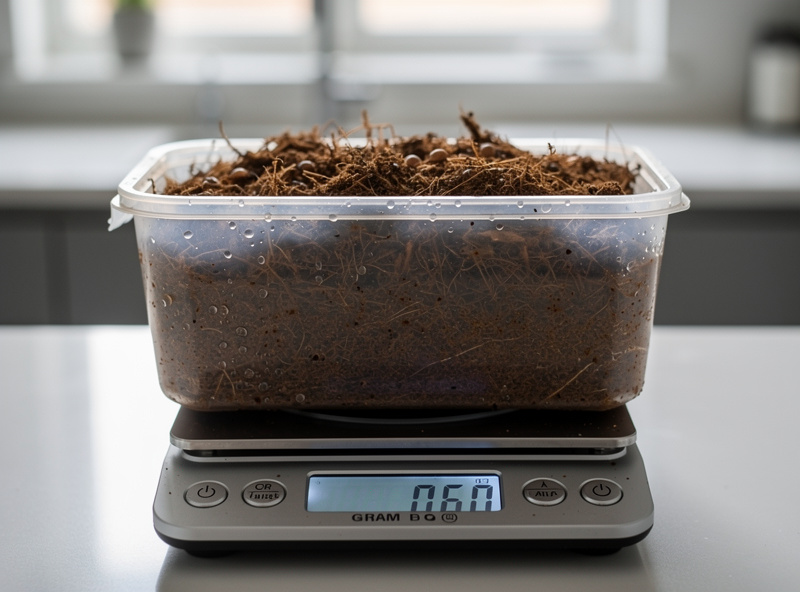
Over-hydrated substrate pools water at the bottom of the bag, colonizes slowly from the top down, and often develops a sour smell and bacterial blotch. The fix before inoculation is to mix in dry material; after colonization has started, there is no good fix and you usually lose the block.
The classic over-wet signature is a puddle in the bottom corner of a filter-patch bag and a band of uncolonized, greasy substrate sitting in it. Mycelium will not grow into standing water, so that zone becomes a bacterial reservoir that can sour the whole block. If you catch it before spawning, fold in dry pellets, straw, or coir until the squeeze test reads right. If you only notice after the block has partly colonized, your options are poor — sometimes standing the bag to drain and crossing your fingers, but more often it is a write-off. Prevention is the only real cure, which is why I test every batch. Over-wetting is one of the most common rookie failures, covered alongside the others in my beginner mistakes guide, and the contamination it invites is diagnosed in my contamination guide.
Too Dry: The Signs and the Fix
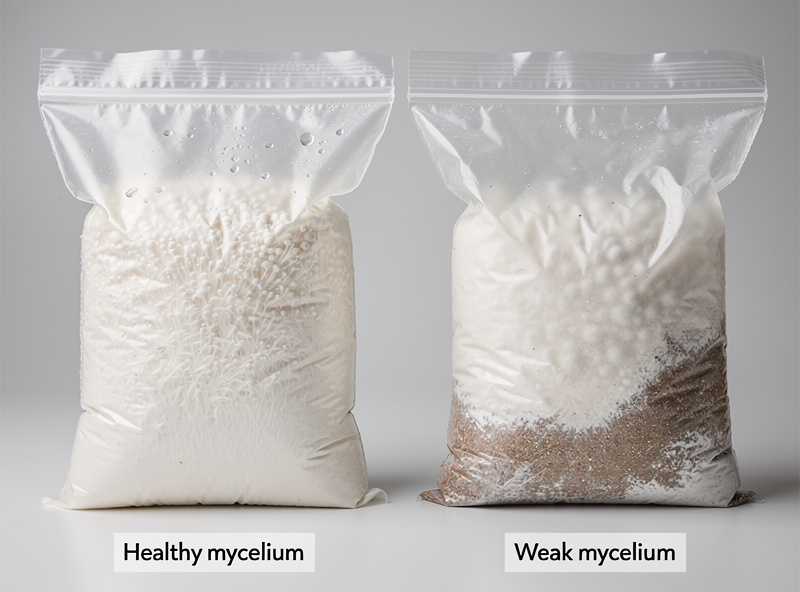
Under-hydrated substrate colonizes slowly and patchily, the mycelium looks thin and wispy rather than dense and rhizomorphic, and the block may never produce pins. Dry substrate is more recoverable than wet — you can sometimes rehydrate, though it is best fixed before inoculation.
Dry substrate starves the mycelium of the water it needs to expand, so colonization crawls and the surface can look fuzzy and stalled. Worse, even a fully colonized but dry block will refuse to pin, because pinning is partly triggered by surface moisture and the mushroom cannot draw enough water to form a fruit. The pre-inoculation fix is easy: mist water in, fold it through, wait, and re-test to field capacity. A colonized block that fruited once and dried out can sometimes be revived with a cold-water soak — a “dunk” — to recharge it for a second flush, though success varies by species. The reliable path is hitting field capacity at mixing time and keeping the fruiting environment humid, which is where a good hygrometer earns its place.
What I use to dial in moisture. A few links below go to Amazon. As an Amazon Associate I earn from qualifying purchases, at no extra cost to you — see my disclaimer. The simple kit that does the job: a digital gram scale to weigh dry and wet, a large mixing tub to hydrate in, a fine-mist spray bottle for small corrections, and a digital hygrometer to keep fruiting humidity up so blocks do not dry out.
A Note on pH
pH matters far less than most beginner guides suggest. Mushroom mycelium tolerates pH 5.5 to 7.5 cheerfully, and the gypsum in most recipes buffers any drift. Unless you are working with very acidic substrates like peat or certain composts, you do not need a pH meter just for substrate moisture work.
I mention this because new growers often spend money on a pH meter before they own a scale, and that is backwards. Hardwood substrates drift slightly acidic and gypsum corrects it; straw and coir run slightly alkaline and the natural acidification during colonization pulls them into range. The one place pH genuinely matters is the casing layer for button mushrooms, which is deliberately limed — covered in my manure substrate guide. For everything else, get the moisture right and the pH takes care of itself.
Frequently Asked Questions
What is field capacity for mushroom substrate?
Field capacity is the moisture state where substrate holds the most water it can without dripping under gravity, about 60-65 percent moisture by weight for most substrates. At field capacity the particles are coated and moist but air still moves through the pore spaces, which the mycelium needs to breathe.
How do you do the substrate squeeze test?
Grab a full handful of mixed substrate and squeeze hard. Two or three drops of water should escape between your fingers. A steady stream means too wet; no drops means too dry. Test from the middle of the batch, not the surface, and re-test after each correction until you get two or three drops.
What moisture percentage should mushroom substrate be?
Most substrates target 60-65 percent moisture by weight. Straw tolerates the wetter end at 65-70 percent because it drains and stays aerated. Grain spawn is the exception, running drier at roughly 45-50 percent with a dry surface, because surface water on grain breeds bacteria.
How do you measure substrate moisture by weight?
To hit 65 percent moisture, hydrated weight equals dry weight divided by 0.35, so 1 kilogram dry becomes about 2.85 kilograms hydrated. Weigh the dry material, hydrate it, and weigh again to confirm you are in the 60-65 percent band. A cheap kitchen gram scale is all you need.
What happens if mushroom substrate is too wet?
Water pools at the bottom of the bag, the substrate goes anaerobic, and the mycelium drowns while bacteria bloom and sour the block. Before inoculation you can fix it by mixing in dry material to field capacity. After colonization starts, a waterlogged block is usually a write-off.
Can you rehydrate substrate that is too dry?
Before inoculation, yes: mist water in, fold it through, wait for it to absorb, and re-test to field capacity. A colonized block that fruited and then dried can sometimes be revived with a cold-water dunk to recharge it for another flush, though results vary by species.