
The three best methods to cook Lion’s Mane mushroom — dry-sear in cast iron, butter-baste over medium heat, and crab-cake-style with breading — all rely on the same core technique: tear the mushroom into chunks and cook on high heat until the moisture evaporates and the surface caramelizes golden brown. The result has the shredded texture of crab and the umami depth of seared scallops.
Lion’s mane crab-cake technique is one of several species-specific cooking patterns I have settled on; the broader cooking-and-storage system is in my mushroom preservation guide.
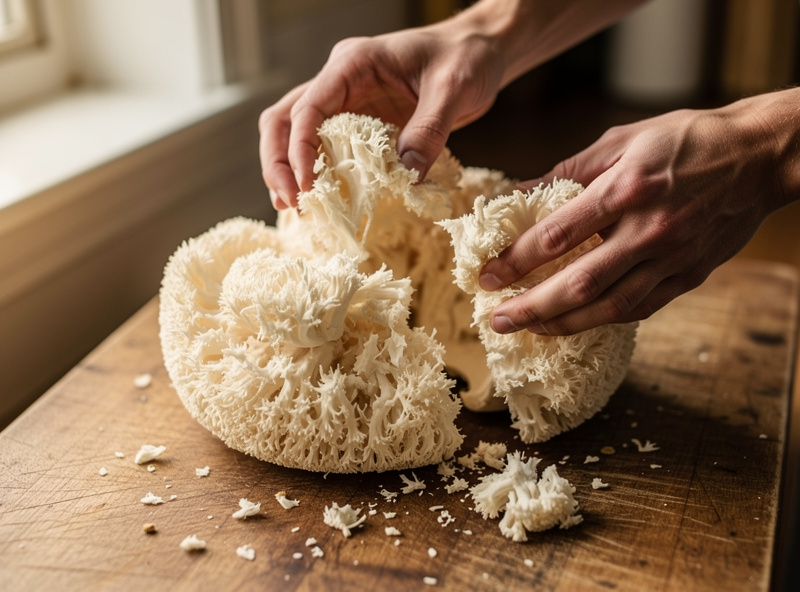
Lion’s Mane is the most beginner-friendly mushroom to cook because it forgives almost every common technique mistake — except one. Cut Lion’s Mane with a knife and the dense flesh holds water, fights the pan, and ends up rubbery. Tear it by hand into rough chunks and the irregular surfaces caramelize beautifully, the texture stays tender, and the seafood-like flavor profile actually develops. The hand-tear step is non-negotiable and the difference between Lion’s Mane that tastes like store-bought button mushrooms and Lion’s Mane that earns its reputation.
Why Lion’s Mane Tastes Like Crab or Lobster
Lion’s Mane carries real levels of glutamic and aspartic acid plus free 5′-nucleotides — the same amino-acid-and-nucleotide combination behind umami synergy in a lot of savory foods, and it’s been documented in comparative amino-acid profiling of culinary mushroom species including lion’s mane (a 2023 untargeted metabolomics study, PMC10453450, profiled amino acids across white button, crimini, portabella, lion’s mane, maitake, oyster, and shiitake). I’ll be honest that I don’t have a clean, citable number for exactly how much more glutamic acid lion’s mane carries versus a button mushroom — I’ve seen that kind of multiplier thrown around online without a source, and I’m not going to repeat an unsourced one here. What seared searing does, regardless of the exact numbers, is drive the Maillard reaction and concentrate whatever umami compounds are there. The shredded texture comes from the fungus’s hedgehog-like spore-bearing structure, which falls apart along natural lines when torn.
What’s actually going on with the seafood comparison:
- Glutamic and aspartic acid: The umami amino acids, present in lion’s mane at levels food-science research has actually bothered to measure and compare against other culinary mushrooms.
- Free 5′-nucleotides: These are what create umami “synergy” with the amino acids above — cooking releases more of them into free form, which is part of why raw lion’s mane tastes flatter than seared.
- High water content: Like virtually all fresh mushrooms, lion’s mane is mostly water. That moisture has to evaporate before real browning starts, which is the whole reason the tear-not-cut and don’t-crowd-the-pan rules below matter.
The Lion’s Mane that ends up tasting “fishy” or “ocean-like” rather than mushroom-like is, in my experience, the batch that got real surface caramelization — a proper sear, not a steam. Under-cooked Lion’s Mane tastes mild and mushroom-like; a batch that’s actually browned diverges further from typical mushroom flavor. For more on what to look for at the cultivation stage, see our Lion’s Mane growing parameters guide.
Method 1: Dry-Sear in Cast Iron
Heat a dry cast iron skillet over medium-high until water droplets dance and evaporate within 1 second. Tear Lion’s Mane into 1-inch chunks and place them in the dry pan in a single layer. Cook 4-6 minutes per side until deeply golden, then add butter, garlic, and salt only at the very end. Total cook time 10-12 minutes.
Why dry-sear works best for the first attempt:
- Heat the pan first. 90-120 seconds on medium-high. Test with water droplets.
- Tear, do not cut. Pull the mushroom into 1-inch ragged chunks by hand.
- Place in dry pan with space. Crowding traps moisture and steams instead of sears.
- Do not move for 4-6 minutes. The chunks need to release their water and form a crust.
- Flip once when first side is deep gold. Cook second side another 4-5 minutes.
- Add butter and aromatics in the last 60 seconds. Butter at the start burns before the mushrooms finish cooking.
- Salt off the heat. Salt drawn into hot mushrooms releases water and softens texture.
The dry-sear method produces the most concentrated flavor and best texture. It is also the most beginner-friendly because the only timing rule is “do not move the chunks until the first side is dark golden.” A perfect dry-sear takes 10-12 minutes total and uses one tablespoon of butter for half a pound of mushrooms.
Method 2: Butter-Baste with Garlic and Thyme
The butter-baste method gives Lion’s Mane the closest flavor to seared scallops by spooning hot foaming butter, crushed garlic, and fresh thyme over the chunks as they cook. Use a stainless or cast iron pan with butter that foams (not browns) for 6-8 minutes total. The constant basting creates a glossy crust that locks in moisture while finishing the surface caramelization.
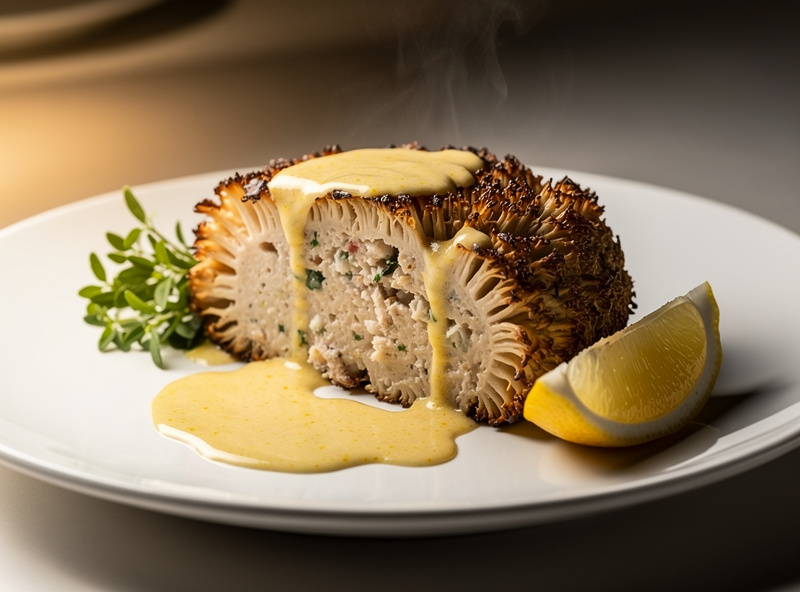
Step-by-step butter-baste technique:
- Tear into thicker pieces. 1.5-2 inch chunks for butter-baste; thicker pieces hold up to the additional moisture.
- Start with 2 tablespoons butter and 2 crushed garlic cloves. Medium heat until butter foams.
- Add Lion’s Mane chunks and a sprig of fresh thyme. Lay flat without crowding.
- Tilt the pan and spoon butter over the tops continuously. Every 30 seconds for the first 4 minutes.
- Flip after 4 minutes. Repeat the basting on the second side for another 3-4 minutes.
- Finish with a squeeze of lemon and flaky salt. Off the heat.
Butter-baste is the chef’s-table method — the chunks come out glossy, deeply flavored, and look restaurant-plated on the plate. It uses more butter (3-4 tbsp per half pound) and demands more attention than dry-sear, but the results justify the effort for a special meal. Pair with crusty bread to mop up the herbed butter that pools on the plate.
Method 3: Lion’s Mane Crab Cakes
Make Lion’s Mane crab cakes by tearing the mushroom into shreds, sautéing 5-6 minutes to evaporate moisture, then mixing with breadcrumbs, egg, mayo, mustard, and Old Bay seasoning before pan-frying patties for 3-4 minutes per side until golden. The texture matches blue-crab crab cakes almost exactly. Serve with tartar sauce and lemon.
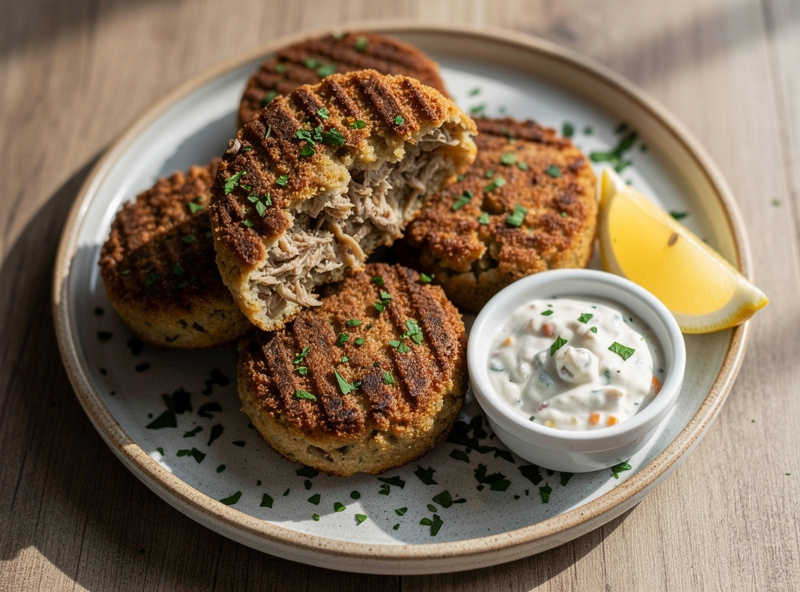
Full recipe for 4 crab-cake-sized patties:
- 8 oz fresh Lion’s Mane: Torn into ½-inch shreds.
- 1 tablespoon butter or olive oil: For the initial sauté.
- ½ cup panko breadcrumbs: Plus extra for coating the formed patties.
- 1 egg, beaten: Binder.
- 3 tablespoons mayonnaise: Moisture and richness.
- 1 teaspoon Dijon mustard: Sharp tang.
- 1 teaspoon Old Bay seasoning: The Maryland crab-cake seasoning blend.
- 2 tablespoons fresh parsley, chopped: Color and fresh herb note.
- Salt, pepper, lemon juice to taste.
Sauté the shredded Lion’s Mane in butter for 5-6 minutes until the edges crisp and the moisture has evaporated. Cool slightly, then mix with all other ingredients except the extra panko. Form into 4 patties, coat each with a thin layer of panko, and pan-fry in 1 tablespoon of oil for 3-4 minutes per side. Serve hot with tartar sauce and lemon wedges. The texture and flavor are close enough to traditional crab cakes that side-by-side blind tastings often confuse experienced eaters.
Common Mistakes That Ruin Lion’s Mane
The four mistakes that produce rubbery or bland Lion’s Mane: cutting with a knife instead of tearing, crowding the pan, salting at the start, and cooking under medium heat. I don’t have a lab number for how much texture or flavor each one costs you, but in my own kitchen any one of them alone is enough to turn a good batch into a forgettable one.
Avoid these and any method works:
- Knife-cutting smooth slices: Compacts the dense flesh, fights moisture release, produces rubbery texture. Always tear by hand.
- Crowding the pan: Steaming instead of searing. Cook in batches if needed to maintain space between chunks.
- Salting at the start: Draws water out and prevents browning. Salt at the end, off the heat.
- Low or medium heat: Mushroom releases water faster than it evaporates; chunks boil instead of sear. Use medium-high to high.
- Adding butter at the start: Butter burns before mushroom finishes. Dry-sear first, butter at the end.
- Washing under running water: The dense flesh soaks up water like a sponge, and that extra moisture has to evaporate before searing can even start — it noticeably extends your cook time and dilutes the flavor. Brush with a dry pastry brush instead.
Get these four right and Lion’s Mane forgives almost everything else. The window of “perfect” is wide; the window of “ruined” is narrow and entirely about water management. Preserve and store unused mushroom according to our guide on how to dry medicinal mushrooms for maximum potency if you have more than you can cook fresh.
Frequently Asked Questions
Should I wash Lions Mane mushroom before cooking?
No. Brush off any debris with a dry pastry brush or a clean dry kitchen towel. Lions Mane absorbs water like a sponge, and washing it noticeably extends how long it takes to sear properly while diluting the seafood-like flavor. Properly grown indoor Lions Mane should arrive nearly clean.
How do I know when Lions Mane is fully cooked?
The chunks should be deeply golden brown on at least one side, no longer release water when pressed with a spatula, and feel firm to the touch — not squishy. Internal texture should be shredded and tender. Total cook time is typically 10-12 minutes for dry-sear, 8 minutes for butter-baste.
Can I freeze fresh Lions Mane for cooking later?
Raw frozen Lions Mane loses texture and becomes mushy. The better approach is to dry-sear or butter-baste fully, cool, then freeze the cooked mushrooms in airtight containers for up to 3 months. Reheat in a hot pan to recrisp the surface before serving.
Why does my Lions Mane taste bland or like wet cardboard?
Three causes: under-cooked (Maillard reaction has not started yet), over-soaked from rinsing, or low-heat cooking that steamed rather than seared. Increase heat to medium-high, do not wash, and cook each side for at least 4-5 minutes until deeply golden.
Is Lions Mane mushroom safe to eat raw?
Lions Mane is generally safe raw but tastes bitter and chalky and provides almost none of the umami flavor cooking unlocks. Researchers studying hericenones and erinacines (the compounds this species is studied for) generally describe them as reasonably heat-tolerant, though I’m not aware of a definitive culinary-specific study on that. Either way, I always cook mine — it’s a flavor decision as much as anything else.
Can I substitute Lions Mane for crab in any recipe?
In most pan-cooked or fried preparations yes — crab cakes, crab fritters, crab-stuffed mushrooms, crab pasta. In raw or chilled applications like crab salad or sushi the flavor profile does not transfer well because Lions Mane needs heat to develop the seafood-like flavor compounds.