
To make a lion’s mane latte, whisk a half teaspoon of lion’s mane powder into a few tablespoons of hot water, then froth it into 200 ml of steamed milk until fully incorporated. The froth is the whole trick — lion’s mane powder floats and clumps in a still cup, but heat and agitation pull it into a silky, café-quality drink with a mild, almost seafood-sweet backbone.
Lion’s mane is the one functional mushroom I’d happily eat off the plate, and yet in a latte I use it as a powder. That surprises people. Fresh, it’s soft and meaty and sears up like crab; dried and ground, it turns into a pale, fine flour that disappears into frothed milk more gracefully than any other functional species I grow. The mild character that makes it a poor fit for black coffee is exactly what makes it perfect for a milk-based drink — there’s nothing bitter to fight, just a gentle earthiness the milk rounds off.
This is one spoke of my functional mushrooms in the kitchen guide. I grow lion’s mane on Masters Mix — a 50/50 hardwood sawdust and soy hull blend — fruit it in my Martha-style tent, and dry and grind the harvest myself, so the powder in this latte is one I made from spore to cup. If you want the growing side, my complete lion’s mane cultivation guide covers the block work; this page is purely the drink.

How Do You Make a Lion’s Mane Latte?
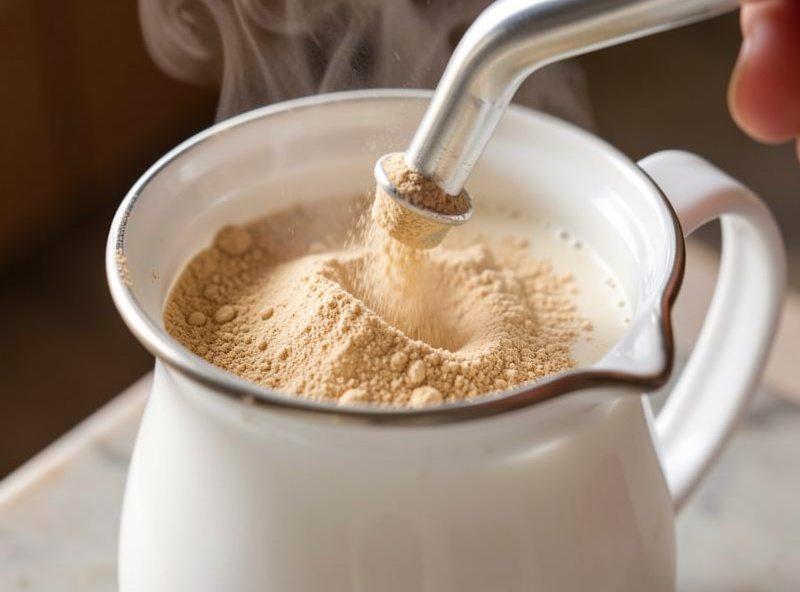
Start by whisking a half teaspoon of lion’s mane powder into two or three tablespoons of hot (not boiling) water to make a smooth slurry — this pre-dispersing step is what stops the clumps. Then steam and froth 200 ml of milk, pour the slurry in, and froth the whole thing together for another few seconds. Sweeten off the heat if you like.
The order matters more than the ingredients. If you dump dry powder straight into frothed milk, it clumps into little dry rafts that never fully wet out, and you end up chewing powder at the bottom of the cup. Making a slurry first — powder plus a splash of hot water, whisked with a small frother until smooth — hydrates every particle before the milk ever touches it. I learned this after a run of gritty, disappointing lattes that I’d blamed on the powder before realizing it was my method. The powder was fine; I was skipping the slurry.
From there it’s a normal latte build. I froth the milk with a handheld frother or the steam wand, combine, and finish. A touch of honey, maple, or vanilla off the heat lifts it, and a dusting of cinnamon on the foam makes it feel like a proper café drink. The whole thing takes about three minutes once you’ve done it a few times, and it’s become my afternoon ritual — the pause where the workshop noise stops and I actually sit down.
How Much Lion’s Mane Powder Goes in a Latte?
Use about a half teaspoon of lion’s mane powder per latte — roughly 1 to 2 grams. Lion’s mane is mild, so you can run it a touch heavier than you would a bitter reishi without the drink turning on you, but past a teaspoon the earthiness starts to dominate the milk and it stops tasting like a treat. I weigh it once, then trust the spoon.
Because lion’s mane grinds to such a fine, low-density flour, a “teaspoon” of it weighs far less than a teaspoon of denser ground reishi or cordyceps — another reason I keep a small scale by the grinder. If you’re building this into a routine, half a teaspoon per cup is the number to memorize. It gives a clearly present but pleasant mushroom note that the milk carries rather than masks — you want to taste the lion’s mane in a lion’s mane latte, unlike a mushroom coffee where the point is to hide it under the roast.
What’s the Best Milk for a Lion’s Mane Latte?
Whole dairy milk and barista-style oat milk froth best and carry lion’s mane’s mild flavor most gracefully, because their fat and protein build a stable, silky foam. Thinner plant milks froth into a looser, faster-collapsing foam and let more of the earthiness through. The milk you choose changes the drink as much as the powder does.
I’ve frothed lion’s mane into most of what’s in the fridge over the years. Here’s how the common options actually behave:
| Milk | Froth quality | Effect on flavor | Verdict |
| Whole dairy | Rich, stable microfoam | Rounds earthiness fully | Best overall |
| Barista oat | Thick, stable, creamy | Adds mild sweetness | Best dairy-free |
| Standard oat | Decent but looser | Slightly more earthy | Good everyday |
| Soy | Good foam, can split | Nutty, competes a little | Workable |
| Almond | Thin, collapses fast | Lets earthiness through | Weakest option |
My go-to is barista oat — the version formulated with a little added fat and stabilizer — because it froths nearly as well as whole dairy and its faint sweetness flatters the mushroom. Standard oat milk works for an everyday cup but throws a looser foam. Almond milk is the one I’d steer you away from: it’s too thin to build a proper froth, and without that stable foam you lose both the mouthfeel and the agitation that keeps the powder suspended. If a latte is coming out gritty on almond milk, the milk is likely the culprit, not your technique.
Why Is My Lion’s Mane Latte Gritty or Clumpy?
A gritty or clumpy lion’s mane latte almost always comes from two fixable causes: powder that’s too coarse, or skipping the slurry step so dry powder hits the milk directly. Fine powder pre-dispersed in a little hot water incorporates smoothly; coarse powder dumped into foam settles and clumps every time. The froth does the rest of the work.
Grind is upstream of everything. I run my dried lion’s mane through a dedicated blade grinder until it’s a genuine flour, then sift out any coarse bits — those coarse particles are what settle into a gritty sludge at the bottom of the cup. Growing and drying my own means I control that grind completely, which is a real advantage over some pre-packaged powders that are coarser than ideal for a latte. Good barista-grade lion’s mane powder is out there if you’re not growing yet; a search for lion’s mane mushroom powder will get you started, and a decent handheld milk frother is the one tool that makes the whole drink reliable.
As an Amazon Associate I earn from qualifying purchases.
The frother is non-negotiable. A spoon simply cannot generate the agitation needed to keep fine powder suspended in milk — you’ll get rafts of powder on the surface and grit on the bottom no matter how vigorously you stir. A cheap handheld frother or a proper steam wand both work; I use a small battery frother for the slurry and the steam wand for the milk, but either one alone is enough. That single tool is the difference between a café-quality latte and a disappointing cup of milky grit.
How Do You Flavor and Sweeten a Lion’s Mane Latte?
Sweeten a lion’s mane latte off the heat with honey, maple, or a little vanilla, and lean on warm spices — cinnamon, cardamom, a whisper of nutmeg — that flatter the mild earthiness. The flavorings go in after the froth, so their aromas aren’t cooked flat. A pinch of salt, oddly, is the secret weapon; it rounds the whole drink and pushes any raw-powder edge into the background.
My default is barista oat milk, a half teaspoon of lion’s mane, a small drizzle of maple, and cinnamon dusted on the foam. When I want it richer I’ll add a few drops of vanilla and a real pinch of flaky salt, and it drinks like a spiced dessert latte with a gentle mushroom undertone. Cardamom is worth trying if you like a chai-adjacent profile — it plays beautifully against lion’s mane’s sweetness. What I avoid is anything sharply acidic or citrusy; it fights the milk and makes the mushroom taste out of place.
A cacao version is my other regular. Whisk a teaspoon of good unsweetened cacao into the slurry along with the lion’s mane, and you get a mushroom mocha where the chocolate carries the earthiness even more completely than milk alone. It’s the build I make for anyone still nervous about the “mushroom” part — between the cacao, the froth, and a little maple, the lion’s mane becomes a warm background note nobody objects to. Think of the flavorings as dials: milk for body, sweetener for balance, spice for aroma, and a pinch of salt to tie it together.
Can You Make an Iced or Blended Lion’s Mane Latte?
Yes — an iced lion’s mane latte works well, and blending is actually the most reliable way to get a perfectly smooth one. For iced, make your hot slurry, froth cold milk separately, combine over ice, and stir. For the smoothest possible drink, skip the frother entirely and run everything through a blender, which pulverizes any stray powder and builds its own foam.
The blender method is my failsafe for guests. A half teaspoon of lion’s mane, warm milk, a little sweetener, and a few seconds in the blender produces a latte with zero grit and a thick, even froth — no slurry step required, because the blades hydrate and disperse the powder violently enough that clumps never form. It’s less elegant than a steam wand but genuinely more foolproof, and it’s what I reach for when I’m making three at once and don’t want to babysit each cup.
For the iced version in warm weather, I make the drink strong and hot first, then pour it over a full glass of ice so the melt dilutes it to the right strength. Cold milk froths differently than hot — looser and faster to collapse — so I either use a barista oat that holds up cold or accept a lighter foam. Either way, keep the powder dose the same half teaspoon; cold masks slightly less than a hot drink, so there’s no need to increase it. An iced lion’s mane latte with a little maple is a genuinely good summer alternative to iced coffee, and it carries the mushroom just as cleanly.
Can You Use Fresh Lion’s Mane Instead of Powder?
Not for a latte — fresh lion’s mane belongs in the pan, not the mug. Its magic in a drink is entirely in the fine dried powder, which suspends in milk; a fresh mushroom can’t do that. Fresh lion’s mane is for searing, where pressing out the moisture and browning it in fat gives you that shredded, crab-like texture that makes it a genuine dinner ingredient.
This is the split that defines lion’s mane in the kitchen. Dried and powdered, it’s a latte and smoothie ingredient. Fresh, it’s food — and the single most important step there is driving off water before you add fat, which is a mistake I made early by oiling the pan too soon and steaming a spongy mass instead of getting a crisp sear. So if you’ve got a beautiful fresh flush off the block, don’t waste it on a drink; sear it for dinner and reach for your dried powder jar for the latte. The two forms do completely different jobs, and both are worth having on hand. Getting a reliable fresh harvest comes down to fruiting conditions, which I break down in my notes on lion’s mane fruiting conditions.