
The best mushrooms to grow at home, ranked by how forgiving they are to a beginner, are pearl oyster, then lion’s mane, then shiitake, with king oyster and the functional species like reishi sitting further up the difficulty curve. Oyster fruits in as little as two to three weeks after a block fully colonizes and shrugs off mistakes that would kill a lion’s mane block outright.
I’ve fruited every gourmet species worth a home grower’s bench time, and I’ve also killed enough grain jars to green Trichoderma to know that “best” is the wrong question. The real question is best for your space, your patience, and your current skill level — a shiitake block that takes three months to brown over is a terrible first grow and a wonderful third one. Pick wrong and you’ll spend $40 on a block, watch it sit for weeks, get impatient, open the tent to “check,” dry out the pins, and quit thinking mushroom growing is hard. It isn’t. You just started with the wrong species.
This is the decision guide I wish I’d had: a straight comparison of the gourmet and functional species I actually run, matched to the constraints that matter. Below every matchup you’ll find a deeper head-to-head, because the choice between two specific species is where most people actually get stuck.
What Makes a Mushroom “Beginner-Friendly” to Grow at Home?
A beginner-friendly mushroom colonizes fast, tolerates a range of substrates, outruns contamination, and pins without a perfectly dialed environment. By that measure oyster wins on all four counts, which is why roughly every serious cultivation resource points a first-timer at it. The species that punish you are the slow colonizers and the ones fussy about fresh-air exchange.
Speed matters more than anything early on. The longer a substrate sits partly colonized, the more chances a mold spore has to establish a beachhead. Oyster mycelium is aggressive — a rhizomorphic, fast-running network that can fully myceliate a 5 lb bag of pasteurized straw or CVG in 10 to 14 days and physically crowd out competitors. Lion’s mane runs slower and its wispy, cottony growth is easier to mistake for cobweb mold. Shiitake is slowest of all: the block has to colonize and then brown, a hardening phase that can stretch the pre-fruiting timeline past two to three months.
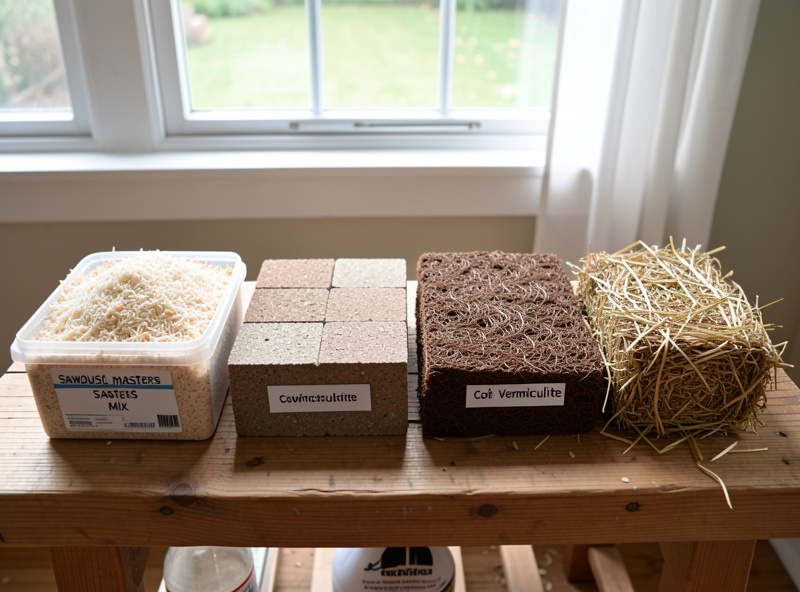
The second factor is substrate forgiveness. Oyster fruits on pasteurized straw, coffee grounds, cardboard, supplemented sawdust, or a CVG (coir/vermiculite/gypsum) bulk — pasteurization at 65–75°C (150–165°F) is enough. Lion’s mane and king oyster really want a sterilized, supplemented hardwood base like Masters Mix (a 50/50 hardwood sawdust and soy hull blend), which means a pressure canner and tighter technique. That single requirement moves a species from “weekend project” to “you need real sterile gear.”
If you’re still losing jars, start with the species that lets you make mistakes. I lay out exactly which ones do in the most forgiving species when you’re still killing jars — it’s the companion piece to this guide and the honest place to start.
The Home-Grow Species Comparison Table
Here’s the at-a-glance version of everything I run, from the oyster on my weekly rotation to the Agaricus bed that works nothing like the rest. “Time to harvest” counts from a fully colonized substrate to first flush, not from spore — add two to six weeks of colonization on top. Biological efficiency (BE) is fresh harvest weight divided by dry substrate weight; oyster’s high BE is a big part of why it feels so productive.
| Species | Best Substrate | Colonized to Harvest | Difficulty | Typical BE / Yield | Best For |
| Pearl / Blue Oyster | CVG, straw, sawdust | 2–3 weeks | Easiest | 75–150%+ BE | First grow, small space, speed |
| Lion’s Mane | Masters Mix | 3–4 weeks | Moderate | 50–75% BE | Second grow, functional shelf |
| King Oyster | Masters Mix | 3–5 weeks | Moderate–Hard | Fewer, heavier fruits | Meaty texture, showpiece |
| Shiitake | Supplemented hardwood block | 1–3 weeks after browning | Hard (patience) | Flushes for months | Long-haul, hardwood lovers |
| Chestnut / Pioppino | Supplemented sawdust | 3–4 weeks | Moderate | Moderate | Flavor hunters |
| Reishi | Supplemented sawdust | 4–8 weeks (antler/conk) | Moderate (slow) | Low mass, tea-grade | Functional shelf, patience |
| Wine Cap | Outdoor wood chips / straw | Seasonal (weeks–months) | Easy (outdoor) | Large flushes in season | Gardeners, no indoor gear |
| Button / Portobello | Composted manure + casing | Weeks after casing | Hard (different) | Modest | Process nerds only |
Read that table as a map, not a ranking. The right pick changes completely depending on whether your constraint is time, space, or nerve. I’ll walk each species below, then point you to the specific head-to-heads.
Oyster Mushrooms: Why They’re the Right First Grow
Oyster is the correct gateway species, full stop. It colonizes fast, forgives substrate sins, and pins so eagerly that a bag left near a window with a few holes cut in it will often fruit whether you meant it to or not. The pearl and blue strains I keep on the weekly rotation will myceliate a CVG tub in under two weeks and throw a first flush that can hit 75–150% biological efficiency — meaning a 5 lb block can return a pound or more of mushrooms on the first flush alone, then flush again.
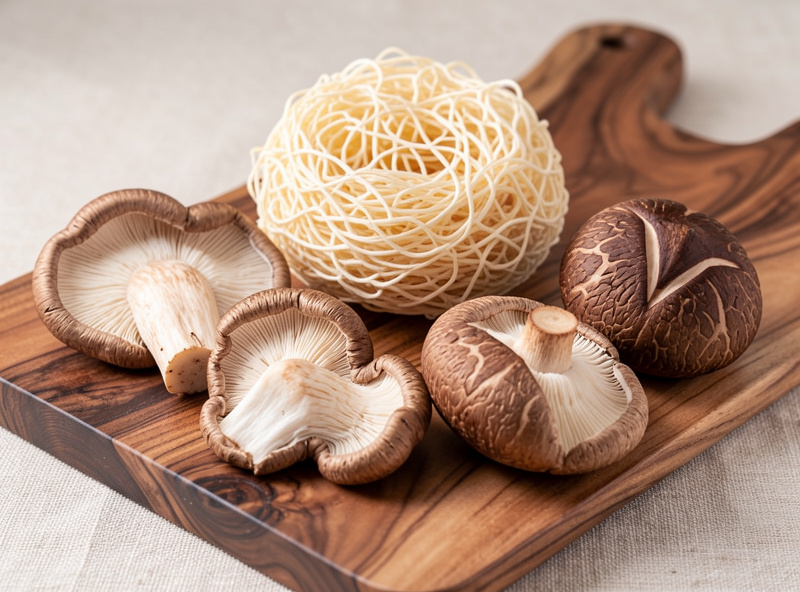
The one thing oyster demands is fresh-air exchange. These are heavy CO2 producers, and a poorly ventilated chamber gives you long spindly stems and tiny caps — the classic “trumpet” look that tells you the fan and the fresh air aren’t keeping up. In my modified shotgun chamber I run a small circulation fan and crack the fruiting tent for exchange several times a day; the payoff is those tight, layered shelf clusters instead of leggy stalks. Oyster also loves to sporulate, and a mature flush will dust everything downwind in white spore print — I harvest just before the caps flatten and start releasing, both for the yield and because heavy spore loads aren’t something you want to breathe in a small room.
If oyster is your first grow, the natural second question is what to add next. That’s a real fork, and I break it down two ways: oyster vs lion’s mane as your second grow for the functional-shelf crowd, and shiitake vs oyster on patience, yield, and effort for the hardwood-curious.
Lion’s Mane: The Functional Favorite That Wants Masters Mix
Lion’s mane (Hericium erinaceus) is the species most people graduate to after oyster, and for good reason — it’s a striking, cascading white pom-pom that tastes like crab when you pan-sear it, and it’s one of the functional mushrooms whose compounds are actively studied in the research literature (I’ll stay in my lane there: I grow it, I don’t make health claims). The catch is that it’s fussier. It wants a sterilized, supplemented hardwood substrate — my Masters Mix, run through the pressure canner at 15 psi for a couple of hours — and it colonizes with a soft, cottony mycelium that new growers routinely panic over, thinking it’s cobweb mold.
The tell: healthy lion’s mane mycelium is uniformly white and advances as a fuzzy front; cobweb mold is greyer, wispier, and grows visibly faster and looser, and it’ll flip to a grey or pinkish hue. When in doubt I hit a suspect patch with a light misting of 70% isopropyl — cobweb mold collapses, mycelium doesn’t much care. Lion’s mane also pins best in high humidity with gentle FAE; too much airflow and the pom-poms cure into a dry, tooth-less blob. Because oyster and lion’s mane are the two most common “which next?” species, I gave that matchup its own full breakdown in oyster vs lion’s mane.
Shiitake: The Patience Play on Hardwood
Shiitake (Lentinula edodes) is where home growers learn patience. On a supplemented hardwood sawdust block it doesn’t just colonize — it colonizes and then browns, forming a leathery, chocolate-colored skin that has to develop before the block will fruit. That browning phase is the long pole: from inoculation to first flush you’re often looking at two to three months, sometimes more, versus the two to three weeks oyster gives you after colonization.
What you get for the wait is a block that fruits in strong, discrete flushes for months, often triggered by a cold-water “shock” soak, and a mushroom with real culinary weight. Cornell’s Small Farms Program has documented outdoor log-grown shiitake fruiting for four to six years off a single inoculated log — a totally different timescale from the indoor block, and a good reminder that shiitake rewards the long view (see Cornell Small Farms). For a home bench, I run sawdust blocks; for the garden, hardwood dowels in oak logs. The direct trade — shiitake’s patience against oyster’s speed — is exactly what I compare in shiitake vs oyster.
King Oyster: The Bench Showpiece That Demands Discipline
King oyster (Pleurotus eryngii) shares a genus with the pearl oyster on your first grow but behaves like a different animal entirely. Instead of layered shelf clusters it grows fat, meaty, single stems — the closest thing in the fungal world to a scallop or a pork tenderloin when you sear it. It wants Masters Mix, it wants precise CO2 and fresh-air control to form those thick stems instead of a mess of tiny aborts, and it’s less forgiving of a sloppy environment than its pearl cousin.
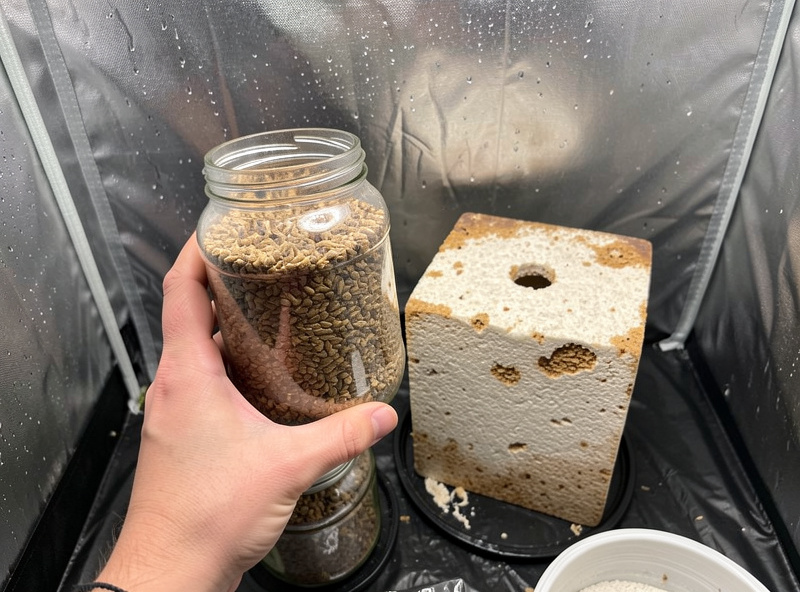
The single biggest mistake I see — and made myself early — is treating king oyster like pearl oyster and giving it too much fresh air too early. King oyster actually wants slightly elevated CO2 during early pinning to encourage a few dominant stems, then more FAE as they bulk up. Get the sequence backwards and you get a fruiting surface covered in dozens of pinhead aborts and no marketable fruit. Same genus, opposite playbook. I unpack the whole “why is my king oyster nothing like my pearl oyster” problem in king oyster vs pearl oyster.
Chestnut, Pioppino, and the Second-Tier Gourmets
Once you’re comfortable with sterilized sawdust blocks, a whole second tier opens up. Chestnut (Pholiota adiposa) gives you crunchy, nutty caps and a beautiful copper color; pioppino (Cyclocybe aegerita) is a chef’s darling with a firm stem and deep umami; nameko brings a glossy, gelatinous cap prized in miso soup; enoki produces those delicate white clusters if you crowd it and run it cold and high-CO2. None of these are beginner grows, but none are exotic once you own a pressure canner and can run clean grain spawn. Maitake (Grifola frondosa) sits at the top of this tier — a prized, cluster-forming polypore that’s genuinely finicky and one of the most satisfying blocks to fruit once you’ve earned it.
These second-tier species are also where “fast” and “slow” diverge sharply, which matters if you’re impatient. I ranked them by real spawn-to-harvest speed in the fastest gourmet mushrooms from spawn to harvest, because “gourmet” and “quick” don’t always overlap.
Reishi, Turkey Tail, Cordyceps: The Functional Shelf
The functional and medicinal species are a different reason to grow. Reishi (Ganoderma lingzhi) forms lacquered red conks or, under high CO2, those sci-fi antler shapes; turkey tail (Trametes versicolor) fruits in colorful concentric bands on hardwood; and Cordyceps militaris grows as orange clubs on a rice or grain substrate. All three are studied in the research literature for their compounds, and that’s exactly how I’ll frame them — I grow them for the tea and tincture shelf, and I let the peer-reviewed work speak to any effects rather than making claims a grower has no business making.
What unites them practically: they’re slow, they’re grown for extract rather than the dinner plate, and they’re generally not difficult so much as patient. Reishi in particular is nearly contamination-proof once it takes, because Ganoderma mycelium is a bruiser — but it can tie up a block for a month or two forming conks. If a functional shelf is your goal, the oyster-vs-lion’s-mane decision is usually the real starting line, since lion’s mane straddles culinary and functional.
Wine Cap and Button: The Two That Break Every Rule
Two species I run don’t fit the indoor-block model at all. Wine cap (Stropharia rugosoannulata) grows outdoors in a wood-chip and straw bed — mine’s tucked into the garden — and it’s arguably the easiest mushroom on this whole list if you have the outdoor space and the patience for a seasonal rhythm. You inoculate a bed with sawdust spawn, keep it moist, and it does its thing on the garden’s schedule, throwing big burgundy-capped flushes. No sterile lab, no tent, no humidifier.
Button and portobello (Agaricus bisporus) are the true outlier: the one major edible I run on composted manure rather than wood, with a two-phase compost and a peat-and-lime casing layer to trigger pinning. It’s a fascinating process — Phase I and Phase II composting, then casing to pin — and it works nothing like the wood-lovers. Penn State Extension, in the heart of America’s mushroom country, has some of the best public documentation of commercial Agaricus composting if you want to understand why it’s a different discipline entirely (Penn State Extension). I built a small bed mostly to understand the process; it’s not my weekly crop.
How to Match a Species to Your Space, Time, and Skill
Every good species choice comes down to three constraints, and you usually can’t optimize all three at once. Space: if you’re working a closet, a shelf, or an apartment corner, you want species that fruit densely off small blocks — oyster leads, and I laid out the full small-footprint playbook in the best mushrooms to grow when you have almost no space. Yield: if you want the most food per square foot and per dollar of substrate, biological efficiency is your metric, and I ranked the heavy hitters in the highest-yielding mushrooms for a small home setup.
Skill and nerve: be honest about where you are. If your last three grain jars went to bacterial blotch or green mold, you don’t need a better species — you need a forgiving one while you fix your transfer technique, which is almost always where home growers actually lose the batch, not at fruiting. Grain and transfers are the failure point; fruiting rarely is. The forgiving-species shortlist is in the most forgiving species when you’re still killing jars.
My substrate rule of thumb keeps it simple: oyster on CVG or straw when you want speed and forgiveness; Masters Mix in a pressure canner when you want lion’s mane, king oyster, or the second-tier gourmets; supplemented hardwood and patience for shiitake; the outdoor bed for wine cap. Field & Forest Products publishes solid substrate and spawn guidance if you want a supplier-side reference to cross-check formulas (Field & Forest Products).
What I’d Grow in Your First Year
If I were starting over with your bench, here’s the path. Month one: two oyster grows back to back, one on pasteurized straw and one on a CVG tub, purely to learn the fruiting environment — the FAE-versus-humidity balance, when pins mean “leave it alone,” how a healthy flush smells versus a sour, contaminated one (that faint sweet-then-sour reek is bacterial, and it means dump the bag). Month two to three: lion’s mane on Masters Mix, your first real sterile block, so you learn the pressure canner and clean grain-to-grain work on a species that pins forgivingly.
From there, follow your motivation. Want variety and umami? Chestnut and pioppino. Want the long, satisfying project? A shiitake block or, better, inoculated oak logs for the garden. Want a functional shelf? Reishi and turkey tail on sawdust, framed honestly. Want the most food for the least fuss? More oyster, and read the yield guide. The beauty of this hobby is that it’s the same clean-process discipline whether you’re colonizing a lion’s mane block, keeping a sourdough starter alive, or watching a salami lose weight in the curing chamber — patience under one roof, four different fermentations. Pick the species that matches where you are today, nail it, then climb.
Where Home Growers Actually Lose the Batch
Here’s the thing almost nobody tells a beginner choosing a species: your success rate has far more to do with where in the chain you’re working than with which mushroom you picked. The full sterile chain runs agar → liquid culture or grain-to-grain → grain spawn → bulk substrate → fruiting, and the overwhelming majority of failed grows die at grain or at the transfer step, not at fruiting. If you’re losing batches, changing species won’t save you — cleaning up your grain work will.
Grain is the danger zone because it’s nutrient-dense and, unlike a fruiting block, a single bacterial cell or mold spore has a feast waiting. That’s why I sterilize grain spawn — rye, milo, or wild bird seed hydrated to roughly field capacity so the kernels are plump but not weeping — in a pressure canner at 15 psi for 90 minutes, not pasteurize it. Pasteurization is fine for a straw or CVG bulk that oyster will outcompete; it is not enough for grain. Get that distinction wrong and you’ll blame the species when the real culprit was the process. This is the same logic that runs across every microbial hobby in my workshop: the contamination discipline that protects a grain jar is the same instinct that keeps the sourdough starter clean and the salami curing chamber free of the wrong molds.
Contamination forensics is the skill that separates a grower from a kit-buyer, so learn to read your jars. Green Trichoderma starts as an innocent-looking white fuzz and then flashes to a powdery forest-green — once you see the green, that jar is gone, bag it and bin it before it sporulates near your other work. Cobweb mold is grey, loose, and grows faster and wispier than mycelium, flipping pinkish as it matures; a light 70% isopropyl misting knocks it back. Bacterial blotch and sour rot announce themselves by smell — that sweet-turning-sour reek and a wet, slimy, sometimes yellow-tinged substrate. Healthy mycelium, by contrast, is bright white, advances in a defined rhizomorphic front, and smells clean and faintly mushroomy. If you can call those four apart at a glance, you’ll save more batches than any species swap ever could.
This is also why species choice and skill level are linked. Oyster’s aggression buys you slack at the bulk stage — it can sometimes outrun a light contamination that would sink a slower species. Lion’s mane and the sterilized-block gourmets give you no such margin, which is exactly why they belong in your second season, once your grain work is clean.
What It Actually Costs to Start
Budget shapes species choice as much as skill does, so here’s the honest gear picture in three tiers. The no-lab tier: pre-colonized grow-it-yourself oyster or lion’s mane blocks, or a pasteurized-straw oyster grow, needs almost nothing — a tub, a still-air spot, a cheap hygrometer, and a spray bottle. You can fruit a first flush for well under $40 and learn the fruiting environment before you spend on anything else. The bulk-substrate tier: add a pressure canner (a stovetop 23-quart is the workhorse I lean on), grain, and Masters Mix ingredients, and lion’s mane, king oyster and the second-tier gourmets open up. The full-chain tier: a still-air box for routine transfers, a laminar flow hood for agar and grain work, a colonization shelf with a heat mat and thermostat, and a Martha-style fruiting tent with an ultrasonic humidifier on a humidistat.
You do not need the full-chain tier to grow excellent mushrooms — I ran a modified shotgun chamber and a still-air box for a long time before the flow hood, and I knew exactly when the SAB was enough versus when only laminar flow would save a plate of agar. Buy up the tiers as your ambitions and your success rate justify it, not before. The single best money a beginner spends isn’t on gear at all; it’s on a second and third oyster grow to build the muscle memory of a clean transfer and a well-run flush.
As an Amazon Associate I earn from qualifying purchases. When I need fresh grain-bag filters, micropore tape, or a decent hygrometer for the fruiting tent, I buy them the same way anyone would — you can browse current mushroom grow bags and fruiting supplies if you’re kitting out a first bench.
What is the single best mushroom to grow at home for a beginner?
Pearl or blue oyster. It colonizes a substrate in 10 to 14 days, fruits 2 to 3 weeks after that, tolerates straw, coffee grounds, cardboard or CVG, and grows aggressively enough to outrun most contamination. Nearly every cultivation resource points first-timers at oyster for exactly these reasons.
Which home mushroom gives the highest yield?
Oyster typically wins on biological efficiency, often returning 75 to 150 percent or more of the dry substrate weight in fresh mushrooms across flushes. King oyster produces heavier individual fruits but fewer of them. Yield per square foot of shelf space usually favors oyster.
Do I need a pressure canner to grow mushrooms at home?
Not for oyster, which fruits fine on pasteurized straw or CVG at 65 to 75 degrees Celsius. But lion’s mane, king oyster, shiitake blocks and the second-tier gourmets want sterilized supplemented sawdust, which requires a pressure canner at 15 psi. Oyster lets you start with no canner.
Why is my shiitake taking so long compared to oyster?
Shiitake has to colonize and then brown, forming a leathery skin before it will fruit. That browning phase pushes the indoor block timeline to two or three months versus oyster’s two to three weeks after colonization. The wait is normal and the block then flushes for months.
Are lion’s mane and reishi safe health claims to make?
No. These functional species are studied in the research literature for their compounds, but a home grower should not assert cures, treatments or personal health outcomes. Grow them for tea, tincture and the plate, cite the peer-reviewed work, and leave medical claims to professionals.
Further Reading From the Bench
- The Most Forgiving Species When You’re Still Killing Jars
- Oyster vs Lion’s Mane: Which Should Be Your Second Grow?
- Shiitake vs Oyster: Patience, Yield, and Effort Compared
- King Oyster vs Pearl Oyster: Different Beasts on the Bench
- The Fastest Gourmet Mushrooms From Spawn to Harvest
- Highest-Yielding Mushrooms for a Small Home Setup
- Best Mushrooms to Grow When You Have Almost No Space