
A functional mushroom kitchen recipes guide comes down to one skill: pulling flavor and the studied compounds out of woody, bitter fungi without ruining the dish. Most of these species — reishi, turkey tail, cordyceps, lion’s mane — need long simmers, hot water or fat, and honest blending. Get that wrong and you brew something that tastes like a wet fence post.
I have made that wet-fence-post tea more than once. The first reishi decoction I ran, years back, I steeped like green tea — 200 grams of sliced conk, three minutes in a mug, and a mouthful so aggressively bitter I poured it down the sink and questioned the whole project. The problem was not the mushroom. It was that I was treating a dense, triterpene-loaded polypore like a delicate leaf. Functional mushrooms live by a different set of rules than the oyster or shiitake I toss in a pan, and this guide is the map I wish I’d had.
I grow every species on this page in my own space in Sweden — reishi and turkey tail on supplemented hardwood, lion’s mane on Masters Mix, cordyceps militaris on a rice-based grain substrate — and I run the whole chain from agar plate to fruiting block to the drying rack. That means when I tell you how a home-grown turkey tail conk behaves in a pot versus a store-bought powder, I’ve had both in the pot. This is the kitchen half of that work: no dosing, no health protocols, just how to make the harvest taste like something you’ll actually drink and eat.
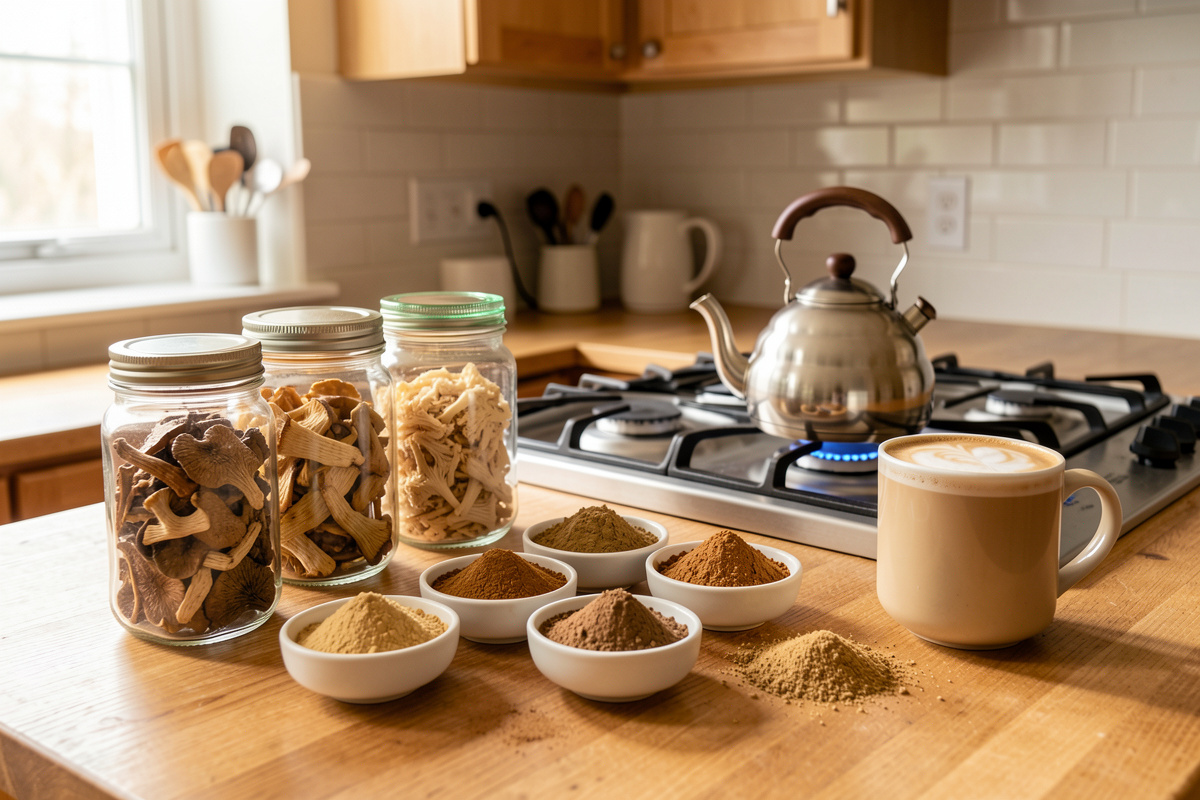
What Counts as a Functional Mushroom in the Kitchen?
A functional mushroom is a species grown as much for its studied compounds as its flavor — reishi, turkey tail, cordyceps, lion’s mane, maitake. In the kitchen the practical line is texture: most are too woody to sauté and instead give their character to water, fat, or a fine powder. That single fact drives every recipe here.
The gourmet mushrooms I cook — oyster, king oyster, shiitake — you slice and sear. Functional species split into two camps. The tender ones, like lion’s mane and maitake, you can genuinely cook: lion’s mane crisps up like crab when you press the moisture out of it. The woody ones — reishi and turkey tail are shelf-like polypores you could not chew if you tried — only surrender their flavor to a long extraction. Cordyceps militaris sits in the middle: my home-grown orange stromata are leathery but tender enough to simmer whole into a broth.
Understanding which camp a mushroom falls into is the entire game. Nobody sautés a reishi slice; you decoct it. Nobody makes a “broth” from lion’s mane; you fry it or powder it. When I plan a week’s cooking around the harvest, I sort the drying rack into “simmer these” and “cook or powder these” before I decide on a single recipe. If you internalize nothing else from this guide, internalize that sort.
Which Functional Mushrooms Actually Belong in Food and Drink?
Five species carry almost all home functional cooking: reishi and turkey tail for teas, cordyceps for savory broths, lion’s mane for lattes and searing, and a house blend that folds several powders into coffee. Each has a distinct texture, dominant flavor note, and a preferred extraction method — matching those is what separates a good cup from a chore.
Here is how I actually sort the species I grow when I’m deciding what goes in the pot versus the grinder. This is the table I’d tape inside a cabinet door if my partner would let me.
| Species | Texture | Flavor note | Best kitchen use | Extraction method |
| Reishi (Ganoderma) | Hard, woody polypore | Intensely bitter, resinous | Simmered tea / decoction | Long hot-water simmer, 1–2 hours |
| Turkey tail (Trametes) | Thin, leathery bracket | Mild, earthy, faintly bitter | Tea, often blended | Simmer 30–60 min, blend to soften |
| Cordyceps militaris | Leathery orange stroma | Savory, faintly sweet, umami | Broths, rice, savory dishes | Simmer whole into stock |
| Lion’s mane | Soft, meaty when fresh | Mild, seafood-like | Latte (powdered) or seared | Powder for drinks; dry-sear fresh |
| House powder blend | Fine dried powder | Roasty, earthy | Mushroom coffee, smoothies | Grind dried caps, stir into liquid |
Two things in that table trip people up. First, reishi and turkey tail look like they belong to the same tea family, but their bitterness lives on completely different scales — reishi will dominate a blend, turkey tail all but disappears. Second, lion’s mane is the odd one out: it is the only species here I’d genuinely call delicious eaten as a mushroom, and yet in the functional-drink context I use it as a powder. If you want the full extraction argument for the woody ones, my write-up on brewing reishi tea — simmer time, bitterness, and what to add gets into the chemistry of why three minutes never works.
How Do You Get Flavor Out of a Woody Mushroom Like Reishi?
Woody functional mushrooms release their compounds only under sustained heat, so the answer is a decoction — a slow simmer, not a steep. I run reishi at a bare simmer for at least an hour, sometimes two, in a covered pot, and I never boil it hard. The extraction is water-driven and slow; rushing it gives you bitterness without body.
The physical reason is structure. Reishi and turkey tail are polypores — their flesh is packed with chitin and, in reishi’s case, resinous triterpenes that are exactly what make it so bitter. A quick steep only pulls the surface bitterness; the actual body of the tea, the mild earthy backbone, needs time and temperature to migrate out of that dense tissue. This is the same logic I use at the pressure canner when I sterilize supplemented sawdust: dense material needs sustained conditions, not a quick pass.
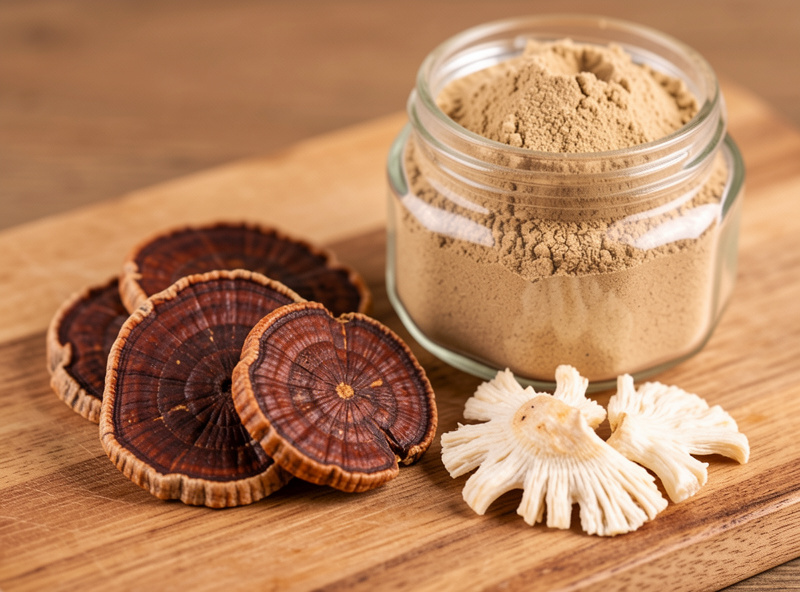
Turkey tail is the forgiving cousin. It’s a thin bracket, so 30 to 45 minutes usually gets you there, and its bitterness is so mild that most of the fixing is about texture and blending rather than taming a harsh note. The two teas are close enough in method that I treat them as a pair, but the details diverge — I put the full method for the second one in turkey tail tea without the bitterness, because the tricks that rescue reishi actually over-correct a gentle turkey tail brew.
My hard-won rule: taste at 45 minutes, then decide. Reishi at 45 minutes is often still thin; give it another 30. Turkey tail at 45 minutes is usually done. And add nothing sweet or aromatic until the extraction is finished — I dumped a cinnamon stick in early once and cooked all the aroma flat before the mushroom had even given up its body. Aromatics go in at the end.
Should You Use Fresh, Dried, or Powdered Mushrooms?
For functional species the default is dried, and often powdered, because drying concentrates flavor and makes the woody ones storable and grindable. Fresh only makes sense for the tender species — lion’s mane and maitake you want fresh to sear. Everything destined for a tea or a coffee blend I dry hard first, which also lets me store a season’s harvest on a shelf.
Drying does real work beyond storage. A fresh reishi conk is nearly impossible to slice thin; dried, it goes brittle and I can snap it into simmer-ready pieces. Turkey tail dries to a stiff leather that grinds far more cleanly than the rubbery fresh bracket. And cordyceps, which I harvest as bright orange stromata, dries down to a concentrated savory chip that dissolves its flavor into a stock much faster than the fresh version. I run my drying on a simple rack with airflow until everything is cracker-dry — cracker-dry matters, because any residual moisture invites the same molds I fight in the grow room.
Powdering is the last step, and it’s the one that unlocks the drinks. A fine powder is what makes a lion’s mane latte or a mushroom coffee possible at all — you’re not extracting, you’re suspending the whole mushroom in the cup. I grind small batches in a dedicated coffee grinder and keep the powder in a sealed jar away from light. If you want to build your own multi-species blend from what you’ve grown, I walk through the ratios and grind in blending your own functional mushroom powder from home harvests.
How Do You Make Functional Mushroom Drinks Taste Good?
The secret to a drinkable functional mushroom drink is that the mushroom should be a supporting note, not the lead. Fat, roast, and a little sweetness carry it: milk or a milk alternative rounds the earthiness, coffee or cacao masks residual bitterness, and froth changes the whole mouthfeel. Balance those and even a skeptic finishes the cup.
Mushroom coffee is the easiest on-ramp because coffee’s own bitterness and roast completely absorb a spoon of earthy powder. I fold a house blend straight into the grounds before brewing, and the result reads as a slightly deeper, earthier coffee rather than anything obviously “mushroom.” The whole build — which powders, how much, how to keep it from clumping — is in making your own mushroom coffee blend at home. It’s the recipe I hand people who are certain they’ll hate the category.

The lion’s mane latte is the one worth learning to do properly, because froth is doing the heavy lifting. Lion’s mane powder has a mild, almost seafood-adjacent character that would be strange in black coffee but disappears beautifully into steamed, frothed milk. The trick is getting the powder to actually incorporate instead of floating in a scum on top — you need heat and agitation, a frother or a blender, not a spoon. I lay out the powder-to-milk ratio and the froth technique in a lion’s mane latte worth making: powder, milk, and froth.
Across all three drinks the sensory tell of a good one is the same: you should smell roast and warm milk first, and only notice the earthy mushroom on the finish, low and pleasant. If the mushroom hits you on the front of the sip, you’ve used too much powder or under-frothed. Dial the powder back before you do anything else — a quarter-teaspoon less almost always fixes a drink that’s tipped too far.
Can You Cook Functional Mushrooms Into Savory Food?
Yes — cordyceps and lion’s mane both belong in savory cooking, though by completely different routes. Cordyceps militaris simmers into broths and rice as a pure umami booster, dissolving its savory-sweet character into the liquid. Lion’s mane you sear: pressed dry and browned in fat, it takes on a shredded, crab-like texture that holds its own as the centre of a plate.
Cordyceps is my favourite functional species to cook because it hides in plain sight. Drop a handful of the dried orange stromata into a chicken or vegetable stock and simmer, and the broth deepens with a savory, faintly sweet note that nobody identifies as “mushroom.” I’ve used it in a simple rice cooked in that broth, in a slow-simmered stock, and stirred into a savory congee. The full set of savory applications — broths, rice, and where cordyceps earns its place in a dish — is in cooking with cordyceps: broths, rice, and savory uses.
Lion’s mane is the exception that proves the “functional means woody” rule. Fresh from the fruiting block it is soft and meaty, and the single most important step is driving off moisture — I dry-sear the torn pieces in a hot pan with no oil first, let them release their water and shrink, and only then add fat to brown them. Skip that and you steam a soggy, spongy mass instead of getting the crisp, seafood-like texture that makes it worth growing. That mistake — oiling the pan too early — cost me a whole beautiful flush’s worth of good texture before I learned to be patient with the water.
How Do You Turn a Home Harvest Into Usable Powder?
Turning a harvest into powder is a three-step chain: dry the mushrooms until they’re cracker-brittle, grind them fine in a dedicated grinder, and store the powder sealed away from light and moisture. Done right, one flush becomes months of tea base, coffee blend, and latte powder — and the concentration means a little goes a long way.
The drying step is non-negotiable and it’s where clean-process discipline pays off. Any mushroom that isn’t fully dry will, given a sealed jar and time, grow the exact molds I spend my grow-room life fighting — I’ve opened a jar of under-dried powder to a whiff of something off and had to bin the lot. So I dry to snap-dry, not bend-dry: a properly dried turkey tail bracket cracks; a lion’s mane piece rattles. Only then does it go near the grinder.
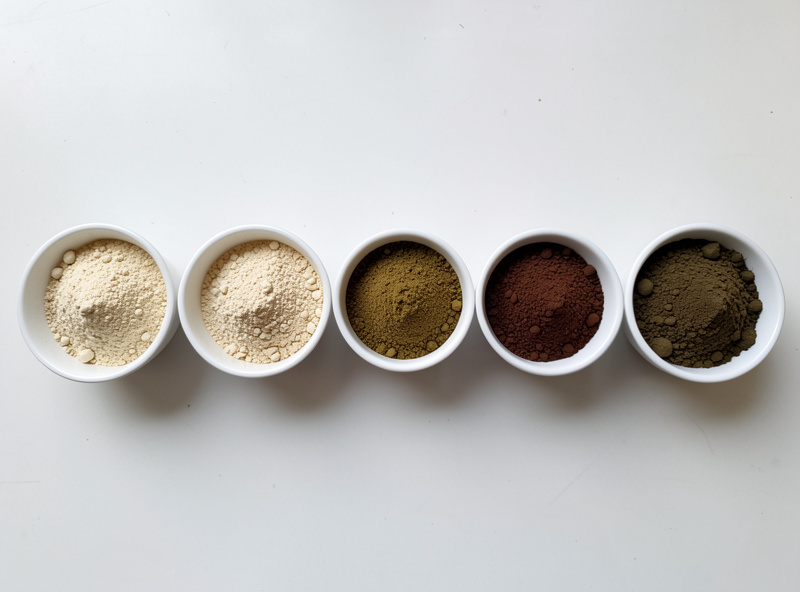
Grinding and blending is where you get to be an artisan. Different species grind to different fineness — turkey tail’s leathery flesh fights the blades, while dried lion’s mane powders almost to a flour — so I grind them separately and blend afterward by weight rather than trying to do it all in one go. That control is the whole point of growing your own: you decide the ratio of earthy to savory to mild, tuned to how you actually drink it. Every ratio and storage detail I use is in the dedicated DIY functional mushroom powder blend walkthrough, and the powders feed straight back into the home mushroom coffee blend and the lion’s mane latte.
The same discipline that keeps a powder jar clean is the discipline that runs the rest of my microbial hobbies — the sourdough starter on the counter, the koji on rice, the salami losing weight in the curing chamber. Clean process across every fermentation of patience under one roof. A mushroom powder is just one more thing you keep dry, sealed, and honest.
How Much Functional Mushroom Should You Actually Use?
For drinks, start with a quarter to a half teaspoon of powder per cup; for teas, roughly 5 to 10 grams of dried woody mushroom per litre of water. These are conservative starting points on purpose — the earthy character builds fast, and it is far easier to add more on the next batch than to rescue an over-mushroomed cup you can’t drink.
I weigh rather than scoop whenever I can, because dried mushroom density is all over the map. A tablespoon of fluffy lion’s mane powder weighs a fraction of a tablespoon of dense, ground turkey tail, so a volume measure that works for one species tastes wildly wrong for another. My kitchen scale lives next to the grinder for exactly this reason. When I’m dialing in a new blend I’ll do it by grams, note what worked, and only then translate it to a spoon measure I can use on a sleepy morning without thinking.
The bitterness scaling is the part worth internalizing. Reishi is the one species where “a little more” can wreck a pot — double the reishi and you don’t get twice the body, you get a tea nobody finishes. Turkey tail, cordyceps, and lion’s mane are all far more forgiving; you can push them harder before they turn on you. So my rule is species-specific: I dose reishi cautiously and to taste over a long simmer, but I’ll cheerfully throw an extra handful of cordyceps into a stock because more umami is rarely a problem. Learning which mushrooms punish generosity and which reward it is most of what separates a confident functional cook from a nervous one.
One more ratio note for the drinks: the fat and liquid matter as much as the powder. A half teaspoon of blend that tastes muddy in water can taste balanced in frothed whole milk, because the fat rounds the earthiness and the froth changes how it hits your tongue. So when a drink tastes off, don’t only adjust the mushroom — adjust the carrier. Often the fix is more milk or better froth, not less powder.
How Do You Store Functional Mushroom Teas and Powders?
Store dried mushrooms and powders in airtight jars, away from light, heat, and any humidity — a sealed glass jar in a dark cabinet is the standard, and it keeps a properly dried harvest usable for many months. Brewed tea is different: treat it like any food, refrigerate what you don’t drink, and use it within a few days. Moisture is the enemy at every stage.
The reason I’m strict about this is that a mushroom powder is a microbial risk the moment it takes on moisture, and I’ve fought enough contamination in the grow room to take it seriously in the pantry. An under-dried powder in a sealed jar is a small, dark, humid environment — precisely the conditions the molds I battle love. So the storage rule is really a drying rule: if it went in cracker-dry, a sealed jar keeps it clean; if it went in even slightly damp, no jar will save it. I’ve learned to over-dry rather than risk it.
For the woody teas, I actually prefer to store the mushroom rather than the brew. Dried reishi slices and turkey tail brackets keep beautifully in a jar, and I decoct a fresh pot when I want one rather than trying to hold finished tea. A finished reishi decoction can be refrigerated and will keep a few days, and I’ll sometimes brew a big batch and reheat over two or three mornings, but I don’t push it past that — a stored brew loses its fresh edge and, like any liquid, is a spoilage risk if you forget it at the back of the fridge. When in doubt, brew less more often.
Labeling is the unglamorous habit that saves you. I date every jar, because a powder that looks identical at three months and thirteen months is not the same product — the flavor fades and the risk climbs. A grease-pencil date on the lid costs nothing and tells me at a glance whether a jar is this season’s harvest or last year’s. That’s the same log-it-or-lose-it discipline I use on grain spawn, pointed at the spice rack.
What Does the Research Actually Say About Functional Mushrooms?
Here is where I stay firmly in my lane: I grow and cook these mushrooms, I do not make health claims about them. The research literature reports a great deal of interest in the compounds in reishi, turkey tail, lion’s mane, and cordyceps, but that is studied territory, not a promise from your kitchen. I’ll tell you how to make them taste good; I will not tell you what they’ll do for you.
If you want to read the actual science rather than marketing copy, go to the primary sources. The U.S. National Center for Biotechnology Information’s PubMed database indexes the peer-reviewed studies on these species, and for basic nutritional composition the USDA FoodData Central is the neutral reference for what’s actually in an edible mushroom. Reading the studies themselves — noting sample sizes, whether they’re in vitro or human trials — is a better use of your time than any blog’s summary, including mine.
My honest position, as a grower: cook these because they’re interesting, because a well-made reishi decoction is a genuinely good bitter tea and a cordyceps broth is a real umami tool, and because growing your own connects you to the whole chain. Any wellness angle beyond that belongs to the literature and to professionals, not to me and not to a recipe.
Which Functional Mushroom Should a Beginner Start With?
Start with mushroom coffee using a store-bought or single-species powder, then graduate to a home-grown lion’s mane latte before you ever tackle a woody decoction. The learning curve runs from “the mushroom is completely hidden” to “the mushroom is the whole point,” and climbing it in that order builds skill and confidence instead of handing you a bitter failure on day one.
Coffee is the gateway because it is nearly impossible to get wrong — coffee’s roast and bitterness swallow a spoon of earthy powder whole, so even a heavy hand just reads as a deeper cup. From there, a lion’s mane latte teaches you the froth-and-fat technique that makes every subsequent drink better, and lion’s mane’s mild character is forgiving while you learn to incorporate powder without clumps. Only once those two are second nature would I point a beginner at a reishi decoction, because that’s the one where technique failures are loud and the ingredient is expensive enough that you don’t want to sink a batch.
On the growing side, the same gentle-slope logic applies. Lion’s mane on Masters Mix is one of the more beginner-friendly functional species to fruit, and it doubles as the tastiest to eat, so a first-time functional grower gets both an easy crop and an easy kitchen win. Reishi and turkey tail take a longer, more patient colonize-and-brown on hardwood, and cordyceps militaris on grain is genuinely fiddly — those are worth graduating to once you’ve got a clean process down. Match your kitchen ambitions to your growing confidence, and the two skills climb together instead of one outrunning the other.
The Mistakes That Taught Me This Whole System
Every method in this guide is scar tissue from a specific failure. The three-minute reishi steep that went down the sink. The cinnamon added too early that cooked its own aroma flat. The lion’s mane I oiled before the water was gone, ending up with a spongy mess instead of crab. The under-dried powder jar that grew something and had to be binned.
The through-line is patience and sequence. Functional mushrooms punish shortcuts the same way a grain jar punishes a sloppy transfer — you don’t get away with rushing the step that matters. Simmer long, dry hard, add aromatics last, keep everything clean. None of it is difficult; all of it is a matter of respecting that these are dense, slow ingredients that give their best only when you give them time.
If you’re starting today, start with the mushroom coffee blend — it’s the most forgiving, and success there builds the confidence to tackle a proper reishi decoction. Then work outward to the teas and the savory cordyceps. By the time you’re blending your own powder from a harvest you grew, you’ll understand these mushrooms in the kitchen the way I’ve come to: not as supplements in a capsule, but as real, difficult, rewarding ingredients.
Do functional mushrooms taste bad?
Only if you prepare them wrong. Reishi is genuinely bitter and needs a long simmer, but turkey tail is mild, cordyceps is savory and pleasant, and lion’s mane is nearly seafood-sweet. In coffee and lattes the mushroom becomes a background earthy note, not the lead flavor.
Can you eat functional mushrooms or only drink them?
Both. The woody ones like reishi and turkey tail are only good as simmered teas because you cannot chew them. But cordyceps simmers into savory broths and rice, and lion’s mane sears into a crab-like texture you eat as a main ingredient.
Should functional mushrooms be fresh, dried, or powdered?
Dried is the default, and powdered for drinks. Drying concentrates flavor and makes woody species grindable and storable. Fresh only makes sense for tender species like lion’s mane and maitake that you want to sear.
How long do you simmer reishi tea?
At least one hour at a bare simmer, sometimes two, in a covered pot. Reishi is a dense polypore and a quick steep only pulls surface bitterness without the earthy body. Taste at 45 minutes and extend if it is still thin.
Are home-grown functional mushrooms safe to cook with?
Yes, provided you grow gourmet and functional species with confident identification and dry them fully before storage. Under-dried powder can grow mold in the jar. This guide covers only culinary preparation and makes no health claims.
Keep Building Your Functional Kitchen
Each of these spokes drills into one preparation in full detail — pick the one that matches what’s on your drying rack:
- Brewing Reishi Tea: Simmer Time, Bitterness, and What to Add
- Turkey Tail Tea Without the Bitterness: Brewing and Blending
- Making Your Own Mushroom Coffee Blend at Home
- A Lion’s Mane Latte Worth Making: Powder, Milk, and Froth
- Cooking With Cordyceps: Broths, Rice, and Savory Uses
- Blending Your Own Functional Mushroom Powder From Home Harvests